
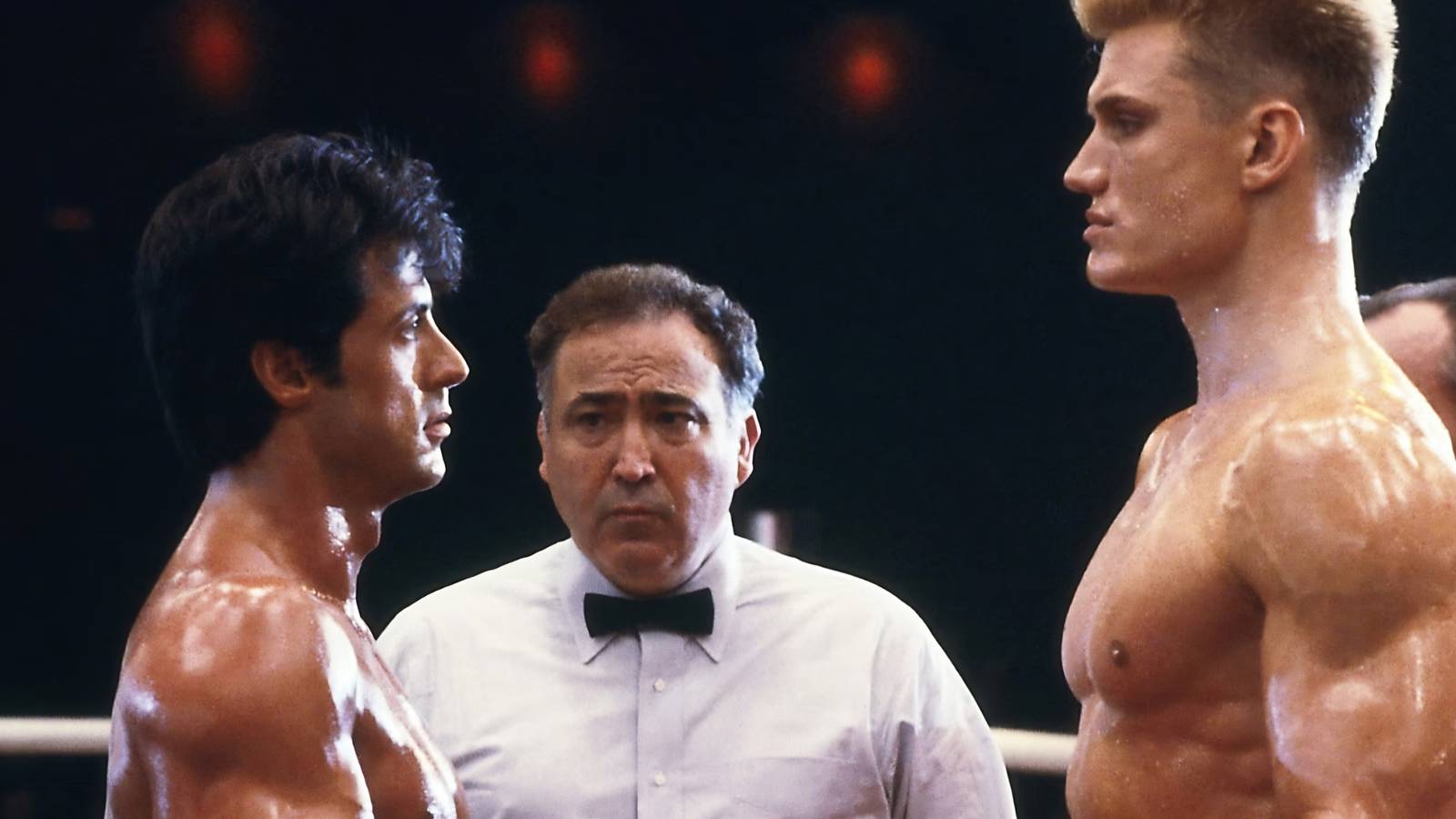
Published Aug 26, 2026, 5:08 AM EDT Lloyd 'Happy Trails' Farley: the man, the myth, the legend. What can be said about this amazing - and humble - man that hasn't been said before? Or, more accurately, what can be said in public? Born in Calgary, Alberta, Canada, Lloyd is a master of puns and a humorist, who has authored one pun book to date - Pun and Grimeish Mint - and is working on a second. His time with Collider has allowed Lloyd's passion for writing to explode, with nearly 1,000 articles to his name that have been published on the site, with his favorite articles being the ones that allow for his sense of humor to shine. Lloyd also holds fast to the belief that all of life's problems can be answered by The Simpsons, Star Wars, and/or The Lion King. You can read more about Lloyd on his website, or follow his Facebook page and join the Llama Llegion. Happy trails! Movie franchises built around sports are few and far between, and those that do exist are mainly comedies, like The Mighty Ducks and Major League, with only a handful of more serious entries, like Karate Kid and Creed, sneaking in. Given all that, being the greatest sports franchise of all time isn't necessarily the achievement one might think it would be. But to also be one of the greatest movie franchises of all time, period, is a different matter altogether, which is where one finds the Rocky films. The series, centered around the titular pugilist from Philadelphia, Rocky Balboa (Sylvester Stallone), has finally met an opponent it can't take down: Netflix, which is hitting the franchise with a knock-out punch as of September 1st, 2026, when it removes all nine movies (including the spin-off Creed trilogy) from its platform. 'Rocky' Made a Hero of an Also-Ran Image via United Artists The first film in the franchise, simply titled Rocky, is a true underdog story both on and off the screen, with Stallone's battle to get the movie made — and for him to be its star— serving as the basis for the upcoming film I Am Rocky. It was unlike any other sports film of its kind, featuring a socially awkward protagonist plagued with self-doubt, who scores the opportunity of a lifetime by chance, when heavyweight boxing champion Apollo Creed (Carl Weathers) randomly selects him as a challenger for his belt. The film focused more on Rocky's life outside the ring, with his training and first steps in his relationship with Adrian (Talia Shire) humanizing him well before the fight even begins. And what a fight it is! It stands as one of Hollywood's greatest and most meticulously choreographed fight sequences of all time (Stallone notes that the fight was laid out in detail across 14 script pages), with Apollo and Rocky trading blows for fifteen rounds before shattering expectations by having Rocky lose. It was a bold move, given that traditionally, protagonists in sports films simply never lose, no matter where they start their journey. But the film was never about winning the belt: it was about Rocky pushing himself to go the distance with Apollo, proving that he was somebody in the process. The reward was that he had succeeded in that goal, and watching that was ultimately more satisfying than the more unlikely scenario of his coming up from the streets and winning it all. Rocky II righted the first film's "wrong" by giving moviegoers the ending they wanted the first time around, with Rocky beating Apollo to take the championship, a feat that felt earned at that point. While not as good as the first, it's easily the best of the sequels, and serves as a meta-commentary to a degree, with Rocky in the film, and Stallone outside of it, both dealing with their new-found fame. The franchise starts to go off the rails a bit with Rocky III, but wins with Mr. T's Clubber Lang, a no-nonsense, villainous aggressor who presents a formidable challenge for Rocky. 'Rocky' Comes Full Circle With 'Rocky Balboa' But if Rocky III is when the franchise started to go off the rails, Rocky IV is when the train fell off completely. It's when Rocky becomes, for lack of a better word, a superhero, who must defeat the Soviet giant Ivan Drago (Dolph Lundgren) not only to avenge Apollo's death, but for the red, white and blue. The film pits American hard work and dedication versus Soviet engineering, ending on a "why can't we all just get along" note that feels insincere and forced, at odds with the other films to that point. That said, Rocky IV is absolutely brilliant as simple popcorn entertainment, with its shameless goal of steering the audience to cheer on Rocky and the side of good against the evil Russians a rousing success. From there, the franchise could go in one of two directions: find a new big bad and keep Rocky on the path of superheroics; or scale it back again to plausibility, where it always felt natural. Somehow, Rocky V found a third option, which was to scale Rocky back to his street roots in a completely implausible arc. In essence, the film hits Rocky with wave after wave of misfortune until he, Adrian, and Robert (Sage Stallone) are back in their old run-down Philly neighborhood. Returning the franchise to its roots wasn't the problem, however; rather, the issue is that it was done without keeping the franchise's heart, emphasizing the doom and gloom of Rocky's situation over the values he'd exhibited from the start. It would be a full 16 years before the franchise crawled out of the hole that Rocky V had placed it in, and Rocky Balboa made it worth the wait. It ditched the plot device of the career-ending brain damage Rocky sustained after the Drago fight, which seemingly only existed as yet another misfortune to pile on. In its place, the movie brought back the grounded, emotional heart of the first films, treating its aging Rocky with grace and allowing Stallone to flex his dramatic muscles once again. That renewed connection with the character and the winning formula of the franchise was carried over to the spin-off Creed, which garnered Stallone an Academy Award nomination as Best Supporting Actor, 39 years after Rocky won Best Picture. And you've only got to the end of the month to catch them all on Netflix. Rocky Release Date November 20, 1976
Say Goodbye to the Most Unforgettable Sports Movies of All Time Before They Leave Netflix
Full Article
Original Source
Read the full article at Collider →KhanList aggregates and links to publicly available news content. We do not host full articles from third-party sources. Always verify important information with original sources.