
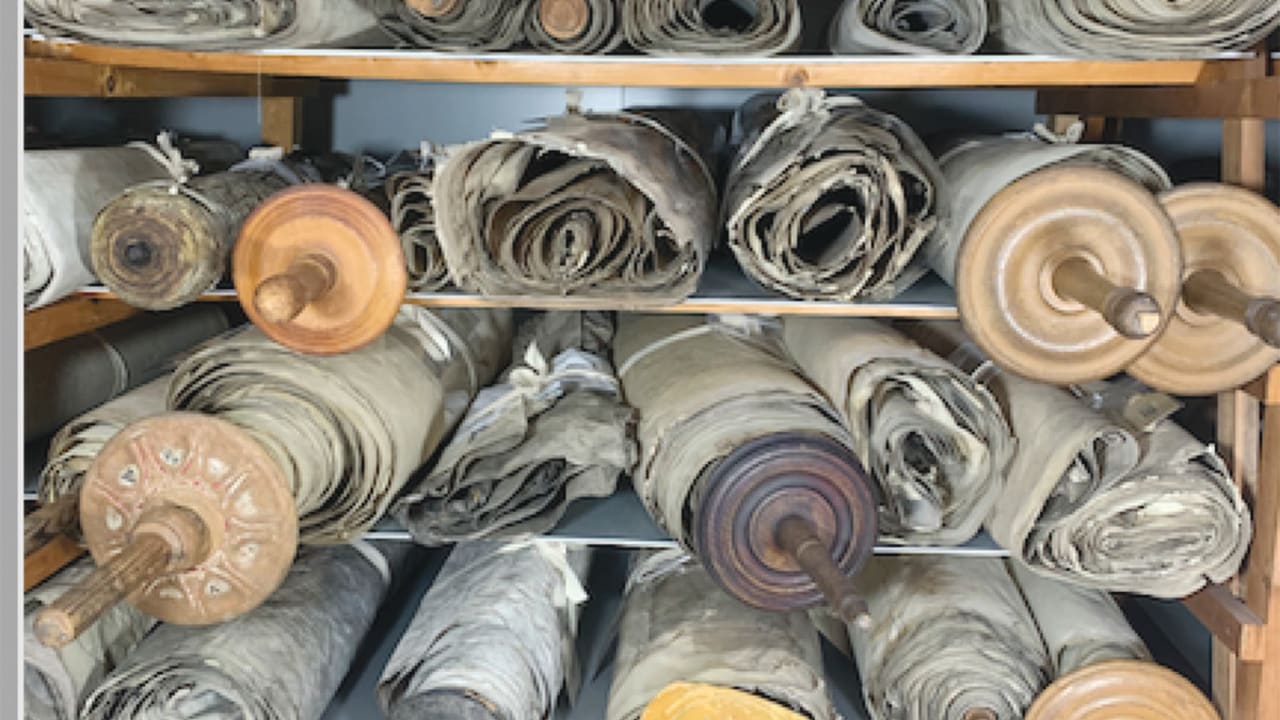
OCTOBER 16, 2026 19:12On an overcast London morning in February 1964, Satmar hassid David Eliahu Brand passed by the Westminster Reform synagogue. Looking for work as a sofer (scribe), Brand took a chance and knocked on the front door. Ruth Shaffer, a native of Warsaw, Poland, and the coordinator for the Westminster synagogue Torah restoration project, answered the door.Speaking in his native Yiddish, Mr. Brand asked her: “Es gibt Torahs?” Do you have any Torah scrolls that have to be repaired? Ruth replied in the affirmative, but added that the synagogue possessed not just one scroll, but 1,564 Torah scrolls that had been rescued from Czechoslovakia after the war.After that astounding revelation, Ruth introduced Brand to the synagogue’s spiritual leader, Rabbi Dr. Harold Reinhart. Thus began the most unlikely arrangement between a Satmar hassid and a Reform synagogue that would last for 27 years!The story begins: Demise of Jewish communities of Czechoslovakia, Moravia and Bohemia: March 15, 1939On March 15, 1939, Nazi German troops violated the Munich Agreement and marched into the capital city of Prague. This began the official annexation of Czechoslovakia. Wherever German troops entered, the Jewish communities were in danger as well.Until 1939, the Jewish communities of Czechoslovakia, Moravia and Bohemia numbered over 120,000 Jews and boasted over 350 synagogues, including the famous Maharal synagogue in Prague.David Eliahu Brand, a Satmar ‘sofer,’ repairs a Torah scroll. (credit: Memorial Scrolls Trust)Prague was also the home of the Old-New Synagogue, which was built in the year 1270, and the Pinkas synagogue, built in 1479.Almost overnight, Jews were stripped of their civic rights, banned from most jobs (including the medical field), and children were expelled from all public schools.Then, in July 1939, the Nazis established the Central Office of Jewish Emigration in Prague (directed by Adolf Eichmann), thus forcing many to abandon their communities, leaving behind their beautiful synagogues (containing hundreds of Torah scrolls) and houses of study.The first miracle: Gathering all Torah scrolls and artifacts to the Prague Jewish MuseumThe Prague Jewish Museum was built in 1906 and in 1939 was under the directorship of Dr. Karel Stein and curator Alfred Engel. Fearing that the holy and beautiful Torah scrolls in the hundreds of Czech Jewish communities would be totally lost, Stein and Engel asked permission from Nazi authorities to centralize all Jewish ritual objects in Prague in order to protect them from widespread plundering.Over 1,800 Torah scrolls and 212,000 artifacts were transferred to the museum.Whether the Nazi intent was merely to amass valuable silver and gold for its treasury or to build a museum to recall an extinct race (once all Jews would be murdered) is a matter of question, but nonetheless all of the Czech Torah scrolls and artifacts were brought to Prague.There, many Jews were employed to sort, catalogue, and store all the items that arrived from over 100 synagogues in Czechoslovakia, Moravia and Bohemia. Tragically, almost all of the employees were later deported to Terezin and other death camps and perished during the Shoah.The Czech scrolls. (credit: Memorial Scrolls Trust)The second miracle: Procurement of the Torah scrollsFollowing the end of World War II, the Torah scrolls lay abandoned and unattended for almost 20 years in a damp, moldy warehouse in Prague.That all changed with a tap on the shoulder in 1963. A British art dealer, Eric Estorick, was approached by a representative of the Czech State Agency to purchase some ritual objects that had been kept in storage. The Czech government, then under Communist rule, was badly in need of money and felt that this was a golden opportunity.Estorick contacted Ralph Yablon, a British philanthropist and member of the Westminster synagogue in London. Yablon consented to provide the £30,000 necessary for the purchase and shipping of all the Torah scrolls and other religious objects that had been stored away for so long.Yablon, aware that many of the scrolls were badly in need of repair, contacted his rabbi, Harold F. Reinhart, in order to determine which scrolls were totally unusable and which could be designated for restoration.Shaffer would spend almost 40 years managing, documenting, and distributing the scrolls to communities worldwide. (credit: Memorial Scrolls Trust)Finally, on February 7, 1964, two enormous trucks carrying the 1,800 stained and tightly packed scrolls arrived in London. The original idea was that these Torah scrolls would be repaired and then returned to the communities from which they came.But soon after their arrival, it was determined that almost all of the former Czech shuls were either destroyed or the communities no longer existed.The third miracle: Restoration of the 1,800 scrollsBy the early part of 1964, all of the Torah scrolls and hundreds of other religious objects (including 400 wimples or binders) arrived in the Westminster synagogue. That is when the divine hand of God directed David Brand to knock on the door of the synagogue.As in the book of Shir Hashirim, which says: “the voice of my beloved knocks,” it was a most unlikely but divinely ordained moment. That is when the major work began in order to determine how many of the scrolls could actually be repaired.Of the total of 1,800 scrolls, Brand, along with other professional scribes, slowly and meticulously determined that hundreds could simply not be repaired-the decades of storage in horrible conditions had made many unusable.Ruth Shaffer, coordinator for the Westminster synagogue Torah restoration project, in discussion with Brand. (credit: Memorial Scrolls Trust)It should be noted that even if one letter of a Torah scroll is written incorrectly or if the ink dries up, the scroll cannot be used at all until repaired. Imagine what happened to the Czech scrolls when they were not used or opened for so long.The fourth miracle: Founding of the Memorial Scrolls TrustOf the entire collection of the 1,800 Torah scrolls, 1,564 were deemed to be usable, but then the decision had to be made as to how they would be used and to whom they would be given. In 1964, after several months of meticulous work by the scribal team, Ruth (1910-2006) took over the directorship of the Memorial Scrolls Trust (MST).Ruth would spend almost 40 years managing, documenting, and distributing the scrolls to communities worldwide. Amazingly, the initial filing and tracking were done on index cards only, and only many years later was the entire system transferred to a digital database.One of her early decisions was that each scroll would be given to a community or synagogue on permanent loan in order to memorialize the communities from which they came originally. In addition, since the Torah is described as a “tree of life,” the scrolls would be read and would become a living memory for all the communities that were destroyed during the Holocaust.About six months ago, I contacted the MST to find out more information about the scrolls and where they are today. I was fortunate that Jeffrey Ohrenstein, MST trustee and chairman, wrote back, and so began a series of discussions and amazing stories.Jeff said the oldest known scroll in the collection is one from the 13th century, and that today about 150 scrolls still remain in the museum in London. Over 1,400 Torah scrolls have been loaned out to communities around the globe, including 1,000 to the US, as well as Israel, Italy, Argentina, Chile, and the UAE (Dubai).Over the last 62 years, these communities have become part of the ongoing memorial to the former Jewish centers, but they have also transformed the Torah scrolls into living and eternal messengers of all who perished at the hands of the Nazis.The scrolls are not stored in the holy ark, but are read and celebrated everywhere where they have been adopted.Like the famous and tragic death of Haninah ben Tradyon (tractate Avodah Zarah 18A), when he is asked by his students what he saw as he was being tortured by the Romans, he replied: “The parchment is burnt, but the letters are flying heavenward.” Those letters, he was saying, are eternal; they can never be destroyed by our enemies.In the case of the Czech collection, both the scrolls and its holy letters have survived, been lovingly cared for, and preserved for eternity.Follow us on Google
Saved from Nazi-occupied Prague, thousands of Torah scrolls find new life through a Satmar scribe
Full Article
Original Source
Read the full article at Jpost →KhanList aggregates and links to publicly available news content. We do not host full articles from third-party sources. Always verify important information with original sources.