
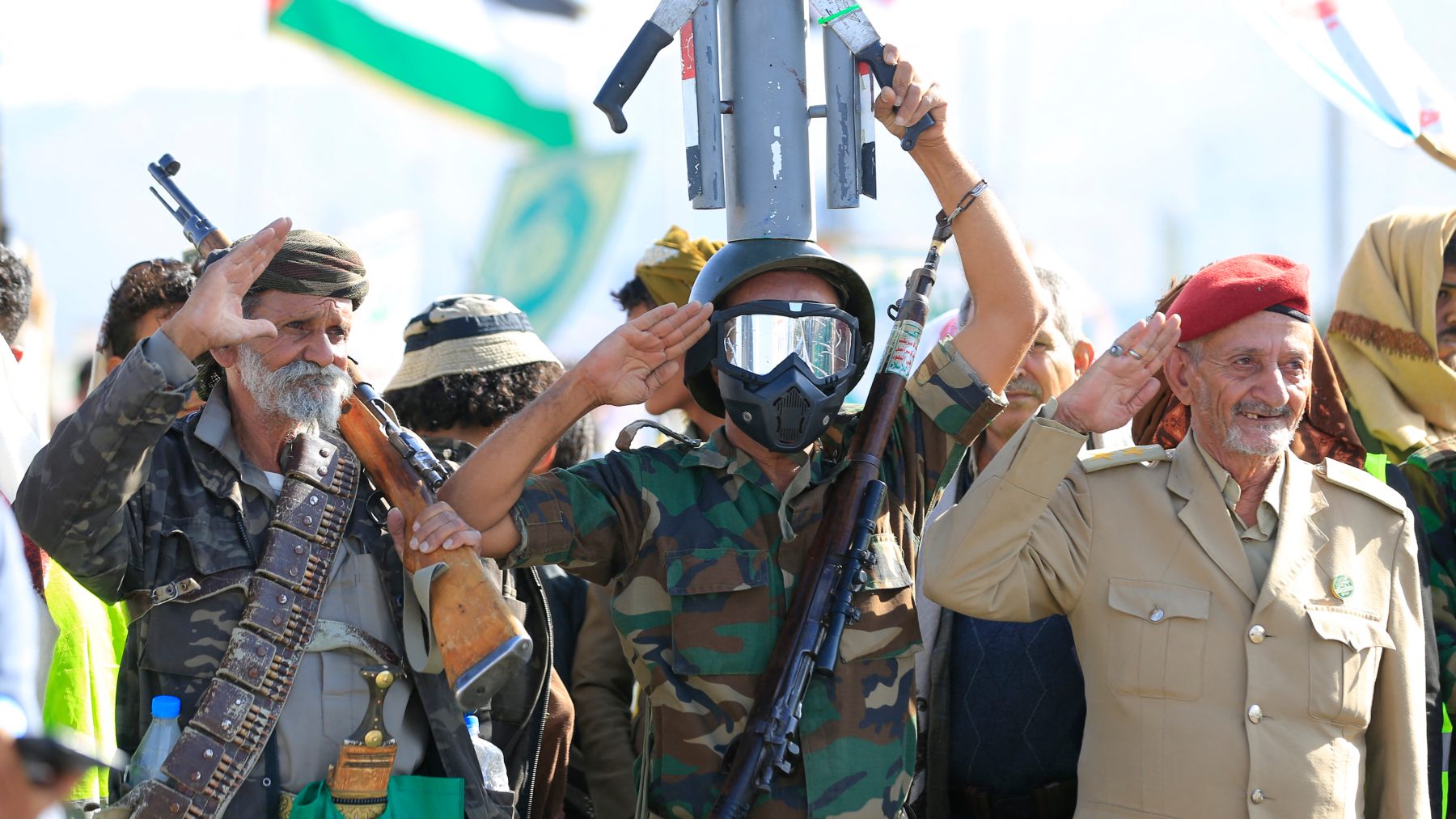
The Southern Armed Forces say the move is intended to reinforce Aden, while the Houthis claim they drove troops from positions overlooking the strategic waterway Supporters of Yemen’s Houthi authorities gather during a protest against Saudi intervention in Sanaa, 9 October 2026 (Mohammed Huwais/AFP) Published date: 16 November 2026 14:44 GMT | Last update: 9 sec ago Saudi-backed forces in Yemen have withdrawn from positions overlooking the strategic Bab al-Mandab Strait, leaving the Houthis with greater leverage over the southern entrance to the Red Sea after weeks of fighting. The Southern Armed Forces, who are backed by Saudi Arabia and fighting alongside the internationally recognised Yemeni government, said on Sunday they had "redeployed" troops from Dhubab airport and surrounding regions of Bab al-Mandab to strengthen defences around the interim capital Aden. “This step is taken based on the priority of securing the capital, Aden, and the neighbouring governorates, as well as strengthening the front lines and addressing existing threats,” the group said in a statement. The Houthis, officially known as Ansar Allah, offered a different account. A military source quoted by the Houthi-run Saba news agency said that they had forced Saudi-backed forces out of positions around Dhubab and Bab al-Mandab after severing their rear supply routes, forcing them to move towards Aden. The Houthi-run outlet also reported that the group's forces had carried out a flanking operation across more than 60km of the mountainous regions of Taiz and Lahij, forcing enemy troops to retreat from positions around Dhubab airport, the outskirts of Kahbub and areas around Bab al-Mandab. New MEE newsletter: Jerusalem Dispatch Sign up to get the latest insights and analysis on Israel-Palestine, alongside Turkey Unpacked and other MEE newsletters The latest developments give the Houthis more leverage over how Bab al-Mandab, one of the most critical points of waterway traffic in the world, is controlled. The strait sits on the maritime route between the Red Sea and the Gulf of Aden, leading into the Suez Canal. Saudi-linked media reported that the withdrawal was a tactical decision to help defend Aden, strengthen lines in Lahij and provide the opportunity to relieve the siege on Taiz. Yemen, Bab al-Mandab and Saudi Arabia: Tehran’s strategic calculus in the balance Read More » A source in Yemen's presidency told Asharq Al-Awsat that troops had been moved to positions offering greater strategic advantages and that the withdrawal did not mean abandoning the coastal front. The government-aligned forces described the move as a redeployment rather than a loss, saying it would allow them to reinforce Aden and neighbouring areas while continuing operations to break the Houthi siege of Taiz. Yemen's government military spokesman, Colonel Majed al-Nuzaili, called on the international community to help restore government control over the strait. “The international community must assume its responsibilities by contributing to the liberation operation, given the strait’s vital importance to maritime security and international trade,” he said. The withdrawal marks a setback for the government and its Saudi ally, whose forces had launched a counteroffensive to retake territory seized by the Houthis along Yemen's Red Sea coast. Heavy fighting On Sunday, the Saudi Press Agency reported that the coalition had intercepted and destroyed two drones launched by the Houthis towards the Mecca region, a separate development from the fighting around Bab al-Mandab. The withdrawal follows a Houthi offensive that began in September, when the group seized territory along Yemen's western coast, including positions near the strategically located port city of Mokha. Houthi strikes mark the end of Saudi Arabia's Yemen 'containment strategy' Read More » Government forces launched a counteroffensive in October, backed by Saudi air power, and initially recaptured positions around Dhubab and the strait. But they failed to dislodge the Houthis from Mokha and other coastal areas. The Houthis have also advanced in highland areas north of Aden, raising the prospect of further fighting near the government's main base in the south. The redeployment comes as the Houthis maintain pressure on Taiz, Yemen's third-largest city, which has been surrounded by the group for more than a month. Aid supplies have been blocked from entering and civilians have faced restrictions on leaving, according to reports by Al Jazeera and Reuters. The United Nations refugee agency has warned that fighting has reached the Kharaz refugee camp in Lahij governorate, putting about 9,600 people at greater risk and further restricting humanitarian access. Nearly 330,000 people have been displaced in Yemen since the fighting escalated in August, according to an update by the UN refugee agency cited in the reporting. About 48,000 were displaced in recent weeks. Middle East Eye delivers independent and unrivalled coverage and analysis of the Middle East, North Africa and beyond. To learn more about republishing this content and the associated fees, please fill out this form. More about MEE can be found here.
Saudi-backed forces retreat from Bab al-Mandab as Houthis gain ground
Full Article
Original Source
Read the full article at Middleeasteye →KhanList aggregates and links to publicly available news content. We do not host full articles from third-party sources. Always verify important information with original sources.