
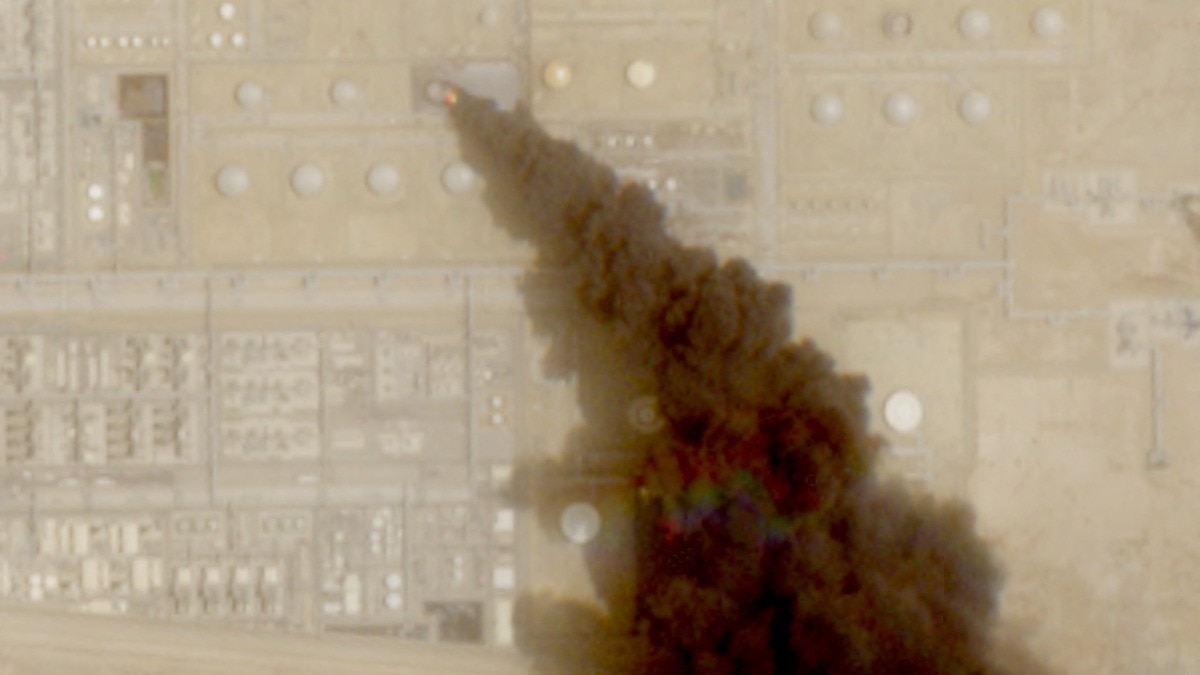
Saudi Aramco's facilities in Jizan were hit in another attack on Monday, with damage still being assessed. The Jizan complex includes a 400,000-barrel-per-day refinery, one of Saudi Arabia's largest, as well as associated processing plants and energy infrastructure.A satellite image shows trail of smoke rising from an oil facility, in Jizan, Jazan province, Saudi Arabia. (File Photo: Reuters)Saudi Aramco's oil facilities in Jizan were hit in a fresh attack on Monday, with the extent of the damage still being assessed, according to the Financial Times. The strike happened only about a month after another attack temporarily disrupted production at the Saudi energy giant's refinery in the same area.Jizan, an industrial city near Saudi Arabia's border with Yemen, has long been a target for the Iran-backed Houthis. However, the group has not claimed responsibility for Monday's attack.JIZAN OIL HUB UNDER PRESSUREThe Jizan complex includes a 400,000-barrel-per-day refinery, one of Saudi Arabia's largest, as well as associated processing plants and energy infrastructure. The latest incident was similar in scale to last month's strike.As per the report, Saudi Aramco chief executive Amin Nasser said after the previous attack that the company had experienced some interruptions to oil production, but insisted there had been no material operational or financial impact. The latest incident comes against a backdrop of renewed Houthi attacks on Saudi Arabia. The rebels reignited conflict with Riyadh after declaring a blockade of Saudi ports on the Red Sea in July, followed by a series of drone and missile attacks against energy infrastructure.The escalation has also hit Jizan's role as an export hub. More refined petroleum products than usual were shipped from the area during the first months of the US-Iran war, as fighting disrupted Saudi exports from the Gulf. But shipments fell sharply after the Houthis resumed attacks, with Kpler data showing no oil products were shipped from Jizan in August.RED SEA FRONT OPENS AGAIN Saudi Arabia intervened in Yemen's civil war in 2015, leading an Arab coalition against the Houthis after the rebels seized the capital, Sana'a, and ousted the internationally recognised government.Fighting largely subsided after a ceasefire in April 2022, but the fragile calm has now broken down. Over the weekend, Houthi forces launched a ground offensive along Yemen's Red Sea coast, apparently seeking to move towards the Bab al-Mandeb Strait.Fighting was reported around the historic port of Mocha and the city of Taiz, forcing thousands of Yemenis to flee their homes. The offensive has produced the fiercest fighting in Yemen in six years, pitting the Houthis against Saudi-backed forces aligned with the Yemeni government.The Houthis have previously threatened to close the Bab al-Mandeb, which is a crucial maritime chokepoint that has become even more important for Saudi oil exports after Iran restricted shipping through the Strait of Hormuz.OIL PRICES EDGE TOWARDS $100The fresh strike has added to pressure on an already unsettled oil market. Brent crude rose about 1.2 per cent on Monday to around $97.40 a barrel, after reaching its highest level since July 24. US West Texas Intermediate crude was also trading near six-week highs.Oil prices have risen sharply following renewed US-Iran attacks and growing risks to commercial shipping. US forces struck three Iranian oil tankers on Saturday, while Iran's Islamic Revolutionary Guard Corps said it had targeted three tankers travelling through unauthorised routes in the Strait of Hormuz. Maritime intelligence firm Marisks described the attacks as a "major escalation"."Commercial tankers are now being deliberately used as instruments of reciprocal economic pressure, substantially weakening the previous distinction between military confrontation and commercial shipping," it said.An average of just 10 commodity ships passed through the Strait of Hormuz each day over the previous 10 days, the lowest level since May, according to Kpler data."If tanker traffic begins to slow materially, the market could price in a much larger supply shock. And there are already signs that this is happening," said Priyanka Sachdeva, head of market insights at Phillip Nova.Goldman Sachs has warned oil prices could rise as high as $120 a barrel if attacks on shipping intensify.- EndsWith inputs from agenciesPublished By: Satyam SinghPublished On: Sep 7, 2026 17:49 IST
Saudi Aramco's Jizan oil hub hit again, damage still being assessed
Full Article
Original Source
Read the full article at Indiatoday →KhanList aggregates and links to publicly available news content. We do not host full articles from third-party sources. Always verify important information with original sources.