
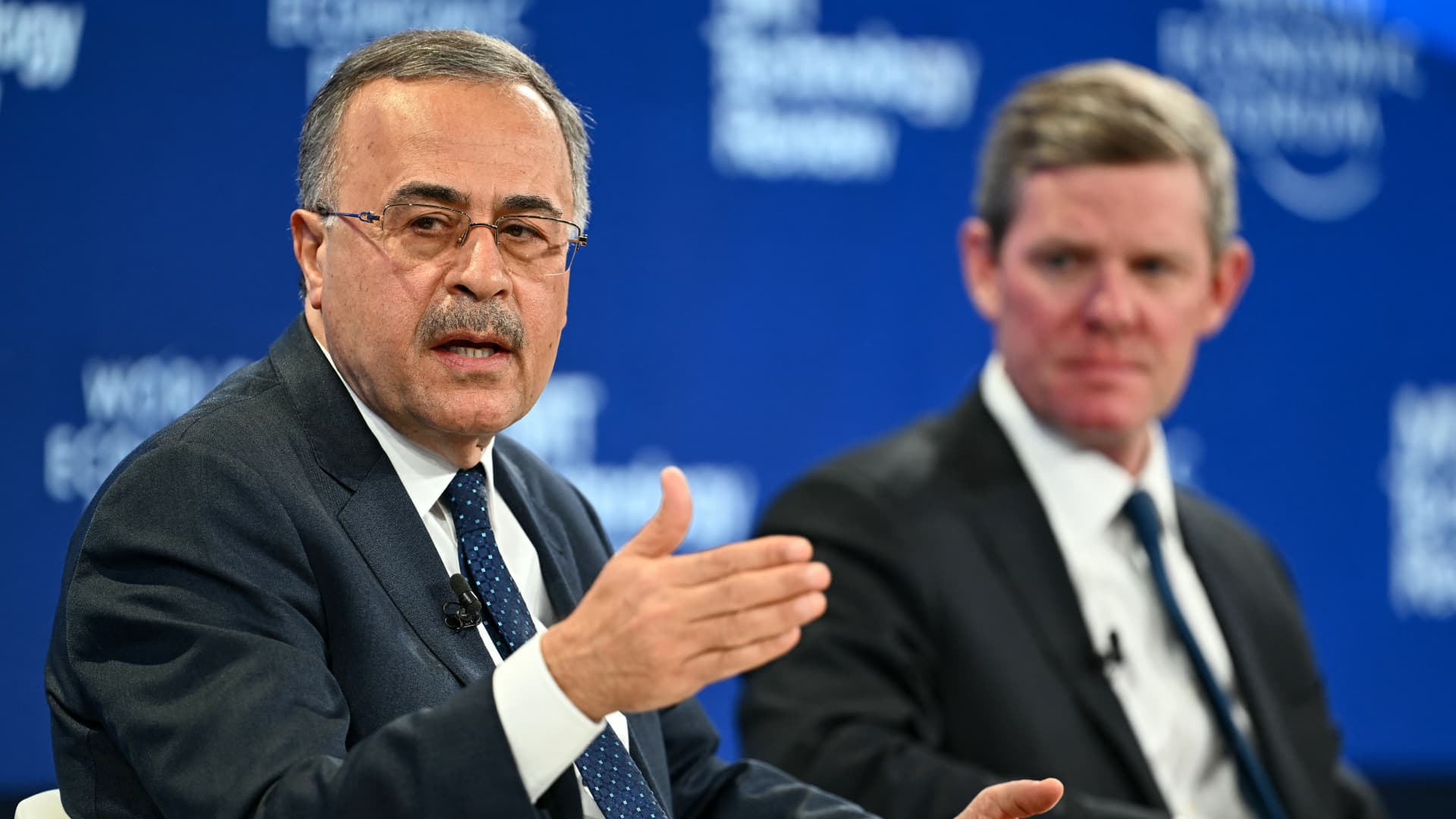
An employee looks out over oil transport pipelines on the Arabian Sea in Saudi Aramco's Ras Tanura oil refinery and oil terminal in Ras Tanura, Saudi Arabia.Simon Dawson | Bloomberg | Getty ImagesThe chief executive of Saudi Aramco said Monday it could take up to two years to rebuild global oil inventories, warning that the squeeze on supplies could yet get worse as the U.S.-Iran war drags on.Speaking at the Energy Intelligence conference in London, Saudi Aramco CEO Amin Nasser said pressure at both ends of the barrel will intensify until the strategically vital Strait of Hormuz fully reopens and confidence returns to energy markets.The war has severely disrupted shipping through the strait, a narrow waterway that typically handles around 20% of the world's oil and liquefied natural gas supplies, sending shock waves through the global economy."Even then, replenishing inventories while meeting demand could take up to two years," Nasser said, according to Reuters. His comments come shortly after G7 governments agreed on Friday to release 100 million barrels of diesel and crude from emergency reserves, following pressure from U.S. President Donald Trump. The G7 members are France, Canada, Germany, Italy, Japan, the United Kingdom and the U.S. France currently holds the group's presidency. The European Union also participates in its meetings. Aramco's Nasser said nearly 3 billion barrels of oil supply had been lost since the U.S. and Israel launched military strikes on Iran in late February, while 1 billion barrels of oil had been released from stocks. Most of the stock draw to date had come from commercial inventories, with the CEO of the world's largest oil company saying the remaining 6 billion or so in storage is "not practically available." He added: "The system is already straining." Read more U.S.-Iran war newsAll U.S. bombers leave UK air base on concerns of suspected terror plots; more tankers struck near Iran in the Middle EastG7 nations to release diesel stocks as wars in Europe and Middle East constrain fuel suppliesWar, $100 oil and a bond sell-off reshaped markets in the third quarterU.S. to send third carrier group to Mideast as Trump warns of new Iran strikesIran and Oman prepare Hormuz deal as U.S. holds back on secondary sanctionsTrump admin unveils anti-Iran global sanctions plan, signals China not exemptStrait of Hormuz shutdown: A visual guide to world’s most critical oil chokepointTrump targets Iran’s trade lifelines — here are the countries most exposedChina needs U.S. dollars but is building a hedge against Washington’s sanctionsTrump says no talks scheduled with Iran as he teases action in Hormuz StraitInvestors scored on Iran war’s oil market boom. Staying long the trade will get trickierWhat is Pickaxe Mountain, the Iranian nuclear facility Trump is threatening to strike?Ukraine strikes Iranian vessels in Caspian Sea, Tehran accuses Kyiv of ‘hostile and criminal act’Saudi military strikes Houthi targets in Yemen after Iran-backed militia attacked Red Sea shippingTehran’s Hormuz threat risks global fallout, Rubio warns as U.S. strikes Iran for 11th straight nightIran says it attacked Amazon infrastructure in BahrainU.S. strikes Iran and Houthis threaten Saudi Arabia shipping as mediators push 10-day ceasefireOil exports through the Strait of Hormuz might not return to levels seen before the Iran warStrait of Hormuz shutdown: A visual guide to the world's most critical oil chokepointOil markets are betting on a swift end to the Iran war. Investors may regret itThe Middle East war is testing the Gulf’s ambitions to become an AI hubAnalysis: An end to the Iran war may be just the beginning of a new era of U.S. inequalityWhy the confusion around the Iran situation could get worse. How to profit anywayStrait of Hormuz: Ships attacked as Trump extends Iran ceasefireTrump tells CNBC he expects U.S. to make 'great deal' with IranMore from CNBC Politics Oil prices traded marginally lower on Monday as Middle East crude exports rose, with flows through both the Strait of Hormuz and Saudi Arabia's key East-West pipeline reportedly trending higher.International benchmark Brent crude futures with December expiry traded 0.1% lower at $102.20 per barrel, while U.S. West Texas Intermediate futures with November expiry stood 0.5% lower at $90.64.— CNBC's Spencer Kimball contributed to this report.
Saudi Aramco chief says replenishing global oil stockpiles could take two years
Full Article
Original Source
Read the full article at Cnbc →KhanList aggregates and links to publicly available news content. We do not host full articles from third-party sources. Always verify important information with original sources.