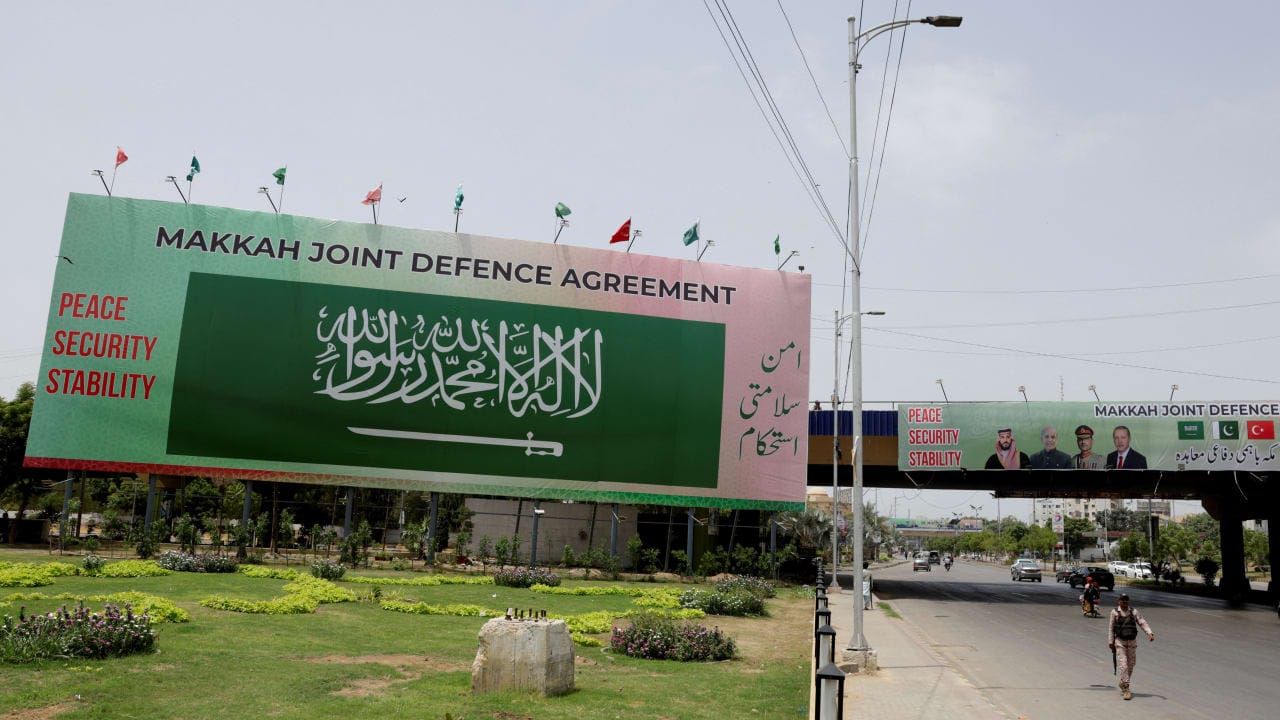
ByZVIKA KLEINAUGUST 11, 2026 05:37The fire at the Aramco refinery in Jizan started Sunday morning. Yahya Saree, the Houthi military spokesman, said his forces had hit it with a drone, precisely, in retaliation for Saudi drones over Saada and Hajjah. The Saudi energy ministry confirmed the fire and said it was extinguished.Forty-eight hours earlier, Saudi Crown Prince Mohammed bin Salman, Turkish President Recep Tayyip Erdogan, and Pakistani Prime Minister Shehbaz Sharif had stood together in Mecca and signed an agreement stating that an armed attack on any one of their countries would be regarded as an attack on all three.Turkey said nothing. Pakistan said nothing. There was never any reason to think otherwise.Israeli commentary reached for the largest available frames: an Islamic NATO, a Sunni axis, a Pakistani nuclear umbrella over the kingdom. The Prime Minister's Office declined to comment at all. The pact deserves neither response.The joint statement says the agreement strengthens collective deterrence against aggression. The text has not been published, so everything written about the pact rests on what officials choose to describe.A composite satellite image shows trail of smoke rising from an oil facility, in Jizan, Jazan province, Saudi Arabia, July 26, 2026. (credit: EUROPEAN UNION/COPERNICUS SENTINEL-2/HANDOUT VIA REUTERS)Turkish Foreign Minister Hakan Fidan has described it the most. He told Anadolu the collective-defense clause is technically comparable to NATO's Article 5, and named the institutions: a ministerial committee and a permanent secretariat in Saudi Arabia. Then he added the part almost nobody covered. If one member is attacked, the others consult to determine the nature and scale of any assistance. Consultation is what NATO members do too. It is also what they did in February 2003, when three of them blocked planning for Turkey's own defense before the Iraq war.Experiment was done once alreadyRiyadh has run this experiment once already. Its defense agreement with Pakistan was signed in September 2025, days after the Israeli strike on Hamas figures in Doha, and both capitals say it obliges each to defend the other. When the United States and Israel began striking Iran on February 28, Riyadh called it in.Reuters reported in May, citing five Pakistani and Saudi sources, that Pakistan sent roughly 8,000 troops, some 16 aircraft, mostly JF-17s, two squadrons of drones, and a Chinese-built HQ-9 battery. Pakistanis operate the equipment. Saudi Arabia pays for it. Two of those sources said the role was mainly advisory and training.Iran spent the months that followed hitting Saudi refineries and American aircraft parked at Prince Sultan Air Base. Two Saudi civilians were killed. The Pakistani squadron stayed where it was, and Islamabad carried on hosting talks between Washington and Tehran.Mecca turns that arrangement into an institution: foreign hardware on Saudi soil, Saudi money paying for it, foreign crews operating it, and no obligation on anyone to fire. A senior Israeli official, asked privately about the Pakistani element, described it in narrow terms. He is right about the military content. The reason to watch this is political.Fidan also let a date slip. Preparations, he said, ran nearly two years and eight months, putting the start around December 2023. They began building this while Israeli forces were in Khan Yunis, long before the first Iranian missile landed on Saudi soil.The claim that Egypt is joining deserves less confidence than it has received. Fidan says Cairo will come in once technical issues are settled and calls it a natural partner. Mada Masr, citing Egyptian and regional sources, reported that Egypt was invited and refused, unwilling to enter a bloc drafted in Riyadh. In May, Egyptian fighter jets flew to Abu Dhabi, not to Jeddah.None of which makes the pact benign.The day after the signing, Pakistan's defense minister, Khawaja Asif, called Israel a threat to the entire Muslim world and urged a united military front against it. He said his position would hold regardless of who wins on October 27. Asif has previously implied that Pakistan's nuclear guarantee covers Saudi Arabia, a claim no published text supports. He does not speak for Riyadh. He does sit inside the arrangement, and within a day he had handed it the enemy its drafters were careful not to name.The question of Israeli normalizationFor a decade, Israeli planning assumed a chain: Iran frightens the Arabs, fear sends them to Washington, Washington routes them through Jerusalem, normalization follows. Israel's place in it rested on being the only address for what Riyadh wanted.The crown prince now has a second address. It cannot defend him, as Sunday showed. It can be photographed and pointed at, and unlike normalization, it costs him nothing at home.Yoel Guzansky, head of the Gulf Research Program at the Institute for National Security Studies, told this paper the agreement "doesn't shut the door completely" on normalization. He is right, and the July civil nuclear agreement with Washington, which President Donald Trump says is conditioned on Saudi accession to the Abraham Accords, is the door.A refinery fire in Jizan was never going to move Turkish or Pakistani forces. The question the pact has not yet been asked is what happens when something larger is hit, and whether Riyadh would want the clause invoked even then, or would prefer to keep it exactly where it is now, useful and untested.Follow us on Google
Saudi Arabia's new alliance did nothing when a drone hit Jizan - analysis
Full Article
Original Source
Read the full article at Jpost →KhanList aggregates and links to publicly available news content. We do not host full articles from third-party sources. Always verify important information with original sources.