
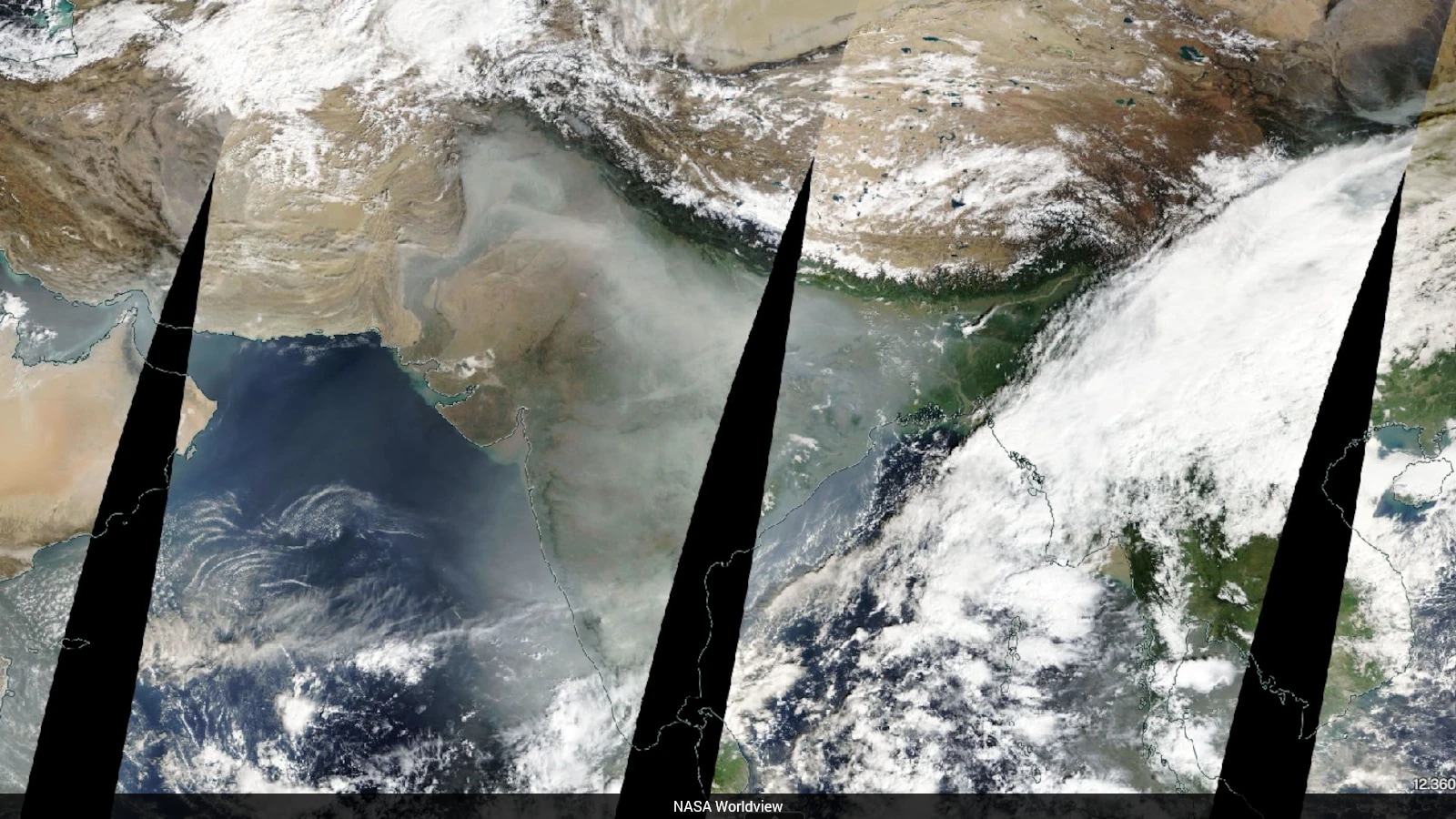
New Delhi: The toxic haze that has taken over much of northern India amid dropping temperatures, an annual event now, is so intense that it is visible from space. A satellite view from the National Aeronautics and Space Administration (NASA) Worldview, an interactive web-based mapping and visualization tool, shows much of India covered in a thick, grey blanket on November 10.The intensity of the haze is at its thickest in northern India, covering the national capital, neighbouring Uttar Pradesh, and some of the surrounding states. The fog, as seen in the satellite view, also extends further north into the Himalayan states of Uttarakhand, Himachal Pradesh, and Jammu and Kashmir.Much of central and southern India is also enshrouded by the haze, though with lesser intensity. READ | 'Green Crackers Rarely Meet Threshold': Experts On Firework Curbs In DelhiThe only parts of India which appear to not be enveloped by the grey cover are the western states such as Rajasthan and Gujarat, and the northeastern states. However, the satellite view of India today stands in contrast to yesterday, November 9, just a day after Diwali. On November 9, the haze was seemingly thinner, scattered, and covering only a few parts of the country including Delhi, Uttar Pradesh, Bihar, and other northern states such as Uttarakhand, Himachal Pradesh, and Jammu and Kashmir.Satellite view of India on November 9 by NASA WorldviewOn November 8 - the day of Diwali, when much of India celebrates with firecrackers that trigger an immediate spike in air pollution - Delhi, western Uttar Pradesh, and other northern regions were smothered in a heavy shroud, as captured by satellites.READ | Data Blindspots, Weak Rules: Inside Delhi's Annual Battle For Clean AirSatellite view of India on November 8 by NASA WorldviewWhile the intensity and position of the haze may have shifted day by day, it has remained stubbornly present over India throughout November. Delhi Air Improves To 'Poor' Two days after Diwali, the air quality in the national capital improved a bit on Tuesday and entered the 'poor' category with an AQI of 299, according to data from the Central Pollution Control Board (CPCB).READ | "Even When There Is No Stubble Burning...": AAP Attacks BJP Over PollutionThis comes a day after Delhi recorded "very poor" air with an AQI of 376 on Monday. The improvement came as wind speeds picked up across the region.According to the CPCB, an AQI between 0 and 50 is classified as 'good', 51 and 100 as 'satisfactory', 101 and 200 as 'moderate', 201 and 300 as 'poor', 301 and 400 as 'very poor', and 401 and 500 as 'severe'.
Satellite Images Capture Thick Smog Over Northern India 2 Days After Diwali
Full Article
Original Source
Read the full article at Ndtv →KhanList aggregates and links to publicly available news content. We do not host full articles from third-party sources. Always verify important information with original sources.