
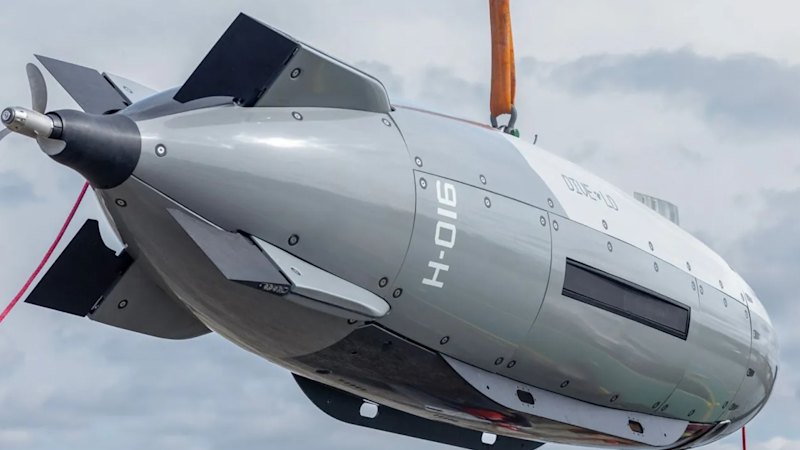
Memphis Barker and Akhtar MakoiiSeptember 10, 2026 — 11:41amIran has captured a high-tech uncrewed submarine from the US Navy amid a covert mission to clear mines from the Strait of Hormuz.The Islamic Revolutionary Guard Corps (IRGC) released footage of the Anduril Dive-LD submersible on Tuesday night (Wednesday AEST), claiming it had “trapped one of the most modern, intelligent and unmanned submarines of the terrorist American army”.The Anduril Dive-LD underwater drone.AndurilThe Pentagon admitted an unmanned submarine “surveying regional waters in support of ongoing operations” had fallen into Iranian hands after it “malfunctioned more than a day ago”.It dismissed the drone as “an older model”, but experts warned that the capture raised the prospect of Iran reverse-engineering Western technology.Iranian newspapers hailed the capture of the “Satan fish” and splashed the image on their front pages.The US Navy has been engaged in a secret effort to clear the Strait of Hormuz of Iranian mines for several months.An image of the captured submersible published by the official website of Iran’s Revolutionary Guard Corps. Sepahnews via APUS Navy SEALs have been using robot boats and specialised underwater drones in the demining operation, the Financial Times reported.Drones, possibly including the Dive-LD, were used to locate the explosives on the seabed. Divers then attached explosives to them in risky night missions, according to the FT.Defence firm Anduril describes the unmanned system as designed for mine warfare, surveillance and precision placement. At 5.7 metres long by 1.2 metres wide, the 3-tonne vessel can carry out 10-day missions underwater.Manufacturer Anduril says the Dive-LD’s relatively low cost makes it more expendable than other uncrewed systems. AndurilAnduril also downplayed the loss in a statement describing the Dive-LD as an “attritable system”, meaning it’s cheap and can be easily replaced.The drone had “already delivered significant value”, the US company said, operating for “thousands of hours in months-long operations in CENTCOM (US Central Command).”The Strait of Hormuz has become a “testing ground” for new technologies such as the Dive-LD, said Professor Kevin Rowlands, a naval expert at the Royal United Services Institute think tank.“I would expect some things to go right, and some things to go wrong,” Rowlands said.“One of the reasons for moving to uncrewed systems is to reduce the risk to life at the front line and reduce the political and diplomatic damage that happens if people are taken captive. It’s not a surprise that in a conflict zone, one side’s kit gets captured. And if that’s a USV (unmanned surface vehicle), so be it.”“There should be a lot of them. And ‘attritability’ is the key thing. The Americans should be able to carry on with the mission despite the loss of one platform.”Tehran might be able to reverse engineer the technology, Rowlands warned, but he said he assumes the US and Anduril “have some protocols in place” to ensure the most sensitive elements “won’t be available to them”.The IRGC said the craft was trapped and taken as a prize “in a complex operation based on intelligence and operational dominance”.A ‘present’ for the ayatollahSome supporters of the Islamic Republic posted pictures of the submarine, calling it a “birthday present” to Mojtaba Khamenei, the supreme leader, who turned 57 on Tuesday.President Donald Trump claimed on August 25 that the US had cleared “all mines” in the strategically crucial waterway. CENTCOM later stated it had removed those from internationally recognised shipping lanes.The USS Michael Murphy taking part in the blockade of Iranian ports.X/@CENTCOmTrump has also sought to encourage ships to cross the strait by providing them with an “air defence umbrella” from nearby US warships. About 1600 vessels have been helped to transit the waterway, according to CENTCOM.However, traffic has yet to resume anywhere near pre-war levels as Tehran launches regular attacks on transiting vessels.Gulf nations have taken greater risks in exporting oil, providing insurance and supplying government-owned tankers. Often, the vessels travel at night and with their transponders switched off.In terms of oil supplies, last week the seven-day rolling average hit about 8 million barrels per day – roughly 40 per cent of the pre-war total.That figure appears likely to fall once more as Iran and the US engaged on Wednesday in the biggest wave yet of tit-for-tat strikes on shipping.Tehran said it had attacked 10 ships near the strait while the US sank five Iranian oil tankers.The escalation pushed up the price of oil, with the international Brent crude benchmark rising above $US100 ($138) for the first time since July. Goldman Sachs recently updated its forecasts to show higher oil prices lasting into next year.Andreas Krieg, a senior lecturer at King’s College London’s School of Security Studies, said: “Even if the Iranians are not consistent in attacking each tanker, and the Americans are able to deter some of the attacks by escorting vessels through the Strait, essentially it remains deeply disrupted.“At the moment, it’s just tactical tit-for-tat,” Krieg added.Trump is facing a run-up to the midterms with fuel prices rising again due to the war with Iran.AP Photo/Julia Demaree Nikhinson“If you asked me who started the latest round of escalation [last night], I wouldn’t be able to tell you because there have been so many different moves that have unnecessarily escalated the situation … They’re equally to blame.”Iran has been negotiating with Oman on the formation of a jointly agreed path for all vessels transiting Hormuz. Tehran objects to tankers hugging Oman’s coast to avoid its “toll-booth” and regularly fires upon those that do.The Trump administration, however, is seeking to avoid any deal that would formalise Iranian control of a strategic choke point where it previously had none.From our partners
‘Satan fish’: The US drone sub captured by Iran in the Strait of Hormuz
Full Article
Original Source
Read the full article at Smh →KhanList aggregates and links to publicly available news content. We do not host full articles from third-party sources. Always verify important information with original sources.