
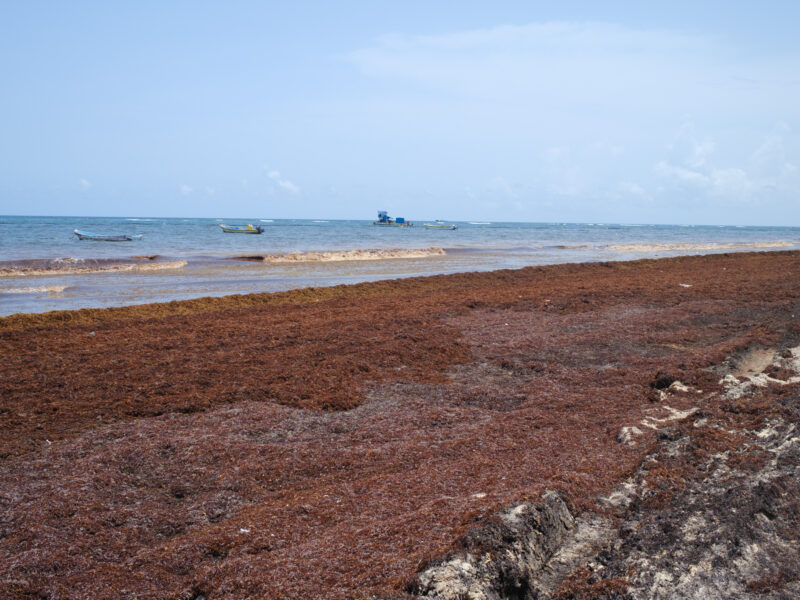
MEXICO CITY (CN) — On an early August afternoon at Playa Paraiso, Omar Camacho and other Playa Paraiso Beach Club staff loaded brown sargassum seaweed into wheelbarrows destined for dumpsters further up the beach. Playa Paraiso is in the Mexican Caribbean beach town of Tulum, Quintana Roo, in an area known as the Mayan Rivera. Only a couple years ago, Tulum was a bustling wellness-focused tourist destination known for its idyllic white sand beaches. It looks nearly abandoned in comparison today.“If we don’t clean it up in front our own hotel, the people won’t come and we die of hunger,” said Camacho, under the sun standing on a mound of sargassum as big as a school bus, pitchfork in hand. “We have beautiful beaches but with the sargassum it’s impossible to enjoy them.”Playa Paraiso Beach Club staff help with sargassum cleaning at Playa Paraiso, Tulum on Aug. 6, 2026. (William Savinar/ Courthouse News)Camacho, whose job description now includes daily cleaning efforts from 7 a.m. until around two in the afternoon, said the local government provides the dumpsters to dispose of the sargassum and sea barriers are in place to stop it before it reaches the shore.“The dumpsters are a big help. But here in Tulum, the barriers don’t work because of the current and the waves in this area — the seaweed goes right over them,” he said.A sargassum seaweed dumpster on Playa Paraiso, Tulum on August 6, 2026. (William Savinar/ Courthouse News)“This thing has turned into a monster,” said Stephen Leatherman, professor and director of the Laboratory for Coastal Research at Florida International University in a phone interview. ‘“I’ve never seen it this bad before.”Sargassum comes from the Great Atlantic Sargassum Belt, which spans from West Africa to the Gulf of Mexico. The Sargasso Sea is the floating macroalgae’s historical epicenter though levels of sargassum have been declining there since 2015. In June 2025, sargassum plumes in the tropical Atlantic reached record levels and continue hovering around those levels today.“One thing lawyers want to know is whose fault it is. Well, there’s no one they can sue in this case,” said Leatherman.Leatherman said that sargassum loves nutrients. He pointed to Brazilian government’s clearcutting of the rainforest for agricultural land as a theory for the massive levels of sargassum washing up onto Caribbean beaches.“They have to add a lot of fertilizer to get a yield, and a lot of that runs off into the Amazon River, which is one of the largest rivers in the world, if not the largest, and those nutrients are shooting out and hitting that offshore current and the amount of sargassum is just exploding,” said Leatherman.“You know, people say it’s global warming. Well, global warming’s only slowly increasing through time. This has been a dramatic increase. This stuff started in 2011 or something and there’s been a dramatic increase since that time,” he said. “It’s just everywhere.”On July 30, Mexican President Claudia Sheinbaum unveiled a $115 million plan to tackle Mexico’s sargassum seaweed crisis, spearheaded by the Mexican Navy.The plan includes acquiring two tugboats, six “sargaceros” — specialized vessels for sargassum collection in the water — more dynamic barriers that are typically used in oil spills and 31 miles of containment booms to eventually increase sargassum collection capacity to 4,000 tons daily.Courthouse News requested an interview with Mexican Navy personnel aiding in clean-up efforts on Playa Paraiso which was declined.A sargacero off the coast of Playa Paraiso, Tulum on Aug. 6, 2026. (William Savinar/ Courthouse News)Sargassum barriers off the coast of Playa Paraiso, Tulum on Aug. 6 employed by the Mexican Navy as part of the Mexican government's $115 million plan to tackle the sargassum crisis. (William Savinar/ Courthouse News)2026 has been an unprecedented year. Around 9,000 tons of the seaweed has been landing on Mexico’s Caribbean coast every day.In neighboring Playa Pescadores, small motorboats tied to their lines bounced up and down with the calm rhythm of the waves.Franco Chan, one of the small-boat operators has been working on this beach his whole life.“I’ve been at it over 40 years,” Chan said while resting in his boat stationed on the sand. He said on a normal day years ago he’d be buzzing around in the water taking tourists snorkeling or fishing. He blamed the lack of visitors on the sargassum but also on something else.“When they opened Jaguar Park two years ago, everything went down the drain,” he said.Chan explained that everything was free before the government turned the public beaches into a government-protected ecological zone called Jaguar Park. Initially, the entrance fee was $24 for foreigners and $15 for Mexicans.The park, in which the Mexican government invested nearly $139 million, was inaugurated in September 2024. The opening coincided with the Mexican military-operated Tulum Mayan Train station, inaugurated the same month.A feather-in-the cap for the Sheinbaum and preceding Andrés Manuel López Obrador administrations, the Mayan Train grants passengers access to cities in towns around the Yucatan Peninsula via a seven-section loop. The final stretch of train was completed in December 2024.On a July 17 trip to Tulum, Sheinbaum announced the “Tulum Reborn” federal initiative which made Jaguar Park access free for now after hotel occupancy hit a low 25%.Since the Tulum Reborn plan was put in place, Josefina Rodríguez Zamora reported in a press conference on Aug. 7 a 10% increase in tourism.Despite the free admission, a reservation sign-up is required for cars who are not already staying in luxury beach-front hotels located inside Jaguar Park.Other hotels are located inside Tulum’s downtown area, a little more than an hour walk from any beaches. Small buses and taxis are available but the powerful Tulum taxi union Tiburones del Caribe have been embroiled in their own drama that include excessive fares, extortion and murder.“The government said they’d never privatize the beaches. But it didn’t take long before it was privatized. Now getting to the beach is really complicated,” said Chan. “That’s why people don’t come here anymore. Everything is expensive.”A young man who worked with Chan overheard his comments and pulled out a 20 peso bill from his pocket, worth a little more than a dollar.“This is how much I’ve made in two weeks, man,” he said, holding up the bill.The majority of tourists on the beach that day—no more than two dozen total— were lounging on beach chairs in front of their hotels. The rotten smell of seaweed wafted by.Empty beach lounge chairs at Playa Paraiso, Tulum on August 6, 2026. (William Savinar/ Courthouse News)Ian and Griselda Gonzalez, a teenage son and his mother visiting from the Los Angeles area, walked down the beach chatting and complaining about the smell. The two had planned a tour in one of the small boats but canceled because of the sargassum.“The guy was selling the tour didn’t tell us about that stuff,” said Griselda, referring to the mounds of brown seaweed. “And then I saw these two people coming out all wet and and the girl’s dress was all brown, and I imagine she’s going to be walking around all smelly so we were like ‘OK, ya know what, let’s just go.’”“We just paid 30-something dollars for nothing, but it’s okay,” she said.A small fishing boat docked on the beach in Playa Pescadores, Tulum. on Aug. 6, 2026. (William Savinar/ Courthouse News)Back in town, Bertoldo Pol Cocón sat in front of his handicrafts shop on Tulum’s main drag, Tulum Avenue. It’s been a slow season for him in Tulum, what he called one of Mexico’s crown jewels and where he has been living and working for 15 years.“But they killed it,” said Pol Cocón, referring to the local and state governments. Local, state and federal authorities did not respond to requests for comment, including those in the Secretariat of Tourism and Quintana Roo Secretariat of Ecology and Environment.Pol Cocón pointed to unsustainable rapid development at the cost of some of Tulum’s natural areas as one of the factors, creating a real estate bubble that burst.In June 2026, environmental organizations denounced the construction of a new 10-mile highway through untouched jungle. The groups said the only purpose of the highway is to “spark a real estate boom.”Between 2010 and 2020, the population of Tulum increased by 65.3%.“What an irony, because they were building the hotels to attract more people, attract tourism, but it turned out the opposite,” he said. “The president herself had to come so they’d let us onto our own beaches — because even we were being charged. That cultural heritage has now been returned to us, the beach belongs to the Mexican people, they can’t charge us to enter. It was the only beach in the country where we had to pay to go to our own beach.”Pol Cocón called Jaguar Park “a museum” that privatized the beach.“Since they invested a lot of money, they wanted to recoup it quickly; but because they were charging admission, a lot of people stopped coming. People stopped coming here for two years. Only now are they starting to come back a bit,” he said, watching some tourists walk by while a restaurant waiter showed them a menu.“The avenue used to be completely full of tourists. Now even the rent is hard to pay. And then the electricity bills too. It all just piles up and turns into ticking time bomb,” said Pol Cocón.Subscribe to our free newslettersOur weekly newsletter Closing Arguments offers the latest about ongoing trials, major litigation and rulings in courthouses around the U.S. and the world, while the monthly Under the Lights dishes the legal dirt from Hollywood, sports, Big Tech and the arts.Additional Reads
Sargassum seaweed piles onto struggling Tulum tourism industry
Full Article
Original Source
Read the full article at Courthousenews →KhanList aggregates and links to publicly available news content. We do not host full articles from third-party sources. Always verify important information with original sources.