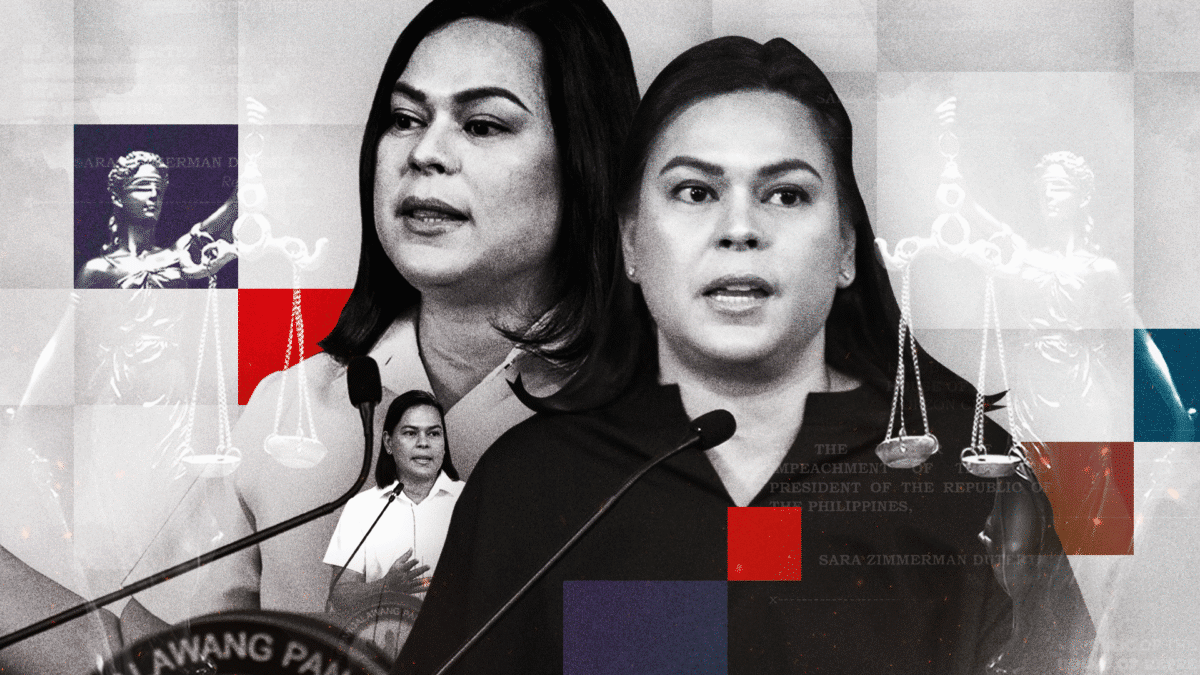
More than a year after the House of Representatives first impeached the country’s second-highest official, Vice President Sara Duterte is now facing trial before the Senate impeachment court. At a glance Duterte, the first Philippine official to be impeached twice, is facing trial that commenced on July 6. After being impeached by the House of Representatives on May 11 for the second time, Duterte faces four Articles of Impeachment. The Senate has approved 92 trial days for the proceedings. The Articles of Impeachment accuse Duterte of the following: Article I: Alleged misuse of P612.5 million in confidential funds from the Office of the Vice President, or P500 million, and the Department of Education, or DepEd, amounting to P112.5 million. Article II: Alleged unexplained wealth, failure to truthfully disclose assets in Statements of Assets, Liabilities and Net Worth, or SALNs, from 2022 to 2024, and failure to divest and willful continued business interests. Article III: Alleged bribery and procurement irregularities involving DepEd officials. Article IV: Alleged assassination threats against President Ferdinand Marcos Jr., first lady Liza Araneta-Marcos and former House Speaker Martin Romualdez. Under the Constitution, conviction requires the vote of at least two-thirds of all senator-judges. If convicted, Duterte faces possible removal from office and perpetual disqualification from holding any public office. Timeline: How we got here In July 2023, the Commission on Audit, or COA, flagged the Office of the Vice President’s use of P125 million in confidential funds, which was fully spent within 11 days in late 2022. In December 2024, three impeachment complaints were filed against Duterte. In February 2025, Duterte was impeached for the first time through the fast-track method, with 215 lawmakers voting to impeach her. In June 2025, the Senate convened as an impeachment court, with Sen. Chiz Escudero as the presiding officer. In July 2025, the Supreme Court unanimously declared the impeachment complaint against Duterte unconstitutional, stopping the Senate trial. The court ruled that the House violated the Constitution’s one-year bar rule by acting on multiple impeachment complaints filed within a year, making the Articles of Impeachment invalid. In August 2025, the Senate voted to archive the impeachment case against Duterte. From January to February 2026, four new impeachment complaints against Duterte were filed. They cited grounds for impeachment almost similar to the three filed a year earlier, but this time included the affidavit of Ramil Madriaga, Duterte’s alleged former aide who identified himself as her bagman. In February 2026, the House transmitted the Duterte complaints to the House committee on justice. In March 2026, the two remaining impeachment complaints against Duterte were found sufficient in substance and sufficient in grounds. In April 2026, the House justice committee conducted clarificatory hearings and invited several resource speakers. The panel obtained Anti-Money Laundering Council reports showing P6.7 billion worth of covered and suspicious transactions, a sealed Bureau of Internal Revenue box, and Duterte’s SALNs that declared no cash from 2019 to 2024, among other records and testimonies presented before the panel. The House panel later found probable cause to impeach Duterte. On May 11, 2026, the House of Representatives impeached Duterte for a second time, with 257 lawmakers approving the Articles of Impeachment for Senate trial. On May 14, 2026, the House of Representatives formally transmitted the Articles of Impeachment against Duterte to the Senate, paving the way for her impeachment trial. On May 18, 2026, the Senate formally convened as an impeachment court and senator-judges took their oaths, marking the start of impeachment proceedings against Duterte before the trial proper. On June 25, 2026, the Senate’s pretrial conference wrapped up on its fifth day after a three-day extension due to the volume of documents from both the prosecution and defense panels that had to be manually premarked. The process was intended to streamline the trial proper by eliminating the need to mark documents during the proceedings. What is happening now Since July 6, the Senate, sitting as an impeachment court, convenes thrice a week, with proceedings beginning at 2 p.m. Although the Articles of Impeachment are numbered I to IV, the House prosecution is presenting its case in a different sequence, as adopted by the Senate impeachment court in its Pre-Trial Order. The prosecution began with Article IV, which covers allegations that the vice president threatened Marcos Jr., his wife and the former speaker, as well as allegations of inciting sedition. It will then proceed to Article I, which centers on the alleged misuse and misappropriation of confidential funds, followed by Article III, which involves alleged bribery and procurement irregularities during Duterte’s tenure at the Department of Education. The prosecution will conclude with Article II, which deals with allegations of unexplained wealth, false Statements of Assets, Liabilities and Net Worth (SALNs), and continued business interests. The Senate, is expected to hear testimony from dozens of witnesses from both the prosecution and defense teams over the coming months before senator-judges vote on whether to convict or acquit the vice president. Key issues to watch out for during the impeachment trial The BIR box One of the first procedural disputes before the Senate impeachment court involves the so-called “BIR Green Box,” which purportedly contains the tax records of Duterte, her husband, lawyer Manases Carpio, and their companies. The Bureau of Internal Revenue, or BIR, submitted the box during the House impeachment proceedings in response to a subpoena. However, lawmakers did not open it after a motion to inspect its contents failed. Instead, the House transmitted the sealed box to the Senate together with the Articles of Impeachment. The prosecution has since requested the court to issue a subpoena on this, along with other relevant documents such as Duterte’s bank records. The tax records of the vice president, her husband Manases Carpio, and their businesses are among the evidence that the prosecution seeks to present in relation to Article II of the Articles of Impeachment, which accuses Duterte of amassing unexplained wealth disproportionate to her lawful income and failing to truthfully disclose her assets, liabilities and net worth. GRAPHIC: Ed Lustan/INQUIRER.net Conviction threshold Under Article XI, Section 3 of the 1987 Constitution, conviction of an impeached official requires the vote of two-thirds of all members of the Senate. With all 24 senators sitting as judges, this means 16 votes are needed for conviction. If fewer than 16 senator-judges vote to convict, Duterte will be acquitted and remain in office. However, questions have emerged over whether the threshold could change if some senator-judges become unable to participate, following the detention of Sen. Jinggoy Estrada, the continued absence of Sen. Ronald dela Rosa as he remains in hiding over an International Criminal Court arrest warrant, and the recent arrest and detention of Sen. Rodante Marcoleta following the filing of plunder case against him. House lead prosecutor Rep. Gerville Luistro has floated applying the Avelino v. Cuenco doctrine, which was used during one of the Senate’s leadership shake-ups. This could reduce the required votes if certain senators are no longer within the Senate’s coercive power. Before becoming Senate president, Sherwin Gatchalian said the Avelino doctrine may justify the Senate’s quorum during legislative sessions but does not necessarily apply to the impeachment court, maintaining that 16 votes are still needed to convict. A Senate minority bloc led by Sen. Alan Peter Cayetano, who was ousted in the June 3 shake-up, has asked the Supreme Court to clarify the validity of the June 3 Senate session and interpret how the constitutional phrase “all its members” should be applied in computing quorum and voting requirements. However, Sen. Chiz Escudero, who was elected as the presiding officer on July 6, affirmed that the conviction threshold of 16 or ⅔ of all members of the Senate stands. Will Duterte attend the trial? Duterte’s personal attendance at the impeachment trial remains one of the proceedings’ biggest question marks. The House prosecution has repeatedly urged Duterte to appear before the Senate impeachment court, arguing that her presence would demonstrate the seriousness with which she is addressing the allegations against her. Prosecutors have also said it would send a strong message to the public that she is prepared to confront the charges directly. Before the trial opened, the impeachment court issued a notice requiring Duterte to appear either personally or through her legal counsel. During the first week of the proceedings, Duterte showed up at Senate building to meet with her defense team but left before the session began. Before departing, she told reporters, “In this bloodbath and bludgeoning, I will be bloodied but unbowed,” an apparent reference to her earlier remark in May 2025 that she wanted the impeachment trial to proceed because she wanted a “bloodbath.” Asked regarding Duterte’s attendance, the defense team said that in this stage of the trial, she has no participation just yet but there is always a possibility that she will come as a spectator. The Senate Secretariat said it keeps a holding room ready for Duterte, as they remain open to the possibility that she arrives anytime as the respondent of the ongoing trial. If she attends, she will be given a seat in the VIP gallery as she is VIP. /dm/dp
Sara Duterte Impeachment Trial: Everything you need to know
Full Article
Original Source
Read the full article at Newsinfo →KhanList aggregates and links to publicly available news content. We do not host full articles from third-party sources. Always verify important information with original sources.