
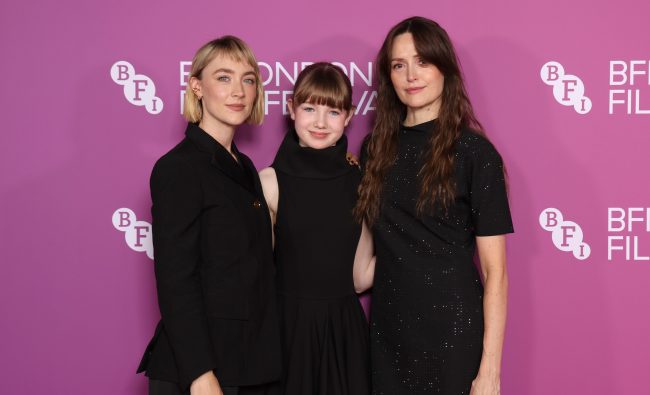
Like all great directors, Saoirse Ronan has the multitasking thing down pat. Earlier this week, IndieWire exclusively spoke with Ronan as she was walking around London during a particularly “crazy busy” time in her life (yes, we asked about Sam Mendes’ Beatles films, and Ronan could only smile and note that she couldn’t share a thing about them at this moment). Headphones on, jacket collar up, Ronan was getting her steps in while also talking about something she’s wanted to do for a very long time: direct a film. Earlier this month, Ronan’s “Paper Plane” won Best Narrative Short at the Austin Film Festival after debuting at Venice earlier in the season. Any win is nice, but a win at an Oscar-qualifying festival like Austin comes with an added sweetener: The film is instantly eligible for Oscar consideration for the 2027 ceremony. Jumping behind the camera is something Ronan has wanted to do for years, and her first offering (which she also wrote) is exquisite. The 15-minute short film stars rising young actress Martha Malone as Fay, alongside Clare Dunne as Mam and Tim Creed as Dad. When we first meet Fay, she’s launched a silent protest, announcing to her mother (via a titular paper plane message) that she will not return to their home until her father, who we instantly understand is a toxic presence, leaves for good. As Fay and her trusty dog sit it out in a grassy lot across the street from the family home, Ronan’s film unfolds with grace and honesty, ending on a heart-stopping note. Ronan also gathered an impressive roster behind the camera, including producer Shirin Eren, who previously produced Ronan’s “The Outrun,” IFTA-winning editor Nathan Nugent, and Kate McCullough, all of whom she describes in sparkling terms. You can get a taste of the film’s tone, visual style, and wonderful performances in an exclusive clip below. Ahead, Ronan goes deep on her process, why she felt the need to make the jump to directing now (thanks to her “Little Women” co-star Eliza Scanlen), emulating her favorite collaborators like Greta Gerwig and Joe Wright, the one thing about directing that really surprised her, and if she’s ready to make the jump to directing features. The following interview has been edited and condensed for clarity and length. IndieWire: When we spoke in 2024 for “The Outrun,” you told me that you had wanted to direct since you were a child. Why was this the right project and the right moment? Saoirse Ronan: I think it was a number of things. It was where I was at in my personal life. I was definitely starting to move into the next stage of adulthood. It felt like a shift was taking place for me internally. I was married, becoming a parent. Change was on the horizon. And I think it felt, to be honest, if I don’t do it now, who knows when I’ll do it. I also wonder how many mothers in particular feel that way before they go into that next stage of their life where they’re like, “Actually, this is all quite unknown, and I don’t know if I don’t do it now, will it be another 10 years before I can find the time or the space within myself to do something like that that’s for me?” So it really gave me a lot of motivation being in that place personally. It’s something that I’ve always wanted to do. I was always drawn toward directing, even from before I became an actor. And I’ve been so hugely influenced by the directors I’ve worked with since the age of 10. I guess I was ready to put that into action, and it was always going to be something that involved a young person and a mother, probably. It just felt very serendipitous that it happened when it did. So felt like everything was aligning at that point. ‘Paper Plane’ You also wrote this script. What was your writing process like? What surprised you about that? Maybe it’s different with journalism, although I’m sure it must be incredibly difficult in other ways, but writing’s just really hard. And I knew it would be, but to conjure up something out of nothing supposedly is mind-boggling. I guess I didn’t realize how much of it is about process. As the Italians say, piano, piano, little by little, you take a step forward, and you take two steps back. I’d never been in that position creatively and professionally where it was all on me, so to find the discipline to do that, sit down, and to go, “OK, well, it’s not going to happen if I don’t make it happen,” was a new challenge for me. I was so lucky to have Shirin Eren, my producer and my partner, Jack [Lowden], and lots of close friends who had already taken that step. Brilliant actor Eliza Scanlen, who’s already done three shorts, and she’s so much younger than I am, has actually been a huge inspiration to me. And I just thought, well, Jesus, if Eliza’s doing it, I have no excuse. What I’ve learned is, when it comes to doing a feature, I’d definitely love to work with a writer, because I’m not one, and I think there’s a lot I have to learn. This was incredibly personal, so it was coming from such a pure place that it had to come from me, and it had to be written by me. But I certainly am excited by the challenge of working with someone who actually does it for a living and to learn about how to structure something and add art and things like that. In the film’s press notes, it says that this is “a love letter to your younger self.” What was the most important thing that had to be in there for you, in terms of the script or the visuals or the casting? There were two things that were very important to me. One was, tonally, I kept circling back to the magical realism route. I wanted it only ever to feel like we were seeing this through a child’s eyes, and in the way that a child makes sense out of the nonsensical and the seemingly impossible and the incredibly difficult thing to fathom and to swallow and to digest and to overcome. Creativity and imagination always plays a part for a child and just making sense out of anything in the world from day dot, from the moment that they’re here. I didn’t want it to feel like a fantasy, but I wanted it to feel like it was heightened in some way, hence the addition of the paper planes, which was something I used to do with my mom. I used to send her little paper planes when she’d send me to my room with a little note saying, “I’m really sorry that I did this. Please don’t hate me. Please don’t send me back,” or whatever. And I’d peek around the corner of whatever room she was in, I’d throw it at her, and then I’d run back to my room knowing logically she’d know it was me, but tricking myself into believing that she’d believed that this had seemingly come out of nowhere. It was also very important to me that the father role was never vilified. I didn’t want this to be a piece that was overly black and white and critical when it comes to the situation. I didn’t want to just point the blame at one character. Although there’s clearly something very toxic and dark within the home that’s happening, and it’s ultimately being created by one member of the family for the most part, there’s a reason why this person unfortunately feels the need within themselves to create that toxicity. I never wanted it to feel like there was any hatred or anger toward that character. It needed to very much be focused on the love of these two girls. Becoming a mother, I really felt with myself that you don’t ever stop being a child. You can say that we become more sophisticated, but I actually don’t know how much we do. And I think to have a character that’s an older female, an older person, and someone who’s younger, but who essentially both remind each other of their inner child, I wanted to bring that out too. ‘Paper Plane’ You’ve worked with so many incredible filmmakers over the course of your career. Was there any filmmaker you really wanted to emulate in terms of how you ran your set? Oh gosh, how I ran my set! It’s a combination of a few people. I think back in the day, the way Joe Wright ran his set was fantastic. The way he was on the ground with his crew, the clarity that he had at the top of the day, the structure he had when it came to planning, I’ve always responded really well to that. I think I was really influenced by that from working with him so early on. The fact that he and Peter Jackson as well always played music live on set, I’ve always felt like that’s a really helpful way to remind cast and crew that, yes, there’s emotional truth in this, but for me, I want to make movies, I want to make films. They’re not documentaries, so there needs to be this heightened quality to it. I feel like having music on set can remind people of that and just get everyone on the same rhythm. I think the way Greta [Gerwig] is just Greta and John Crowley, the way they are as directors with their actors, I haven’t marched with anyone greater than those two. They bring out something that I haven’t experienced with anyone else, really, and I’ll always strive to be a tenth to what they are as a director. One thing that Greta said is that you need to think of yourself as the most supportive audience member for your actors. She always makes you feel so loved and interesting and wanted, and so I wanted the actors to feel that way. And to be honest, weirdly, out of every kind of hat that I had to wear as director, directing the actors was the thing that made me the most nervous. Everything else, I was all right, but it felt really natural. But to actually be in the driving seat with other actors and to guide them, I was really, really nervous about that and constantly feeling like, God, I can’t let them down. I can’t steer them wrong. I always want them to feel safe, and they can do whatever they want to do. Was that the most surprising thing for you? Yes, that really did surprise me. I wasn’t expecting that, but actually when I think about it and when I think about the kind of actor that I am, it does make sense, because I’m not one of those actors ever that’s like, “Don’t worry, I’ll take control of the room.” Maybe I’ve started to do that more as I’ve gotten older, but we all know plenty of actors that will start giving other actors notes, which is never helpful. Well, sometimes it is actually, maybe that’s not true, but I haven’t been that kind of actor. So that definitely took me by surprise just how self-conscious I was initially. But I think they were happy. The girls said that they felt good, so that’s all I can ask for really. In our interview for “The Outrun,” we talked about process, and your process is so internal and personal. It’s about being in the moment. You’re not Method. You don’t get caught up in stuff, so I did wonder how that would translate to directing. It was funny actually because that seemed to translate well. I think because of the way I work, it’s so much about working with the crew and enjoying the atmosphere on set, and it feels so natural for me to be there, so I felt really confident doing that. I’ve been on so many sets where I’ve looked at directors or producers who don’t quite know how to talk to their crew, don’t quite know what the crew needs, and how to wrangle the truth, how to make them feel appreciated and motivated. I feel like I know how to do that. I’ve been on so many sets and grown up with it, and more than anyone else, I spend time with the crew, and I hear what irks them, what their complaints are, what drives them forward, what they appreciate from a director, from a leader. So I knew what to do in that sense, I think, I hope. I loved working with my first AD. I loved working on the schedule with her. I loved being able to work so in-depth with a production designer. Actors never get to do that kind of stuff. I don’t think being a director is necessarily the hardest job out of every crew member. I think that the skill of being a director is to surround yourself with really, really, really brilliant people who know what they’re doing and to have good taste. Watch an exclusive clip from “Paper Plane” below. It sounds like it was pretty joyous for you to assemble your crew. I think what every director will tell you, which I now know, is that making a short film is fucking really hard and frustrating, because crew need to go and work on a film that will actually pay the money and will keep them employed for two, three months, and a short film is not going to do that. So actually being able to get the crew that you want can be really, really difficult, but it does mean that the people who do come on board are there because they really want to be. It’s not because they’re getting paid. It’s not because it’s necessarily going to further their career or anything like that. It’s just, they’re doing it because they want it, because they love what they do, and they want to get their energy in the story. They were there because they wanted to invest themselves in the story, and they also wanted to support me, which was just so lovely. You’re someone who started acting at a young age, so I find it very interesting and compelling that you centered your film around a young star. How did you make sure Martha felt safe and comfortable and supported? I knew that on day one, Martha was going to be super nervous. She was 14, 15 at the time, and she’d done a few things, but I think whenever any of us have our first day on set, no matter how experienced we are, we’re always scared. I just wanted her to know that I was too, that I was nervous as well, and that we were going to be nervous together, and it was OK, and we were going to take care of each other. I have the utmost respect for young performers, and I think that when you find ones that are disciplined as well as being talented, you just need to make them feel like they’re never pressured, they’re supported, but they’re being pushed. You’re not necessarily wrapping them in cotton wool, but you want them to feel loved. I wanted her and Claire to feel loved and wanted because they were, and that ultimately I would have to guide us because somebody does, but that there was a contribution they were going to be able to make as performers that I couldn’t, and I valued that. You mentioned if you make a feature, you want to work with another writer. The inevitable question: Do you want to direct a feature? Yeah, I do. I do want to do a feature, and I think part of the reason why I was making shorts is because I wanted to see if I could, and if I could, then what was my style, and what did I respond to, and what did I need to work on, and what were my strengths, so that I didn’t use everyone as my training ground on a feature film. Again, I’ve been on the other side of that as well, where you’ve got someone in the driving seat, and you’re like, “Uh-oh.” I didn’t want to put anyone else in that position. I didn’t want to put myself in that position. I loved it so much, and I do have a lot to learn. I really want to keep going with it. So I would love to do a feature. I have a rough idea of what I want to do, but I know now that that can be the starting point and that it will become what it’s meant to become.
Saoirse Ronan Has Wanted to Direct Since She Was a Kid, and Her Exquisite First Short ‘Paper Plane’ Proves She’s Got the Goods
Full Article
Original Source
Read the full article at Indiewire →KhanList aggregates and links to publicly available news content. We do not host full articles from third-party sources. Always verify important information with original sources.