
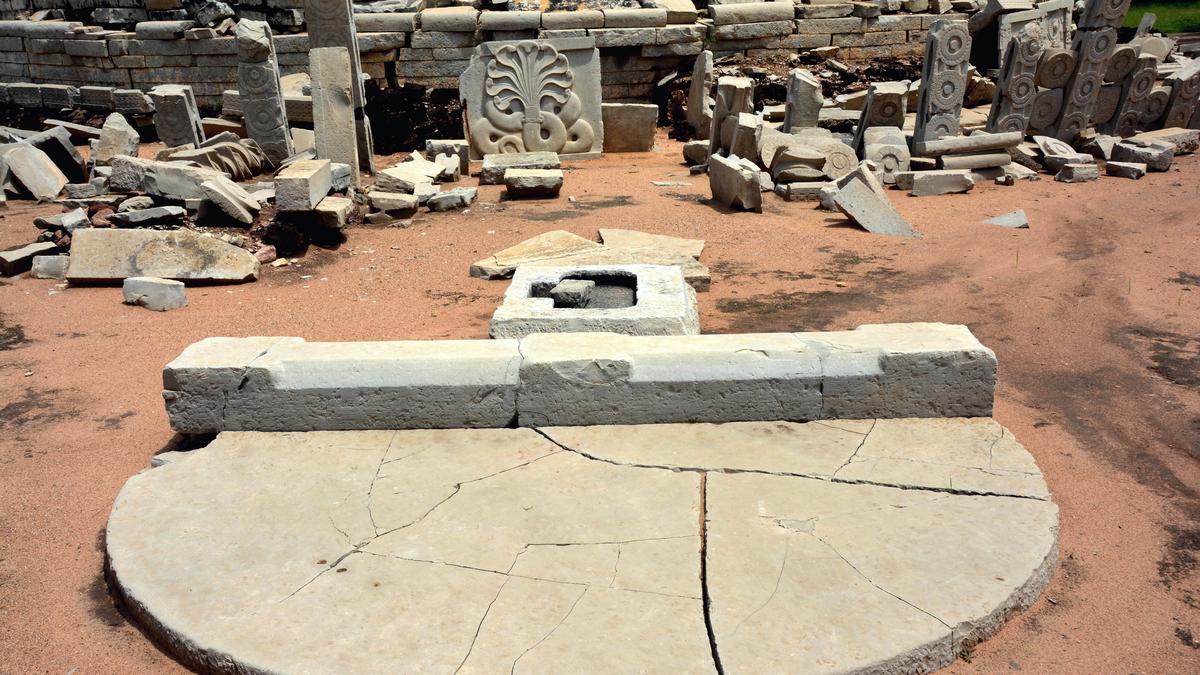
The ancient Buddhist heritage site of Sannati in Chittapur taluk of Kalaburagi district could soon receive a major institutional and infrastructural boost, with the Cabinet approving the Sannati Development Authority Bill, 2026, recently to facilitate its transformation into an international heritage, cultural and tourism destination.Expected to be introduced in the Winter Session of the legislature, it aims to provide a statutory framework for the conservation and development of Sannati and the neighbouring Kanaganahalli archaeological site, which together represent one of the most significant centres of Buddhist civilisation in the Deccan.Home Minister and Kalaburagi In-charge Minister Priyank Kharge, under whose Assembly constituency of Chittapur the site falls, said the authority, announced in the 2025-26 Budget, will play a significant role in preserving Sannati’s rich heritage, promoting local development and boosting tourism.What the Bill proposesThe authority will be chaired by the Kalaburagi district in-charge Minister, with the Minister for Minority Welfare as its co-chairperson and Ministers from departments concerned, legislators, senior government officials and representatives of local bodies as its members.The authority will prepare a comprehensive development plan and submit it to the government for approval.Prior approval of the authority will be mandatory for development activities within its notified area to prevent unregulated construction. The Bill also provides for land acquisition to facilitate development projects. The sculpture-portrait of Ashoka with his queens at Kanaganahalli ASI site on the bank of the Bhima in Chittapur taluk of Kalaburagi district. | Photo Credit: KUMAR BURADIKATTI Archaeological treasureSannati’s global archaeological significance came to light in 1986, when a natural calamity partially destroyed the Chandralamba temple complex in the village. While replacing the damaged idol, villagers found letters etched on the pedestal (panipeetha) of the idol. Epigraphists deciphered the text as a 2,000-year-old Ashokan edict in Prakrit and the Brahmi script.The inscription led archaeologists to an abandoned well-like depression at Kanaganahalli village, about 3 km from the temple, on the bank of the Bhima. The Archaeological Survey of India (ASI) began excavations in 1994. The four-year exercise unearthed the remains of the Adholoka Maha Chaitya, or the Great Stupa of the Netherworlds, believed to have been developed during the Mauryan and the Satavahana periods between the third century BC and the third century AD.One of the most remarkable discoveries was a stone sculpture depicting Mauryan Emperor Ashoka surrounded by his queens and female attendants. The inscription ‘Raya Asoko’ (King Ashoka) in Brahmi script established the identity of the emperor. It is widely regarded as the only surviving sculptural portrait of Ashoka identified by an inscription bearing his name. The excavated items in an open area at Kanaganahalli ASI site on the bank of the Bhima in Chittapur taluk of Kalaburagi district. | Photo Credit: KUMAR BURADIKATTI The excavations also yielded around 60 dome slabs depicting Jataka stories and episodes from the life of Buddha, 72 decorated drum slabs, Buddha sculptures and footprints, fragments of Ayaka pillars and nearly 250 Brahmi inscriptions. These remains provide valuable evidence of the spread of Buddhism in the Deccan.Conservation challengesDespite the international archaeological significance of the discoveries, the site faced years of neglect.The Karnataka government had earlier constituted Sannati Development Board in 2006 to conserve antiquities and develop the area. However, the initiative failed to take off. A museum built near the excavated monument at a cost of ₹3.52 crore in 2009 is not handed over to the ASI even 17 years after their construction. The structures developed cracks, while the premises was gradually overrun by weeds.The ASI initiated a restoration project estimated at ₹3.5 crore in July, 2022, to reassemble the remains of the Maha Stupa. The project involved documentation, condition mapping and the use of LiDAR technology to determine the original dimensions and positioning of the structure.Potential for international tourismSannati has the potential to become an important destination on India’s Buddhist tourism circuit. However, it would require coordinated efforts by the State government and the ASI to ensure conservation, improved connectivity, accommodation, museum facilities, research infrastructure and visitor amenities. The possibility of pursuing UNESCO World Heritage recognition could also be explored through the prescribed processes. Inscriptions in Prakrit language using the Brahmi script on the Panipeetha, the base slab, of the Kali idol of Chandralamba temple. | Photo Credit: KUMAR BURADIKATTI The proposed authority is expected to provide a coordinated institutional mechanism for these efforts. Its success, however, will depend on sustained funding, scientific conservation and time-bound development works.
Sannati set for a heritage makeover as Karnataka Cabinet clears development authority Bill
Full Article
Original Source
Read the full article at Thehindu →KhanList aggregates and links to publicly available news content. We do not host full articles from third-party sources. Always verify important information with original sources.