
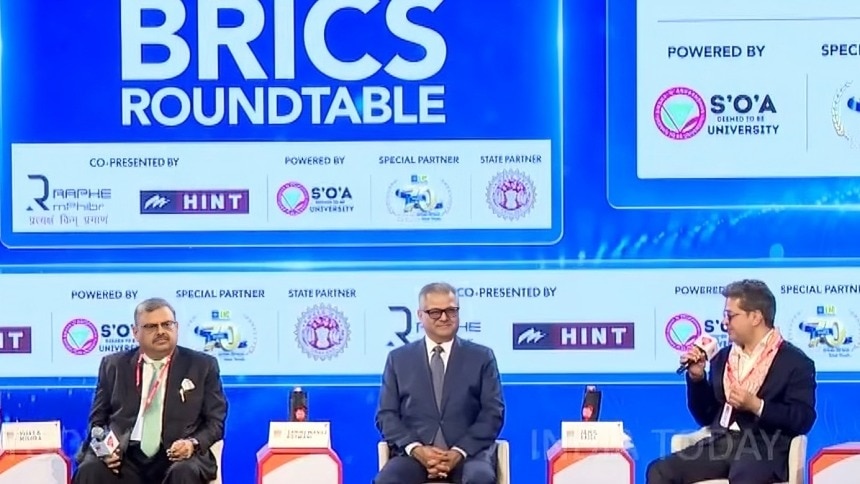
Businessmen and industrialists said sanctions may create additional compliance and logistical challenges for businesses, but they do not necessarily stop commercial activity.Sanctions seen as hurdles, not blockers, by Indian businessmen. “Sanctions are a joke,” said Sammy Manoj Kotwani, an Indian businessman based in Russia, while explaining how companies continue to find ways to trade and operate in economies facing restrictions from the US and Europe.Speaking at the India Today BRICS Roundtable on the session “India’s Businesses in Sanctioned Economies”, Kotwani said sanctions may create additional compliance and logistical challenges for businesses, but they do not necessarily stop commercial activity.“Let me start by saying for me as a businessman sanctions is like a joke,” Kotwani said, citing the example of India-Pakistan trade. He argued that even when direct trade is restricted, products can continue to reach consumers through third countries.Kotwani was specifically referring to unilateral sanctions imposed by countries such as the US and European nations, rather than UN sanctions. He said that from a business perspective, companies have to look at how to navigate the restrictions rather than simply abandon markets.‘SANCTIONS CHANGE HOW TRADE IS DONE’The practical impact of sanctions was explained by Jameel Saidi, Industrialist who has business interests in Iran and other West Asian markets. “Sanctions do not stop trade. It just changes how the trade is done,” Saidi said.According to him, sanctions primarily alter the mechanics of doing business — from banking and logistics to insurance and documentation. He cited instances where oil trade has continued through different documentation and trading arrangements despite restrictions.For Indian companies, the challenge is therefore not simply whether trade is possible, but whether businesses can manage the additional risks and costs involved.Saidi also argued that India should not automatically follow unilateral US sanctions when they are not backed by the United Nations. He recalled former foreign minister Sushma Swaraj saying that India did not recognise unilateral sanctions, while making a distinction between such measures and sanctions imposed through the UN framework.RUSSIA OPPORTUNITY LIES IN JOINT MANUFACTURINGKotwani said the nature of India's business opportunity in Russia has also changed.According to him, simply exporting finished products from India to Russia is no longer the most viable approach. Instead, Indian companies should look at joint manufacturing and local production, allowing them to serve Russia as well as the wider Commonwealth of Independent States market.“Today nothing can be sold from India to Russia except spices, tea and coffee,” Kotwani said, arguing that Indian companies need to change their approach and manufacture locally.He said the same logic applies in the other direction, with Russian companies needing to establish manufacturing operations in India rather than relying solely on exports.Kotwani said Indian businesses looking at Russia should also look beyond the country itself and consider the wider CIS market, which he described as having more than 300 million people.BRICS CAN HELP BUILD ALTERNATIVE TRADE ROUTESThe discussion also turned to how BRICS could help businesses navigate a world where sanctions and geopolitical tensions are increasingly affecting trade.Saidi said India has an opportunity through its BRICS presidency to create alternative channels for trade with countries such as Iran. He suggested mechanisms including trade in Indian rupees and barter arrangements, arguing that demand for goods does not disappear because of sanctions.“BRICS should not be just a block of bricks, it should be a bridge,” Saidi said, arguing that India could use its relationships with different sides of the geopolitical divide to build economic bridges.He also stressed that sanctions often end up hurting ordinary people rather than those directly involved in conflicts, pointing to restrictions on civilian airlines and the wider impact of sanctions on food, medicine, labour and trade.INDIA’S BRICS ROLEThe speakers said India's position as a country with relationships across Russia, Iran, the West and other emerging economies gives it an opportunity to help build alternative trade and investment channels.Kotwani argued that Indian businesses should respond to geopolitical fragmentation by building trusted partnerships and localising production rather than withdrawing from difficult markets.Saidi, meanwhile, called for India to use its diplomatic goodwill to push for greater economic connectivity and peace.The discussion comes as India hosts the 18th BRICS Summit in New Delhi in September 2026, with India holding the BRICS chairship this year. India's BRICS agenda has emphasised resilience, innovation, cooperation and sustainability, with economic and financial cooperation among the grouping's core areas.- EndsPublished On: Sep 10, 2026 14:55 IST
Sanctions are a joke: Businessman on how trade continues with sanctioned economies
Full Article
Original Source
Read the full article at Indiatoday →KhanList aggregates and links to publicly available news content. We do not host full articles from third-party sources. Always verify important information with original sources.