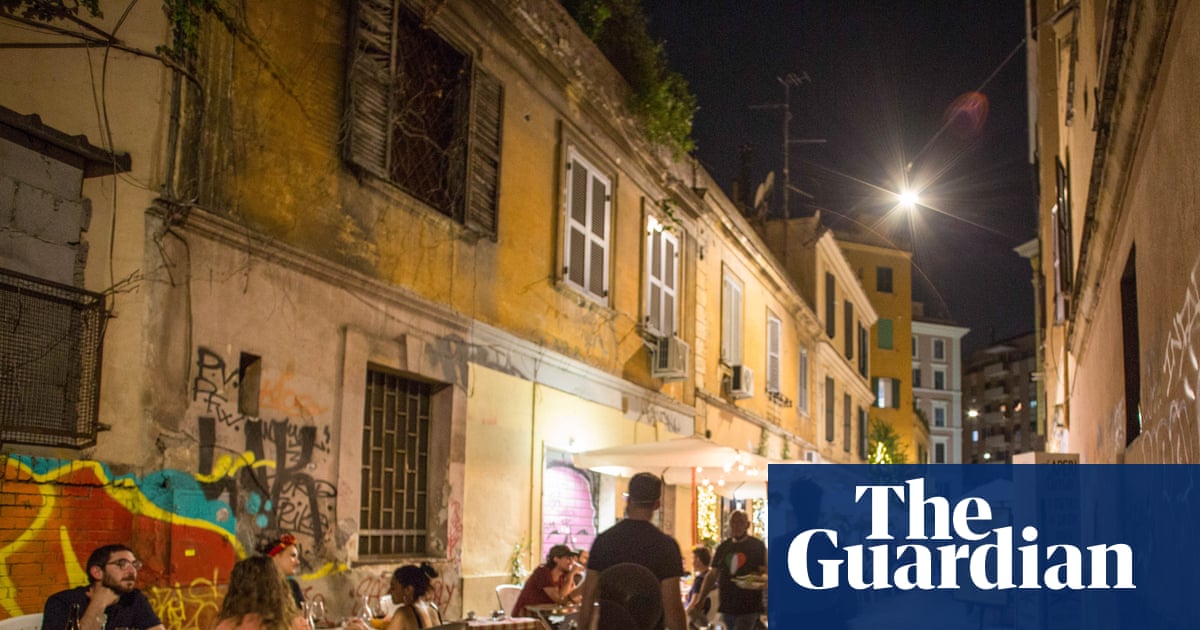
Why go now?One of Europe’s hotspots, central Rome has increasingly come to resemble a tube station during rush hour: stifling, overpacked and claustrophobia-inducing. Last year, the Eternal City welcomed a record number of tourists, driven in part by the 2025 Vatican Jubilee - 22.9 million arrivals stayed in the city, almost 10 times the number of residents.There is no sign of the great tourist boom slowing down, either, with local sources indicating that 2026 could steal the crown from 2025.Yet while holidaymakers stream out of Rome’s main railway station, Termini, making a beeline towards the Colosseum, the Roman Forum and Piazza Venezia, few realise that a 20-minute walk in the opposite direction leads to one of Rome’s most overlooked quarters: San Lorenzo.La Sapienza is one of the world’s oldest universities. It was founded in 1303. Photograph: Peter Spiro/Getty ImagesBuilt in the late 19th century for the working-class community, San Lorenzo carries more modern historical weight than many of its city-centre counterparts. During Benito Mussolini’s rise to power, both local residents (sanlorenzini) and the Arditi del Popolo (AdP) – an anti-fascist military group – were involved in acts of resistance.During the little-documented 1922 battle of San Lorenzo, members of the AdP resisted squadrist incursions into the neighbourhood, forcing them to retreat under gunfire. Five months later, during the March on Rome, barricades were erected to prevent the blackshirts from entering the area. Though 13 people were killed in the unrest, fascist forces never fully controlled the neighbourhood. It became known as the red zone, symbolising its leftwing politics.Tragedy struck again towards the end of the second world war, when allied bombing destroyed swathes of the area and killed about 1,500 sanlorenzini.Today, the living situation in this counterculture quarter is a lot less combative. Students from nearby La Sapienza University mingle with artists, creatives and longtime residents who have remained rooted in their working-class, leftwing identity. Although it has had a cash injection, and clubhouse chains Soho House and Social Hub have opened their doors, the neighbourhood has retained much of the character that sets it apart from Rome’s increasingly crowded centre.Where to eat and drinkSan Lorenzo is known for its non-touristy eating and drinking spots. Photograph: Bloomberg/Getty ImagesSticky menus with photos of food on them are thankfully few and far between, as are plates of carbonara for more than €10. The district’s Pizzeria Formula 1 is a rite of passage for those living in the area. The no-frills spot has served up Roman-style thin-crust pizza since 1978, specialising in classic toppings such as margherita. Its interior matches what is served: a wood-lined room with white ceilings that looks like it hasn’t been touched since its opening. Both old and young come for meals that rarely stretch beyond €10 per head.A few minutes away is Osteria da Marcello, a family-run fixture since 1961. Before Marcello Santececca and his wife, Alessandrina, opened their doors, the premises catered largely to fagottari, diners who bought food from home and wine from the establishment. Typical Roman dishes, such as stewed tripe, deep-fried Jewish-style artichokes (carciofi alla giudia), cacio e pepe pasta, and braised oxtail are served on plates placed on paper-covered tables in a dining room retaining its indoor picnic atmosphere.It’s not just inexpensive eateries that prevail. Nena Mercato e Cucina, run by Italian actor Cristiano Caccamo and his business partner Lorenzo Biancolella, represents a newer side of San Lorenzo: trendy without pomp. Tiled tables and plates hung on the walls lend a Spanish feel, while the menu reworks old-school Italian staples with a sprinkle of modernity, from duck fettuccine with parmesan foam to carbonara with truffles.Pizzeria Formula 1 is a rite of passage for sanlorenziniThose with a sweet tooth can cleanse their palates with a bona fide gelato from the aptly named Gelato San Lorenzo, which serves flavours ranging from the obscure (avocado, lemon and pepper) to classic (strawberry).Nearby, 103-year-old chocolate factory SAID dal 1923 serves up desserts centred on chocolate. Display cabinets show off handmade pralines and truffles, and chocolate-making paraphernalia dangles from the walls, offering a reminder of the zone’s industrial past. Come autumn, the chocolatier’s rich hot chocolate is moreish enough for Augustus Gloop to want to wade in.As dusk falls, Piazza dell’Immacolata becomes the neighbourhood’s unofficial living room, where raucous university students spill out with beers and plastic cups of wine in hand.Wine bars are few, but it doesn’t mean they are non- existent. Hidden in plain sight is minuscule Ramnes, a wine bar where patrons and newcomers revel in conversation between sips of local wine (such as the crisp Bellone) and beverages from slightly further afield (such as velvety reds from nearby Abruzzo).skip past newsletter promotionafter newsletter promotionCultural experiencesBasilica San Lorenzo fuori le mura (Basilica of St Lawrence Outside the Walls). Photograph: Reda/Getty ImagesMuch like central Rome, faith makes up a part of San Lorenzo’s sightseeing. The Basilica of St Lawrence Outside the Walls was built around the tomb of the quarter’s namesake. The basilica is one of the Seven Pilgrim Churches of Rome and houses the relics of St Stephen. The original church was destroyed by allied bombings in 1943, with the latest facade rebuilt from the rubble.In keeping with the religious theme, tree-lined Verano Monumental cemetery (known as Il Verano by locals) offers a place of reflection and tranquillity away from the hubbub of the area. The 83-hectare burial ground is divided into Jewish, Catholic and Protestant sections, with a monument to the victims of the first world war. The resting place of Italian acting icons Alberto Sordi, Bud Spencer and Gigi Proietti, it’s Rome’s answer to London’s Highgate cemetery.Beyond piety, San Lorenzo’s modern spin stands out. Where central Rome is defined by frescoes, San Lorenzo is defined by street art. As in any neighbourhood, there’s a fair amount of graffiti, but then there are standout pieces such as Marina Biagini and Elisa Caracciolo’s Murale contro il Femminicidio (Mural Against Femicide, 2012-13), each of the 107 figures representing a victim of femicide from the year before. Rome-born street artist Alice Pasquini painted a block-long mural called “Welcome to San Lorenzo” along Via dei Sabelli. Street art tours are frequent.Elisa Caracciolo’s Murale contro il Femminicidio Photograph: Andrea Sabbadini/AlamySan Lorenzo’s creative identity extends beyond the streets. It is also a key destination for contemporary art in Rome, anchored by the Fondazione Pastificio Cerere, a former pasta factory transformed into a cultural centre in the 1970s, with frequent exhibitions. Independent galleries and creative spaces also contribute to the area’s broader artistic ecosystem, including Collettivo noMade and Monti8.Where to shopWith not a pristine Gucci bag or a sharp suit in sight, alternative, vintage clothing is high on the priority list for sanlorenzini. There are many secondhand clothes shops, such as Latini 34, where everything from boldly coloured preloved trench coats to shoes can be found. You can also find artisanal leather goods at Laboratorio Pellerossa, and handpicked garments from little-known designers across the globe at L’Anatra all’Arancia. Music-aficionados can pick up a range of vinyl from Ultrasuoni Records Roma.Don’t missIt’s pretty hard to miss Giardino Verano in the summer, an open-air space near Il Verano; noise and laughter can be heard throughout the quarter. The four-month-long summer festival hosts (every day until October) free concerts, an outdoor cinema and drinks and games until 2am.Where to stayThe Social Hub. Photograph: leonardoworldwide.comThere’s little in the way of plush hotels in San Lorenzo but Ateneo Garden Palace (doubles from €188) is set with a sizable courtyard, and offers spacious, airy rooms. Down the road, the newly opened Social Hub (doubles from €250) offers all the facilities from onsite restaurants to a rooftop pool with a bar.
San Lorenzo: Rome’s rebel neighbourhood shaped by resistance, art and students
Full Article
Original Source
Read the full article at Theguardian →KhanList aggregates and links to publicly available news content. We do not host full articles from third-party sources. Always verify important information with original sources.