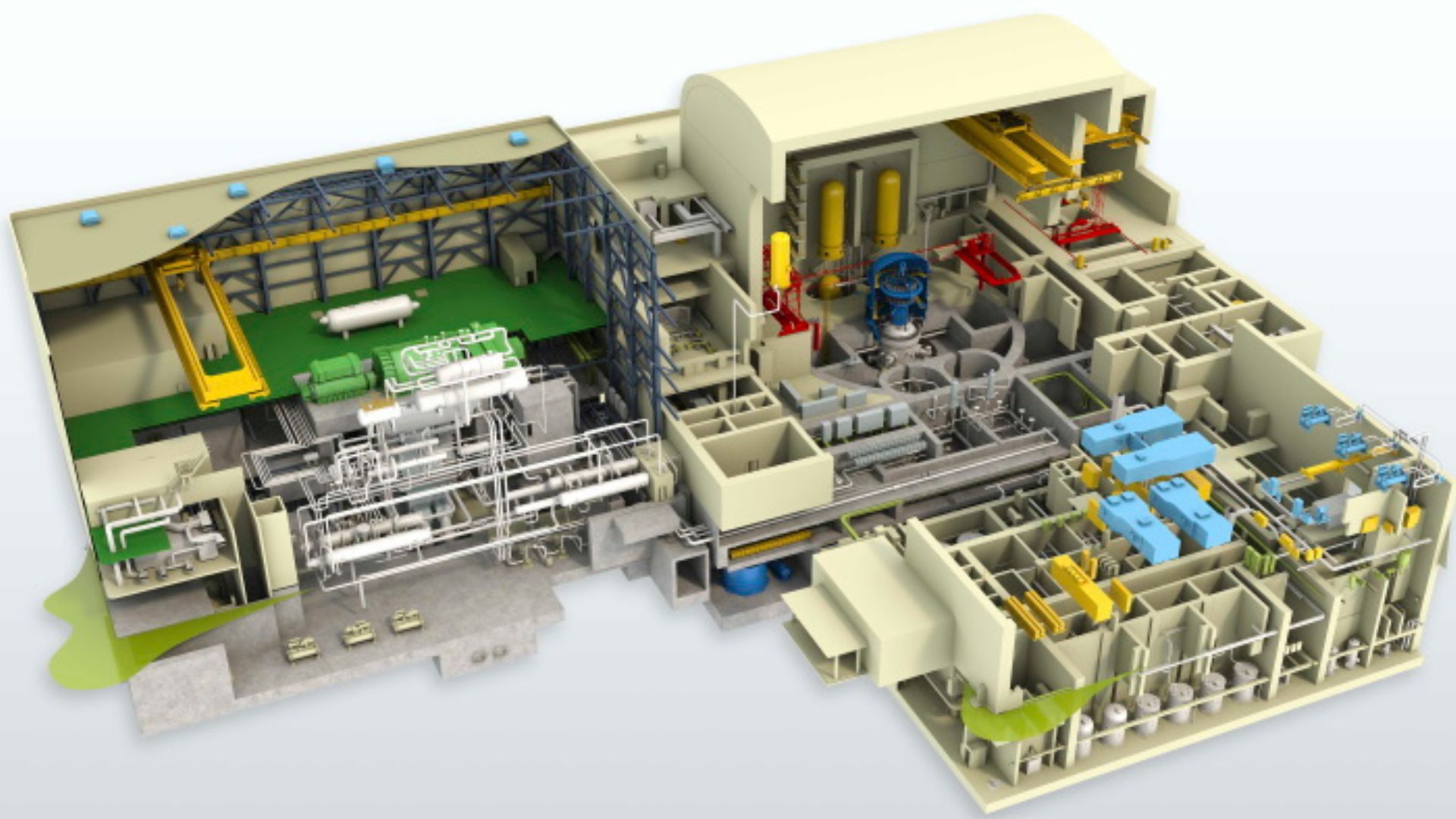
South Korea-based Samsung Heavy Industries has joined hands with a United States-based nuclear power design and engineering firm for developing a floating small modular reactor platform. Samsung Heavy Industries has signed a memorandum of understanding (MOU) with Sargent and Lundy (S&L) for developing a standardized floating small modular reactor platform. Under the MOU, the two will jointly work to develop a standard platform for multiple reactor types. The signing of the MOU was carried out in Washington, D.C. earlier this week. The event saw attendance from Kim Kyung-hee, Head of Samsung Heavy Industries’ Future Business Division (Executive Vice President), and Siben Sulka, S&L’s Chief Nuclear Officer (Senior Vice President). What is a floating small modular reactor? A floating small modular reactor (FSMR) is a nuclear energy platform that has one or multiple small reactors onboard to generate electricity. The compact, factory-built nuclear reactors are mounted on an offshore platform, and they could offer cost-effective power for coastal cities, remote areas, and offshore projects. Putting the small modular reactors on specialized floating platforms reduces the need for on-site structure construction work. It also allows for mobility, and therefore, the platform can be deployed at a site where power is needed at a certain point in time. Moreover, they can also be easily scaled in case more energy needs to be made available at a faster pace. They are also considered to be safer than large-sized nuclear power plants as many of the modern SMR designs use passive safety systems for cooling. The added benefit of cooling the reactor without relying on external power improves the safety and reduces the risk of a meltdown in the core. To date, Russia operates the world’s first floating nuclear power station. Called Akademik Lomonosov, the 472 feet (144-meter) power barge was developed by Rosatom. The floating nuclear power plant is operated in the remote Arctic town of Pevek in Chukotka. It has two KLT-40S reactors that can generate up to 70 megawatts of electricity alongside heat. In 2025, the nuclear plant crossed the one billion kilowatt-hours of energy generation milestone. Samsung Heavy Industries’ nuclear power plans The MOU between Samsung Heavy Industries and S&L is to develop a standard platform that is not limited to reactor type. Further, the two firms will also cooperate at the development, licensing support, construction, and deployment stages to ensure an early commercial deployment of the platform. The agreement targets global markets for commercial deployment, including the United States. It should be noted that in December 2025 Samsung Heavy Industries had received Approval in Principle from the American Bureau of Shipping for a floating marine nuclear power platform with two SMART100 small modular reactors. Under this, the SHI was responsible for the overall design of the nuclear power generation facility and a multi-barrier reactor containment system. The SMART100 modular reactors are developed by the Korea Atomic Energy Research Institute (KAERI). The SMART100 can produce up to 110 MW of electricity, as per KAERI. The original design was built for land-based operations, and the Korean agency is in charge of suiting it for offshore floating platforms.“The collaboration between S&L and Samsung Heavy Industries on FSMR development will be a significant step forward for the future of clean energy in the United States,” said Shiven Sulkar, Chief Nuclear Officer (Vice President) of S&L.Recommended ArticlesGet the latest in engineering, tech, space & science - delivered daily to your inbox.Abhishek brings a wealth of experience in covering diverse stories across different beats. Having contributed to renowned wire agencies and Indian media outlets like ANI and NDTV, he is keenly interested in Tech, Business and Defense coverage.
Samsung teams up with US company to develop floating nuclear reactor platform
Full Article
Original Source
Read the full article at Interestingengineering →KhanList aggregates and links to publicly available news content. We do not host full articles from third-party sources. Always verify important information with original sources.