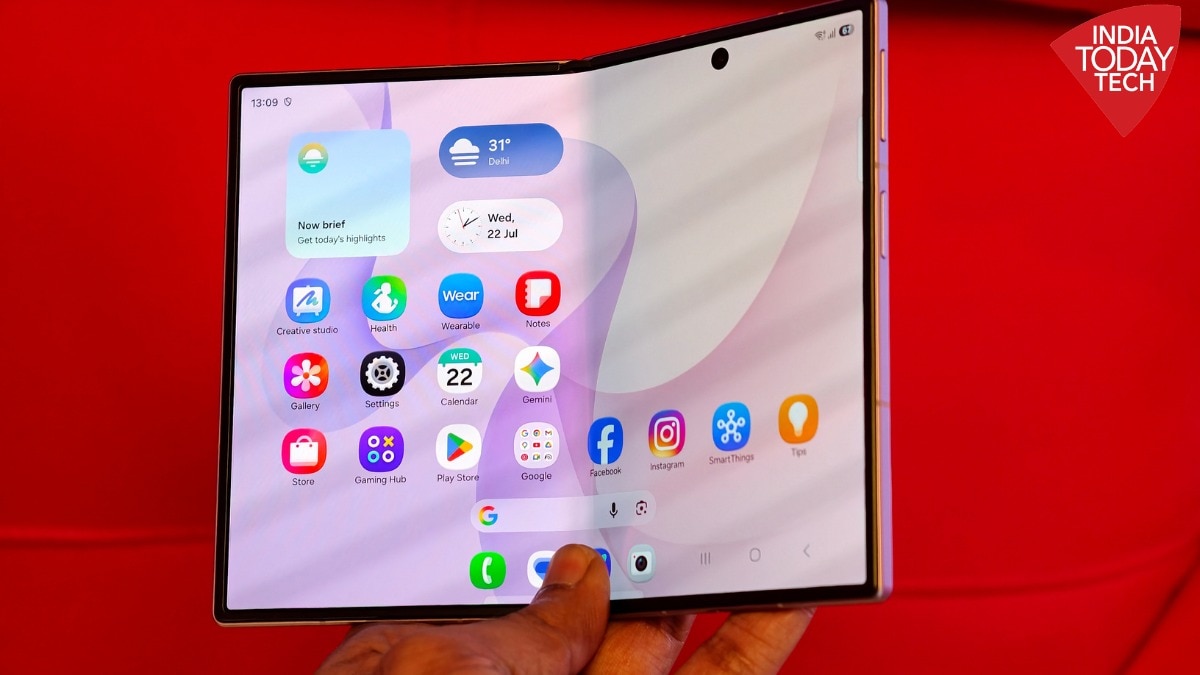
Here's why 2026 might finally be the year foldables go mainstream.A fresh take on Samsung's foldables.Since the OG Fold 1, Samsung has been obsessed with making foldables high and mighty. The brand has gone to excruciating lengths to put the biggest folding phone its engineers could design in your hand, even if the initial models looked—and felt—more like a TV remote with ultra-tall—and narrow—cover screens than conventional bar-shaped phones. That is mostly true about the newly launched Galaxy Z Fold 8 Ultra as well. But there is also a second model—Galaxy Z Fold 8—launching alongside that does just the opposite.It sheds the tall, narrow legacy of the Fold in favour of something short(er) and wide(r)—almost passport style—marking the first big form-factor change for the lineup since 2019. Experts believe that this is no coincidence. They are saying that Samsung kept this ace up its sleeve for years silently waiting for Apple’s eventual entry into the foldable space. Some are going so far as to call it a “pre-emptive strike.” There is some consensus brewing that this is the shape that all foldables, including Apple’s long-awaited entry, are destined to be. In which case, you’re bound to ask: Has Samsung finally cracked the code on the foldable of the future, and will Apple bite?Is the Galaxy Z Fold 8 the future of foldables?Every Z Fold series phone to date—the latest Galaxy Z Fold 8 Ultra included—has had an incredible inner display hamstrung by an outer display that felt like an afterthought. At its best, you got big screen real estate, two, in fact, that turned heads and started conversations. It was the ultimate party trick. But it also meant that you had to rewire your brain to adjust to a whole new reality which invariably brought its own set of challenges, particularly while dealing with different aspect ratios. The Fold 8 changes that dynamic entirely.Samsung’s engineering team went back to the drawing board, reworked on the chassis, then shrunk everything down for what’s being billed as the world's lightest book-style fold at a whisper-light 201 grams—lighter than many traditional glass-and-metal slab flagships. Unfolded, it measures a razor-thin 4.5mm and closed, it is just 9.7mm. More importantly, the inner screen is now a 4:3 7.6-incher while the outer one, a 5.5-inch with a 10:16 aspect ratio. It responds to you—the user—and content a bit more effortlessly. So, while there is still a bit of learning curve, you’re likely to adjust to it faster. “Is Galaxy Fold 8 the future of foldables? You can say so, because two major players (Samsung and Apple) are coming up with similar-sized or similar form factor kind of devices within 2-3 months of each other,” Navkendar Singh, Associate Vice President of Client Devices at IDC India tells India Today Tech. “I’m using the Fold 7 right now. It is not very usable in the sense that the front screen is very narrow and it's taller. It's a very polarising device.”When you pair that form factor with the Qualcomm Snapdragon 8 Elite Gen 5, up to 16GB of RAM, 1TB of storage, a 4,800mAh battery with 45W fast charging, Android 17 (One UI 9) with seven years of software support, and an IP48 rating, the Z Fold 8 feels less like an experiment and more like a complete smartphone.Early market feedbackUnderneath the hood, Samsung did make a few calculated trade-offs to achieve the Fold 8’s razor-thin silhouette. The camera array features a dual 50-megapixel wide and 50-megapixel ultrawide setup, omitting a dedicated optical telephoto zoom lens altogether.Then there is the financial barrier. Starting at Rs 1,79,999 for the 12GB/256GB base variant and going up to Rs 2,39,999 for the top-end 16GB/1TB model, the Fold 8 is unapologetically luxury tech.Be that as it may, Singh points out that the reception to the new design is strong. “We don't have the numbers out yet. But people are liking the (new) form factor,” he says, adding, “obviously, it needs to be seen that other specs like the cameras are not compromised for this form factor. That along with the high price have been one of the inhibitors of widespread adoption of foldables. They're very delicate devices, so to say.”Despite those headwinds, some analysts appear positive about the refinement of the display crease and hinge mechanics that Samsung is highlighting.“We believe that foldables as a category are here to stay, though it will take some time for them to become mainstream,” says Tarun Pathak, Research Director at Counterpoint Research. “Book-style foldables in particular still have an ASP four times higher than standard smartphones, making them out of reach for billions of potential users.”Pathak adds, however, that user satisfaction on the hardware itself is hitting record highs: “However, with the Fold 8 design, we believe the form factor will perform really well when it comes to user experience. Early feedback has been very positive, with the content consumption experience being by far the best on the Fold 8. Samsung has also done a good job addressing key user feedback regarding the crease and hinge durability, which should help them attract first-time foldable users.”According to Samsung, customer response to the eighth-generation foldables overall has been impressive with the brand recording over 2,71,000 pre-orders within just 72 hours of their launch on July 22 in India.Samsung’s first-mover advantage over Apple: Does it matter?Samsung launched its first Galaxy Fold back in 2019, giving the South Korean tech giant an early headstart to refine flexible glass, develop hinge stress tests, and optimise Android to work on two screens. Prabhu Ram, Vice President of the Industry Research Group (IRG) at CMR notes that hardware lead in tech does not guarantee long-time success.“While Samsung’s eight-generation headstart has helped establish its leadership in foldables, that advantage is steadily narrowing. Sustaining foldable leadership will require Samsung to move beyond incremental upgrades.”When Apple enters any segment, it rarely comes first. But it comes with an ecosystem designed to lock consumers in across Mac, iPad, Apple Watch, and AirPods.“Samsung may have some first-mover advantage, but we have to see that over Apple, it's a different ecosystem. When you buy into Apple ecosystem, that means you are using other devices and you're able to move from one device to another, and the whole ecosystem and the integration of the OSs across the devices is much better than Samsung. Although Samsung also makes buds and watches and laptops, we all know that Apple has done a much better job in terms of ecosystem integration, or at least the positioning and the marketing of that in the minds of the consumer,” Navkendar Singh says.Will Apple bite?All signs point to one thing: Apple isn't just going to bite, it is preparing to swallow a massive slice of the premium foldable pie.Supply chain reports and market intelligence suggest Cupertino’s maiden foldable iPhone is set to launch in September at an even higher price tier than Samsung’s. For millions of iOS loyalists who have watched Android users unfold tablet-sized displays in coffee shops and airports, the demand has been building for years.Singh points out that consumer appetite for an “iPhone Fold” or “iPhone Ultra” is already primed. “It will be more expensive than this one (Fold 8), and we believe it will be at a premium—iPhone Pro Max and iPhone Fold will have somewhere similar kind of pricing. And it will do well because many consumers which we have spoken to, they tell us that one thing which is missing from Apple's arsenal is foldable. So many people are actually waiting for an iPhone Fold to come in. So hopefully, Apple also does as good a job as Android has done for this in terms of apps working compatibility on that foldable form factor—at least this form factor, 4:3 and others.”Rather than sparking a zero-sum war, Apple’s entry might actually expand the entire category, driving software developers to optimise apps for foldable ratios at scale.“Once Apple enters the market, the category is likely to expand even faster, benefiting both Samsung and Apple,” highlights Tarun Pathak. “Even with current constraints, we expect foldables as a category to continue growing over the next couple of years.”Ram echoes this sentiment, emphasizing that Apple's entry will change the game: “With Apple’s expected entry into the segment, competition is likely to shift beyond hardware specifications toward industrial design, ecosystem integration, and the ability to deliver a more seamless foldable experience.”Is 2026 the year of the foldable phone?With the Galaxy Z Fold 8 setting new records for thinness and usability, and Apple on the horizon, is 2026 the year the candy bar phone is left behind?Not quite. While tech enthusiasts may feel like foldables are everywhere, market volume still tilts heavily toward regular phones. High manufacturing costs, delicate hinge engineering, and premium price tags mean flagships like the Galaxy S series and iPhone Pro lines will continue to drive bulk consumer volume.“Is 2026 the year of the foldable? No, not really. Apple foldable will do well. This (Fold 8) will also do well, but still the pricing is very high. And there are other phones. The Pro Max and Pro will launch—18 Pro and Pro Max—then you have S27 series launching, S26 is doing well. So, it's not a year of the foldable, but I think we are seeing something interesting: that this particular form factor—a passport, wider, smaller form factor—is an interesting trend to watch out for. We believe other players will also enter this fray."However, while 2026 may not see foldables completely replace conventional slab phones in every pocket, it represents something equally transformational. As Prabhu Ram concludes, “2026 is shaping up to be the year foldables begin their transition into the mainstream.”- EndsPublished On: Aug 2, 2026 14:26 IST
Samsung built the foldable of the future, but will Apple bite?
Full Article
Original Source
Read the full article at Indiatoday →KhanList aggregates and links to publicly available news content. We do not host full articles from third-party sources. Always verify important information with original sources.