
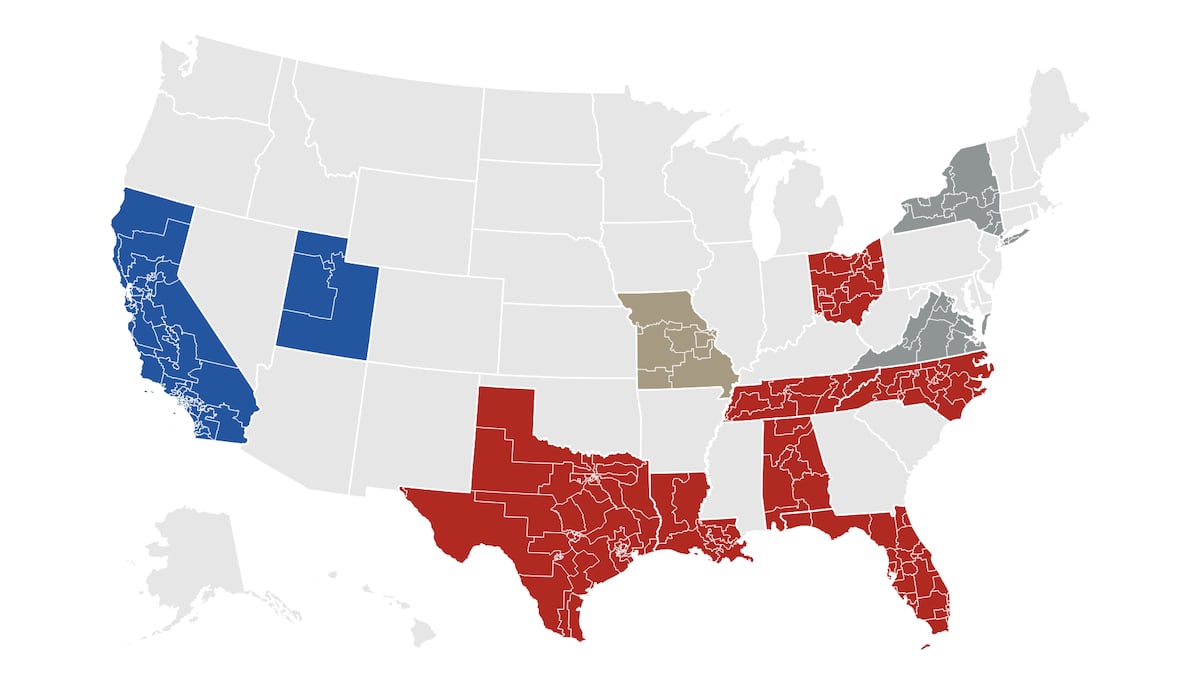
The U.S. midterm elections come after aggressive efforts by both Democrats and Republicans to redraw district maps in their favor, a practice known as gerrymandering.In this election cycle, both parties have redrawn district boundaries in an attempt to secure additional congressional seats. Republicans in Texas fired the opening shot. Pressured by U.S. President Donald Trump, the state legislature approved a new district map last year that Republicans hope will deliver five additional seats in these midterm elections. California responded in November with Proposition 50, a referendum that approved a map designed to give Democrats five more seats, effectively wiping out the Republican gains expected in Texas.Congressional districts are normally redrawn once every decade, following each census. Since 2025, however, 12 states have attempted to redraw them ahead of schedule. According to data from the National Conference of State Legislatures (NCSL), this is the largest wave of mid-decade redistricting since the 19th century.How gerrymandering worksPartisan maps generally rely on two techniques. The first is known as packing: concentrating rival voters into a small number of districts, which they win by such overwhelming margins that many of their votes are effectively wasted. The second is known as cracking: spreading the remaining opposition voters across several districts so that they remain a minority in each of them.Let’s see how this would work in a hypothetical state:It is worth noting that gerrymandering is intended to help a party win more seats, but the projections are not always accurate.Who gains seats, state by stateA total of 12 states have redrawn their congressional maps ahead of the November 3 midterm elections. The changes are designed to deliver as many as 15 additional seats to Republicans and six to Democrats, although those outcomes are far from guaranteed, as the estimates are based on outdated polls and projections. This chart shows how many seats each party could potentially gain under the new maps.Five other states attempted to redraw their maps but failed. In Indiana, South Carolina and Maryland, the proposals died in the state Senate; in Kansas, Republicans did not have enough votes to override the governor’s veto; and in Georgia, the legislature refused to take up the measure.Districts, before and afterThese maps compare each district before and after redistricting, with colors based on the results of Donald Trump and Kamala Harris in the 2024 presidential election. In some cases, the change in color is barely noticeable, yet the political consequences are significant. For example, in North Carolina’s 1st Congressional District — where Trump won but a Democrat currently holds the seat — the Republican advantage increases from three percentage points to 12.Methodology: The net change in seats compares, in each state, the projected distribution under the previous map with that under the new one, based on the sources cited. The map colors indicate which candidate won each district in the 2024 presidential election (Kamala Harris or Donald Trump) and by what margin, as calculated by The Downballot for both sets of maps; they are not a forecast for November. For that reason, the number of districts of each color does not always match the net change in seats: some districts won by Trump are currently represented by Democrats. District boundaries are based on data from the U.S. Census Bureau and state legislatures. Maps for Missouri, New York and Virginia are not included because their district boundaries have not changed.Sign up for our weekly newsletter to get more English-language news coverage from EL PAÍS USA Edition
Same voters, different outcomes: How gerrymandering works in the United States
Full Article
Original Source
Read the full article at English →KhanList aggregates and links to publicly available news content. We do not host full articles from third-party sources. Always verify important information with original sources.