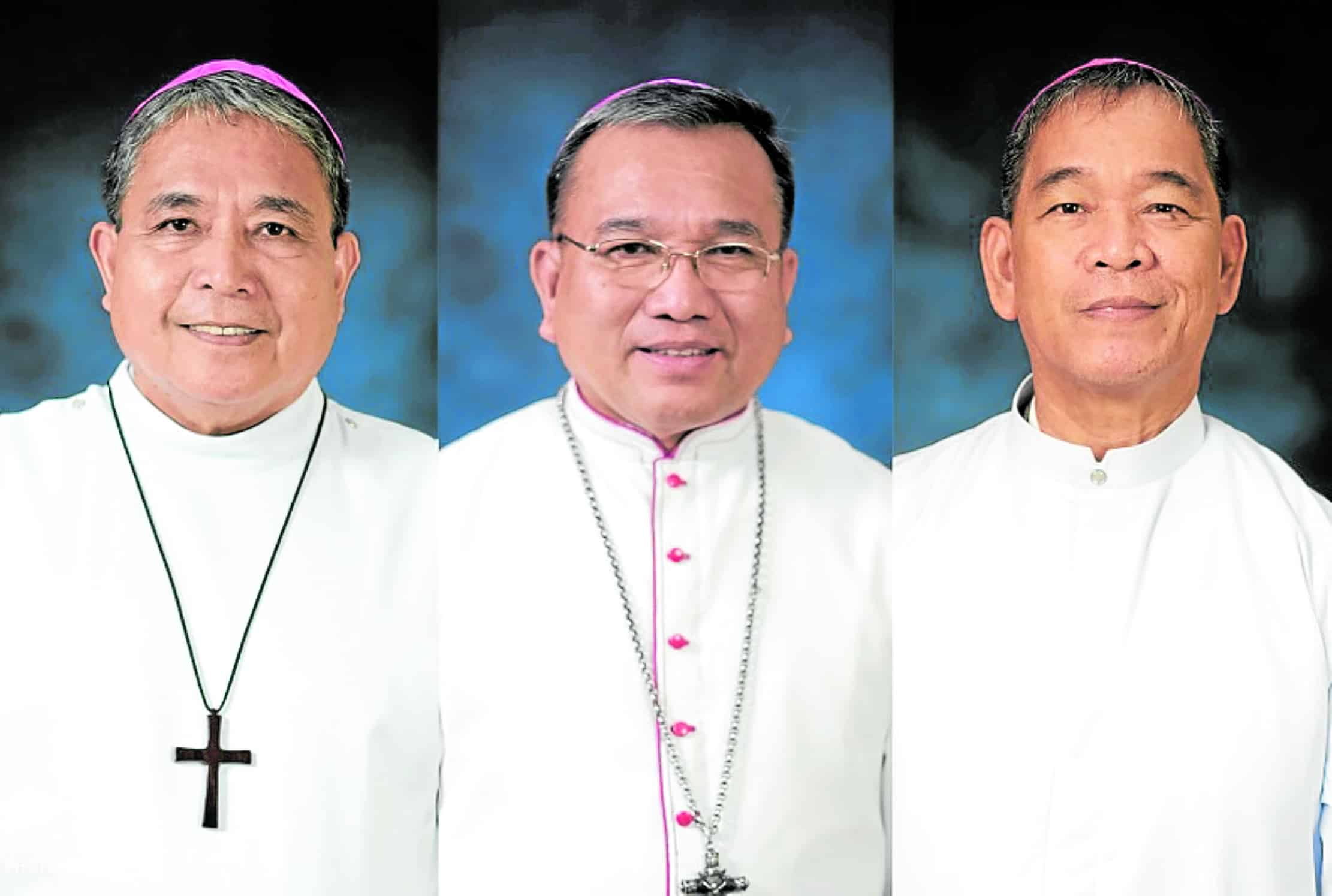
UNITED STAND (From left) Bishop Crispin Varquez of Borongan, Bishop Isabelo Abarquez of Calbayog and Bishop Nolly Buco of Catarman stand united in endorsing a pastoral statement urging local governments in Eastern Samar to reject mining and protect the island’s forests, watersheds, farmlands, coastal ecosystems and communities. —CATHOLIC BISHOPS’ CONFERENCE OF THE PHILIPPINES PHOTOS BORONGAN CITY—The three Catholic bishops of Samar Island have united in opposing mining activities in Eastern Samar, warning that even mineral exploration could pave the way for large-scale extraction that threatens forests, watersheds, farmlands, coastal ecosystems and the livelihoods of local communities. Bishops Crispin Varquez of the Diocese of Borongan, Isabelo Abarquez of the Diocese of Calbayog, and Nolly Buco of the Diocese of Catarman endorsed a pastoral statement calling on local government units in the municipalities of Giporlos and Balangiga to reject mining and reaffirm resolutions opposing extractive activities within their jurisdictions. Article continues after this advertisement The statement was adopted during the Samar Island Partnership for Peace and Development (Sippad) meeting held on July 23 and came after the Mines and Geosciences Bureau (MGB) approved Exploration Permit No. EP-2026-001-VIII, covering about 902.99 hectares in portions of Giporlos and Balangiga. Although the permit authorizes only mineral exploration and not commercial mining, the bishops said exploration is often the first step toward large-scale mineral extraction, making it imperative for communities and local governments to declare their position early. Bearing the theme, “The earth is the Lord’s and all that is in it” (Psalm 24:1), the pastoral statement described environmental protection as both a civic responsibility and a moral obligation rooted in Christian stewardship. Quoting Pope Francis’ encyclical Laudato si’, the bishops said genuine development should not be measured solely by economic gains but by its impact on human dignity, environmental integrity and future generations. “Development should never come at the expense of human dignity or the integrity of creation. True progress is measured not only by economic gains but also by the protection of communities, ecological sustainability, and peace founded on justice,” the statement said. Article continues after this advertisement Previous experience The Diocese of Borongan urged the municipal councils of Giporlos and Balangiga, along with affected barangay councils, to pass or reaffirm resolutions rejecting mining within their territories. The bishops said their stand was shaped by Samar Island’s own experience with mining and mineral exploration, particularly in Homonhon and Manicani islands in Guiuan, Eastern Samar, and Bagacay in Hinabangan, Samar, where extractive activities have long generated environmental and social concerns. Article continues after this advertisement Homonhon island, historically recognized as the first Philippine landfall of Ferdinand Magellan in 1521, hosts existing mining operations that have drawn criticism over their environmental impacts. The Church warned that mining could degrade forests and watersheds, pollute rivers and coastal waters, reduce agricultural and fishing areas, heighten the risks of erosion, flooding and landslides, and trigger conflicts within communities. The bishops stressed that these risks are especially significant in Eastern Samar, one of the country’s most typhoon-prone provinces, where forests, watersheds and coastal ecosystems serve as natural buffers against disasters while sustaining farming and fishing communities. “Our concern is rooted in Samar’s own experience. The stories of Bagacay, Homonhon and Manicani remind us that decisions on mineral development have lasting consequences for communities and the environment,” the statement read. Giporlos Mayor Gilbert Go, however, clarified that no mining operations are currently taking place in his municipality and that the MGB permit covers exploration only. Go said any future application for commercial mining would still have to undergo the required legal, environmental, and public consultation processes before it could proceed. Sippad—a coalition of the Church, government agencies, civil society organizations, academe, media, youth groups, and other stakeholders—backed the pastoral statement, saying experiences from mining-affected communities demonstrate that decisions involving natural resources have long-term implications for ecological integrity, food security and the welfare of future generations. The group urged local governments across Samar Island to exercise their authority under the Constitution and the Local Government Code by adopting policies that safeguard the environment and protect the interests of their constituents. Your subscription could not be saved. Please try again. Your subscription has been successful. The bishops and Sippad noted that their appeal extends beyond the current exploration permit, calling instead for a long-term development vision that preserves Samar Island’s forests, rivers, farmlands, fishing grounds, and other vital ecosystems while ensuring sustainable development for future generations.
Samar bishops urge LGUs to reject mining
Full Article
Original Source
Read the full article at Newsinfo →KhanList aggregates and links to publicly available news content. We do not host full articles from third-party sources. Always verify important information with original sources.