
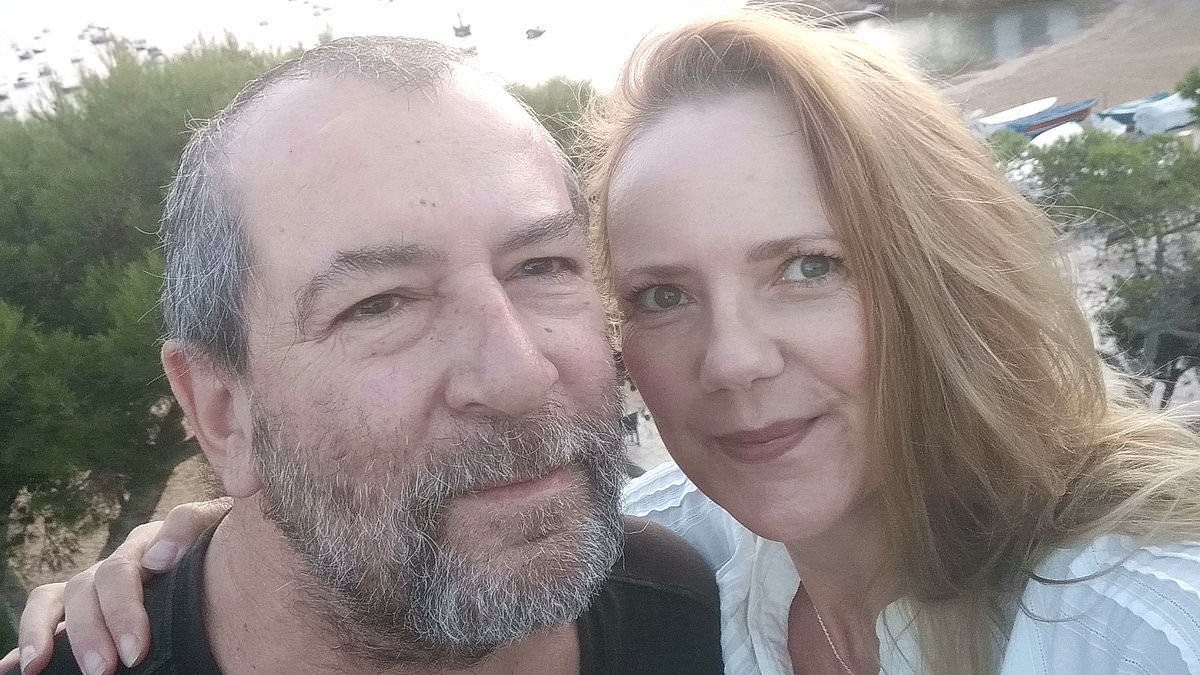
Marching towards the woman who had just unlocked her cherry red Fiat 500, I looked her straight in the eye. ‘Are you disabled?’ I demanded. ‘No,’ came the curt reply.There was zero shame and certainly no apology – no wonder I could feel a red mist descending.I’d just driven for three hours to check into a hotel with my husband, Pascal, 65. Not on a jolly but so he could attend a vital hospital appointment the following morning.We’d arrived to find four disabled parking spaces, all taken, and yet only one vehicle displaying a disabled badge.It had taken me a year – not to mention hours of form filling and countless appointments – to get this much-needed concession for Pascal, who struggles to walk more than 50 metres unaided and can’t manage without at least one crutch, even on a good day.So, even though she was just leaving, I let rip: ‘What were you thinking? Taking a space that someone else genuinely needs! Would YOU like to take 22 meds a day just to stay alive?’ On and on I went.The woman, in her 20s, just shouted at me to move my car out of the way.With her tanned, athletic body, it was like looking at myself 30 years ago. I wondered how she’d feel if she ever found herself in my position in the distant future – a full-time carer for the man she loved. Samantha and her 65-year-old husband Pascal have been married for 18 years and live in rural south-west France In April 2023, Pascal was hospitalised for a month with a life-threatening condition and Samantha said there were nights she didn’t know if he’d still be alive the following morningI have found it both a privilege and – though I find this difficult to admit – sometimes really bloody tough. And yet, like carers everywhere, I don’t have a choice.An hour later, and with Pascal ensconced in our room, I went to the hotel gym and burst into tears. How had shouting at people about parking spaces become my life?Happily married to Pascal, a retired carpenter, for 18 years, we live in rural south-west France. Until five years ago, we thrived on physical activities together and embraced all kinds of practical projects.We even renovated our farmhouse together. Pascal replaced everything from the roof beams to the tiles, windows and electrics. While Pascal is ten years my senior, the age gap was never so great that I imagined becoming his carer in my 50s – especially as he had always been so strong and fit.But then, in January 2021, a routine knee replacement operation turned into a nightmare when he collapsed and lost consciousness after being discharged. It’s only in hindsight we now know that other health issues – including undiagnosed type 2 diabetes and atrial fibrillation (an irregular heartbeat) – doubtless compromised the procedure.Pascal was just 60 and I had expected him to get back to normal with a few months of physio, but instead he has catapulted from one health crisis to the next.Osteoarthritis has caused pain and further mobility problems with his neck, hips and other knee, but further operations have also come with serious complications.He has been diagnosed with numerous life-limiting illnesses, from heart failure, oedema (swelling due to build up of fluid) and peripheral neuropathy (nerve damage).The most acutely stressful time came in April 2023 when Pascal was hospitalised for a month with a life-threatening condition involving organ failure, which required him to be transferred to a hospital two-and-a-half hours away.For nearly two months, his condition was so critical there were nights I genuinely didn’t know if he’d still be alive the following morning. And when he was discharged, it was like living with a ghost: his spirit had gone. The man who came home was not the same physically robust husband I had known before.For several weeks, he could barely get out of bed. I’d have to physically haul him onto his feet so he could go to the bathroom.In those terrifying, sleep-starved months, I forgot everything else, focusing only on him.Now I am no longer on such high alert, but constant worry has become the backdrop to my life. Most weeks involve blood tests, GP appointments, physio or specialist visits.I’ve given up working mornings – any appointment is usually a good two-hour round trip – but if we need to go to a university hospital then it’s a three-hour drive, one-way.As I pointed out to the woman in the car park, he takes 22 different tablets a day and managing that is a huge responsibility, ensuring everything is taken properly and he never runs out.If any new medication is introduced, or an existing one tweaked, I have to monitor for adverse effects. For a long while I felt that I was coping – I am someone who loves to rise to a challenge – but since the start of the year, I’ve been tired, short-tempered: pushed to the limit really. No wonder. I’m now 55 and it recently occurred to me that I have spent my entire 50s doing this – seven days a week, 52 weeks a year.I don’t rely on state handouts, I juggle work around Pascal and I’m certainly not looking for sympathy. But I never imagined the true reality of being a carer, or that my life would shrink like Pascal’s.Until recently, I didn’t even know that carer fatigue – the physical, emotional and mental exhaustion that can develop when you spend a prolonged period continually caring for a loved one – was a recognisable condition.Inevitably, it’s mostly experienced by women. In the UK, it’s us who shoulder the majority of unpaid caring responsibilities. According to the 2021 Census analysed by Carers UK, around 59 per cent of unpaid carers are female.A 2025 study of 25,000 couples by the University of Florence found they were significantly more likely to split if the woman reported poor health – but there was no increased break-up risk when the man did, reinforcing the idea that women are still far more likely to adapt to a caregiving role than men. Samantha has given up working mornings, and most weeks involve blood tests, GP appointments, physio or specialist visits Pascal is receiving preventative pre-op care, including iron infusions and prehabilitation physiotherapy. Samantha hopes that will give him a stronger start to his recoveryIronically, right now I’m in the best health of my life. We have two large rescue dogs which I walk for at least two hours a day, which gives me some much-needed solitude. I practise yoga several times a week, meditate twice a day, follow a vegetarian diet and cook from scratch.I haven’t touched a drop of alcohol for more than three years. I’m religious about getting at least seven hours of sleep, too.And yet… I have never felt more drained, physically and mentally.Pascal needs help with everything from descending stairs to removing his clothes and, at times, I have to be responsible for making and acting on medical decisions for him.Not everyone likes the fact that I prioritise my husband over my social life, either. Some girlfriends have called me out for what they see as me putting my life on hold.When they pop in and see him on a good day – when he’s jovial and a perfect host – I get it, I really do. But in an isolated community there really isn’t anyone to keep an eye on Pascal while I swan off for a girly lunch and – let’s be honest – would I really enjoy it? I’d be worrying about him the whole time. My husband’s family live too far away to offer any respite and, besides, Pascal is reluctant to involve them. Call it male pride, but he doesn’t want loved ones to see him vulnerable.His eldest son died in 2014, leaving his two other children: one who lives seven hours away in Marseille and his youngest son, who is an hour away. It is difficult enough having your wife look after you. No father wants his children to have to care for him, too.Meanwhile, French bureaucracy is bafflingly complex and living in a rural community severely limits the help and support available.For example, in theory he should be able to have state-funded transport to take him to and from physio, but the few services in our area are booked up months in advance.My choice is either to spend hours – sometimes days – on the phone or emailing various departments, or to suck it up so we can get on with our lives.Small acts of kindness have become everything – a friend arriving with lunch, my sister quietly cleaning the house during a visit, my mum coming out to support me or the care packages from my dad and stepmum. They are all appreciated so very much.Inevitably, caring has changed my outlook. I’m intolerant of pettiness and have found I can prioritise what (and who) is important to us and who isn’t.I’m now on first-name terms with our GP and his medical secretary wife. The same goes for our community nurse. As lovely as they are, and at the risk of sounding like Meghan Markle, no one has ever once asked how I am.Sometimes, walking the dogs, I have a bloody good cry. But what has surprised me the most is how often I have held it together.I empathise with any married carer thinking, ‘I’ve had enough of this’ because, round-the-clock, we are on the receiving end of our beloved’s frustrations.The grumpiness when an appointment is running late, the shortness of temper because of the agony when they’ve left it too long to take their pain medication, the frustration when they can’t get out of their clothes unaided. But then there’s a flash of their old humour and you remember who they really are.The biggest light bulb moment for me was reading The Unexpected Journey: Finding Strength, Hope And Yourself On The Caregiving Path, by Emma Heming Willis.Published last autumn, she left no stone unturned in recounting the impact of being both a wife and carer after her husband, the actor Bruce Willis, was diagnosed with frontotemporal dementia.She describes the emotional exhaustion of trying to hold life together while navigating the relentless uncertainty of life-limiting illness. I cried while reading it, because finally I felt seen.Now we face Pascal’s original left knee being redone next month. This time I’ve put measures in place to ensure I don’t feel like I’m living in a Russian gulag again.Pascal is receiving preventative pre-op care, including iron infusions and prehabilitation physiotherapy. I can only hope that will give him a stronger start to his recovery and make the weeks ahead less onerous for both of us.Yet there is no escaping the fact that, when he comes home, I will be caring for him on my own.But then I remember those six agonising weeks when I genuinely didn’t know if Pascal would survive and I remind myself that the alternative is a life without my funny, lovable husband.Only now do I truly understand the meaning of compassion, patience and unconditional love.Yes, there are moments when I’ve had to dim my own light to keep his burning. But do I regret it? Not for a second.
SAMANTHA BRICK: I married a man 10 years older than me... but now he's a ghost of the husband he was before. It's difficult to admit but this isn't how I imagined my life in my 50s - the strain is unimaginable
Full Article
Original Source
Read the full article at Dailymail →KhanList aggregates and links to publicly available news content. We do not host full articles from third-party sources. Always verify important information with original sources.