
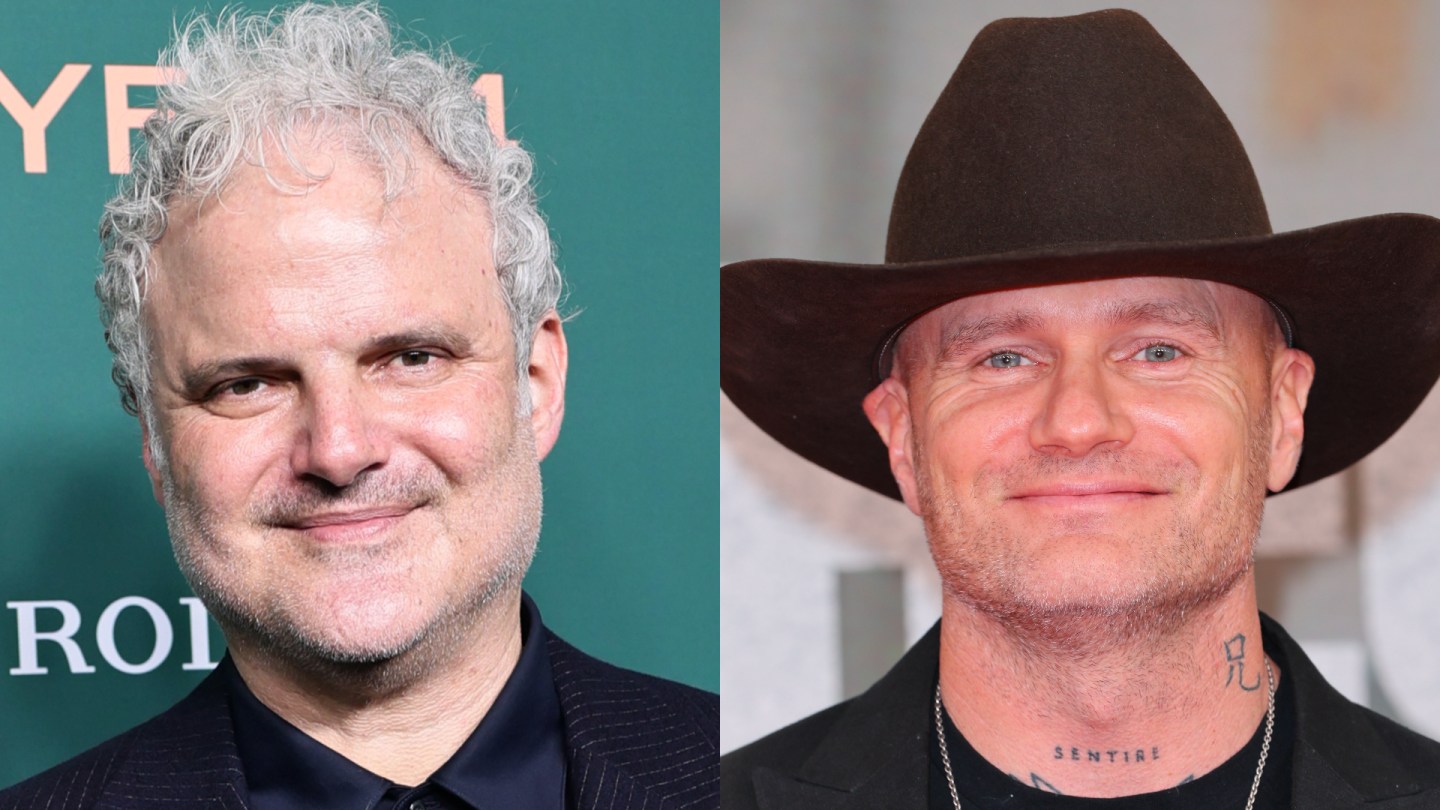
It would be hard to find two cameramen less alike than Sam Levy and Jamie Ramsay. Levy, the Boston-born son of a classical violinist, who played for the Boston Symphony and the Boston Pops (and can be heard on a few soundtracks recorded by Boston Pops conductor John Williams, including The Empire Strikes Back) studied comparative literature and first considered a career as a diplomat before stumbling into film. He worked his way up, first as an assistant to acclaimed cinematographer Harris Savides (Zodiac, The Yards) before becoming, through collaborations with Noah Baumbach (Frances Ha, While We’re Young) and Greta Gerwig (Lady Bird), a defining visual voice in American indie cinema. Ramsay, who grew up in South Africa, is a self-described “punk” who was kicked out of pretty much every school his parents sent him to, until he got accepted at the Academy of Film and Dramatic Art in Johannesburg. “That was the light turning on for me.” His career trajectory has been distinctly international. Emerging from the South African film industry as a camera operator on Neill Blomkamp’s District 9 and through his longstanding partnership with director Oliver Hermanus (Beauty, Moffie), Ramsay has since established himself in British and international cinema through films like Andrew Haigh’s All of Us Strangers and Pressure from Australian director Anthony Maras. Ramsay’s visual style tends towards a deliberately composed visual aesthetic — see his latest, Sian Heder’s 1970s historic drama Being Heumann — while a Levy-shot film, like his work on Noah Segan’s crime thriller The Only Living Pickpocket in New York, is more observational and fluid. ‘Being Heumann.’ Courtesy of TIFF John Turturro in ‘The Only Living Pickpocket in New York‘ Jon Pack/Courtesy of Sony Pictures Classics But the two found common cause at ToruńCamerimage, the Polish festival honoring the art of cinematography. Speaking to an audience of students and up-and-coming filmmakers, Levy and Ramsay eschewed technical talk about lenses, cameras and lighting techniques in favor of a more personal approach to filmmaking. “It’s less about the how than about the why,” explained Levy. “Your greatest weapon as a DP is your intuition.” In a wide-ranging conversation, the cinematographers discussed the formative moments in their careers, and the lessons they’ve learned along the way. For Levy, his mentoring by Savides was key. “From the first day of working with Harris, I just wanted to be like him,” said Levy. “His knowledge was just so vast. He used to say: ‘Making a movie is very messy,'” said Levy, “it’s a moving train and it doesn’t stop.” Levy recalled working as a camera loader on a commercial Savides was shooting, directed by Gus van Sant. The team was sent to “steal shots” in the subway in New York, working without filming permits. “Harris told me, ‘If anyone asks, tell them we’re doing a student film,'” Levy recalled. “We start and someone does come up. I tell them: ‘This is a student film.’ They say: ‘You’re shooting a student film with Gus van Sant?'” Giancarlo Esposito and John Turturro in ‘The Only Living Pickpocket in New York’ Jon Pack/Courtesy of Sony Pictures Classics Noting he was “never the tech guy,” Levy described how he finds an emotional way into the visual aesthetic of his films. The Only Living Pickpocket in New York stars John Turturro as Harry an aging wallet thief who finds himself out of sync with the modern world. It was shot on digital, on the ARRI Alexa 35, but to capture the analog nature of Harry’s profession, Levy decided to used Bausch & Lomb Super Baltar prime lenses, the same set famously used by Gordon Willis to shoot The Godfather. Ramsay remembered the on-set confrontations and failures that he said led to his greatest breakthroughs as a cinematographer. “I’ve always been more driven by negatives than positives,” he noted. “If you say I can’t do something, then the rebel in me kicks in.” But his only real confrontations he has had on set he said, “the only people I ever beef with” have been assistant directors “over time” and line producers “because of money. Because those are the two most important things you have as a cinematographer: Time and money.” Mark Ruffalo in ‘Being Heumann’ Apple TV+ Levy and Ramsay described very different approaches to confrontations on set. Levy, “the would-be diplomat,” always tries to find common ground, he said. Ramsay, the rebel, “finds it hard to pander to something that doesn’t make sense to me.” That two so different artists could achieve such acclaim, using such different methods, was the point of the Camerimage session. For both, the takeaway was the same: trust your instincts and the people you work with, and don’t let the craft get lost in the technique. “What you guys do lives forever,” Ramsey told the young cinematographers in the room. “Think of that. It’s pretty immense. It’s pretty important. It’s worth doing everything you can to get it right.”
Sam Levy, Jamie Ramsay Offer Advice to Up-and-Coming Cinematographers: “What You Guys Do Lives Forever”
Full Article
Original Source
Read the full article at Hollywoodreporter →KhanList aggregates and links to publicly available news content. We do not host full articles from third-party sources. Always verify important information with original sources.