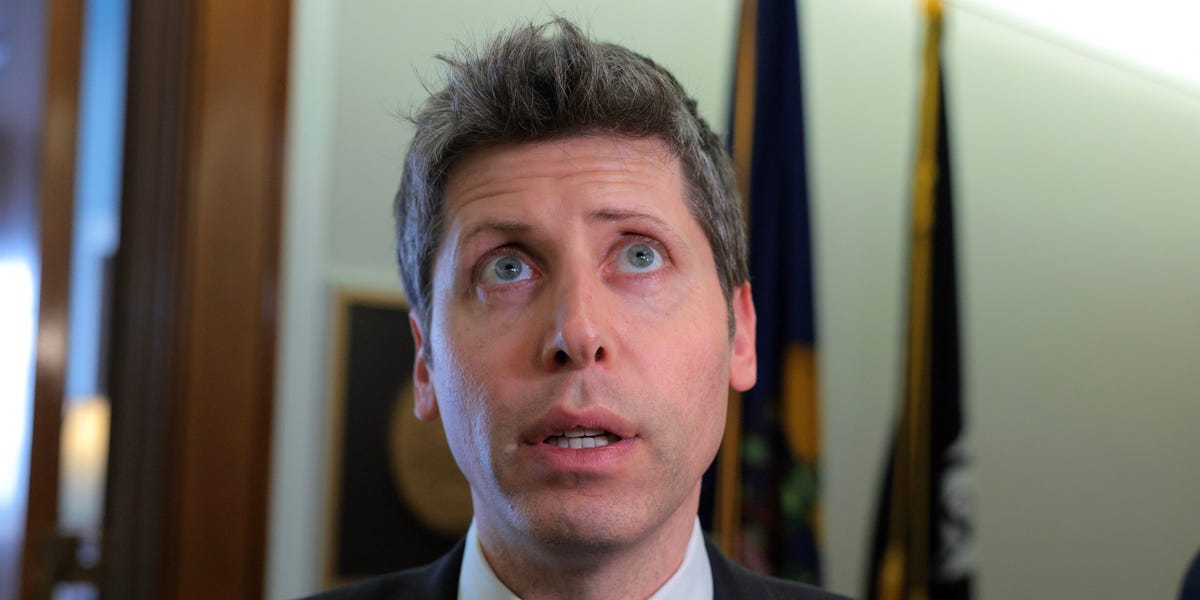
OpenAI CEO Sam Altman. Chip Somodevilla/Getty Images Sam Altman says one of AI's underappreciated risks is that people may let the technology do so much thinking for them that their own mental muscles begin to weaken."One that I don't think gets much attention is how are we going to avoid cognitive atrophy?" the OpenAI CEO said on an episode of the "Invest Like the Best" podcast that aired on Tuesday, when asked about the most important unresolved questions facing AI."How are we going to use these tools and make sure that we are stretching our brains more and more and continuing to understand the stuff that really matters?" Altman said.His comments come as a growing number of researchers have warned that while the technology could make workers faster, it could also weaken their underlying job and cognitive skills."There's never been a tool like this that has offered us the opportunity to let thinking be done for us," Nataliya Kosmyna, an MIT researcher whose preliminary study found that people using generative AI to write essays performed worse over time than participants using Google or no aid, told Business Insider earlier this month.Vivienne Ming, a theoretical neuroscientist and AI researcher, has described the risk of people abandoning cognitive work because AI can do it for them as "chronic substitution." She told Business Insider last month that repeated substitution could weaken cognitive reserve, a key defense against dementia.Those concerns are especially pressing as AI tools move beyond answering questions and generating text to taking on increasingly complex work, including document review, research, analysis, customer support, and coding. Altman isn't the only tech leader to have raised concerns about AI's effect on cognition.Last year, Arthur Mensch, the CEO of Paris-based Mistral AI, told The Times that AI's biggest risk may be "deskilling" workers and making people progressively lazier as they increasingly rely on the technology to search for information.Still, during the podcast interview, Altman struck a more positive tone about what lies ahead.He described a "pretty magical" future where a personal AI could be always on, reading documents, listening to meetings, recalling emails from weeks earlier, and using spare computing power overnight to generate ideas and suggest what they should do next.However, he said that even powerful models may struggle to replicate the qualities that make humans distinctive."The world may need like a new kind of word for the kind of judgment that people are very good at, that AI seems to really deeply struggle with," he said. Read next Thibault is a business reporter at Business Insider's London office.He covers the intersection of wealth, work, and technology — focusing on the global economy, AI’s impact on the workplace, job and cognitive skills, and how economic changes are affecting careers. Before moving to the trending team, Thibault covered international affairs, including the Russia-Ukraine war, tensions in the South China Sea, and Russia’s economy on the news desk.He has previously worked at the Daily Express and held internships at Agence France-Presse, Politico Europe, and Factal.Il parle français. Se habla español.Email Thibault at tspirlet@businessinsider.com, connect with him on LinkedIn @ThibaultSpirlet, or follow him on X @ThibaultSpirlet and BlueSky @thibaultspirlet.bsky.social.ExpertiseAI and the future of work Job and cognitive skills in the AI economyWorkforce trendsFirst-person, "as-told-to" business storiesPopular articlesAI isn't making us smarter — it's training us to think backward, an innovation theorist saysNetflix tried full pay transparency for senior staff — it ended up fueling petty rivalries, Reed Hastings saysDuolingo gives staff 2 weeks off over the holidays — and the CEO says it pays offA Nobel Prize-winning physicist explains how to use AI without letting it do your thinking for youAI is giving workers the illusion of expertise — and quietly making them worse at their jobsSatya Nadella says he spends his weekends studying startups as Microsoft's size has become a 'massive disadvantage''Think big': A 35-year finance veteran urges Gen Z to start their own businesses as entry-level jobs dry upAI is reshaping the teenage brain — and an Oxford study says it is making students faster, but shallower thinkersSwitching jobs used to mean higher pay raises. Not anymore.Canadians were urged to boycott travel to the US in response to tariffs — and numbers suggest they listened AI Artificial Intelligence Sam Altman More
Sam Altman says cognitive atrophy is one of the most overlooked risks of the AI era
Full Article
Original Source
Read the full article at Businessinsider →KhanList aggregates and links to publicly available news content. We do not host full articles from third-party sources. Always verify important information with original sources.