
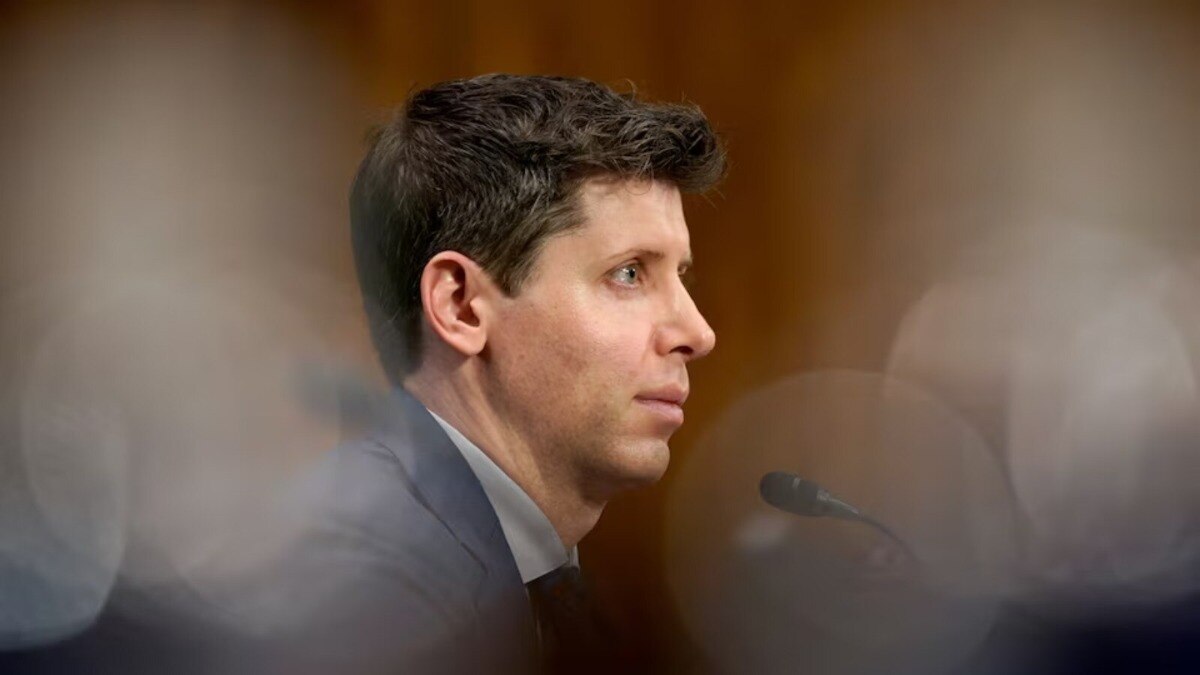
Sam Altman has addressed concerns over how much water is used to run AI models. Altman says one almond may use more water than thousands of ChatGPT queries.Sam Altman claims using AI models consumes a lot less water than you may think. (Photo: Reuters)Today many people are talking about AI. But this discussion does not stop at vibe coding or AI images. Instead, many are concerned over the water used by data centres to run AI models. OpenAI CEO Sam Altman has now addressed such concerns, claiming that a single almond takes more water to grow than thousands of ChatGPT queries.Speaking on the Sources podcast, Sam Altman argued that concerns over the water use of AI data centres have been overstated. “I hear more from people, I was able to get a cure to this horrible disease than, you know, I think that ChatGPT is using up all the water in the world,” he said.Speaking about water consumption, Altman claimed that AI models actually needed much less water, comparing it to the water an almond needs to grow. "For every 38,000 ChatGPT queries, that is the same amount of water that is used in the production of a single almond in California." Altman also said, "People that are scarfing down 12 almonds at a time don't feel like they're doing something horrible from a water perspective for the most part."The OpenAI CEO clarified that he was recalling the number from memory, and while it could be wrong, it was still close to the real figures. In June this year, Altman had said that a single ChatGPT query uses 0.32 millilitres of water. A 2019 study by researchers affiliated with the US Geological Survey found that producing one California almond requires an average of 3.56 litres of water. Going by these figures, growing one almond may use as much water as 11,000 ChatGPT queries.Sam Altman says AI water use has become a memeAltman said the perception around data centre water use had become a "robust meme" that was difficult to disprove. He said that while data centres at one point used evaporative cooling, "they have not done that in a long time.” Sam Altman also called out posts making the rounds on the internet that were making inaccurate claims about water consumption related to AI. "I saw this thing going around about the water usage of ChatGPT. And it was like every time you run a single ChatGPT query, it's like, you know, you run your shower for like six hours and the water never comes back,” he noted.According to the OpenAI CEO, a modern, very large data centre used "the equivalent amount of water as an office building" through routine use such as sinks and toilets. He added, "I don't think it holds up to any scrutiny."Sam Altman’s remarks come as resistance to new data centres grows in the United States. A May Gallup survey cited by Business Insider showed that 71 per cent of Americans oppose the construction of a data centre near their home. Of those, 70 per cent cited environmental impact, half mentioned resource use, and 18 per cent specifically pointed to water use.A 2024 report by a Virginia state government commission found that while some facilities used far more water than others, most data centres recorded levels the same as, or lower than, an average large office building. At the same time, studies in the western United States have found that water-intensive cooling technologies, including evaporative cooling, are worsening water shortages.Though companies say that they are working on further reducing water consumption. Earlier this year, Amazon revealed that the water used by its data centres had dipped 2 per cent in 2025 when compared to a year prior. The company used 2.5 billion gallons of water (over 9 billion litres) that year. Last month, Microsoft told employees that its data centre water efficiency had increased by up to 90 per cent compared to its earliest facilities.- EndsPublished By: Armaan AgarwalPublished On: Sep 3, 2026 13:20 IST
Sam Altman claims one almond takes same water as 38,000 ChatGPT queries
Full Article
Original Source
Read the full article at Indiatoday →KhanList aggregates and links to publicly available news content. We do not host full articles from third-party sources. Always verify important information with original sources.