
Salvador Dalí was never conventional in his waking hours, and apparently the same was true in his sleep. In his book, 50 Secrets of Magic Craftsmanship, Dalí described a peculiar napping method loosely translated as “slumber with a key,” in which the artist would sit in an armchair holding a heavy metal key with a plate just below it. As he began to doze off, his muscles relaxed, and the key slipped from his fingers. The key would then hit the metal plate with a loud clang, waking Dalí immediately before he could sink into deeper sleep. From that not-yet-deep sleep, he would capture some of his most creative ideas. Decades later, research found that this strange ritual did in fact have some scientific backing As we fall asleep, we pass through N1, the lightest stage of non-REM sleep. Thoughts produced during this stage, also known as the hypnagogic state, are dreamlike and based on recent experience. Rational thought dwindles, but a person can still retain enough awareness to observe what is happening. Because of this, people awakened during N1 sometimes even insist they were never asleep. In a 2021 Science Advances study, researchers gave 103 participants a math puzzle with a hidden shortcut. Those who hadn’t solved it rested for 20 minutes while holding a plastic bottle. If they fell asleep, it would drop and wake them. Twenty of the 24 participants who reached N1 later found the shortcut, compared with 15 of 49 who stayed awake. Spending at least 15 seconds in N1 nearly tripled the odds. Participants who entered deeper sleep did not see the same benefit. Researchers suspected the transition may help people approach a problem differently, but why remains unclear. Then, in 2023, MIT researchers used a wearable called Dormio to test whether guiding thoughts during sleep onset could influence creativity. Researchers tested 49 participants: some napped with prompts to dream about trees, while others napped without prompts or stayed awake. After 45 minutes, they completed tree-related creativity tasks. Those who napped with prompts scored 43% higher on the study’s creativity measure than unprompted nappers and 78% higher than awake participants who received no prompts. These findings are promising, but they come from a small, controlled study involving specific tasks. Whether people can reliably reproduce the effect at home remains unknown. Dalí wasn’t the only creative thinker fascinated by novel napping Thomas Edison, for example, was famous for working extraordinarily long hours. According to the Smithsonian’s Lemelson Center, he took frequent catnaps whenever he needed them—at a workbench, under a bush, or on a cot in his laboratory. There’s also a famous story that Edison would sit holding a steel ball in each hand as he fell asleep. When his muscles relaxed, the balls would drop to the floor and wake him. The idea was to catch the fleeting thoughts that came during the transition into sleep. This particular technique is an anecdote rather than a firmly documented part of his routine, but it closely resembles Dalí’s approach. Nikola Tesla also had his own unusual relationship with rest. In a 1935 interview with Physical Culture magazine, the inventor claimed he slept just two hours out of every 24. He explained that he sometimes lay down while his mind continued working through his “most difficult problems.” Albert Einstein and Leonardo da Vinci often get lumped into this list for allegedly having bizarre sleep habits, like sleeping with a spoon or pencil or taking 20-minute naps. But those might be more legend than verifiable facts. Want to experiment with Dalí’s falling-key trick? Woman asleep in chair with book. Canva You don’t necessarily need a custom MIT wearable to explore the idea. Start by choosing a subject or creative problem you’d like to explore. It could be a story you’re writing, a project you’re working on, or simply a question you’ve been turning over in your mind. Find a comfortable place to recline and hold a lightweight object, such as a small plastic bottle, loosely in one hand above a soft surface. As you begin to drift off, your relaxing grip may cause the bottle to fall and wake you. Keep a notebook or voice recorder nearby. When you wake up, jot down any images, associations, or fragments of thoughts you remember. Even if they seem unrelated to your original question, they may give you something interesting to explore. You can also borrow an element from MIT’s Dormio research by recording an audio prompt about your chosen subject and listening to it as you begin to fall asleep. It’s important to remember that a falling object doesn’t necessarily confirm you’ve reached N1. In those laboratory studies, researchers used physiological monitoring to accuratley identify the participatns’ sleep stages. A home experiment also wouldn’t likely yield the same results as a lab. Still, it could be a fun creative experiment to explore. Other brilliant minds have thought so, anyway.
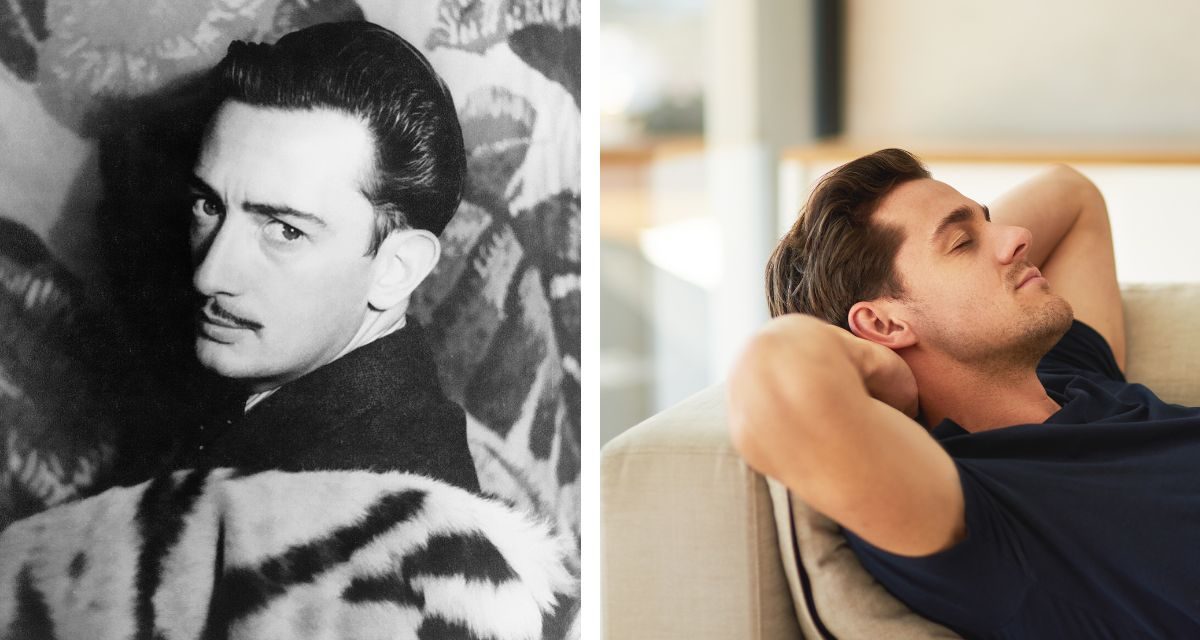
Salvador Dalí used a peculiar nap trick to capture ideas. Scientists now think he was onto something.
Full Article
Original Source
Read the full article at Upworthy →KhanList aggregates and links to publicly available news content. We do not host full articles from third-party sources. Always verify important information with original sources.