
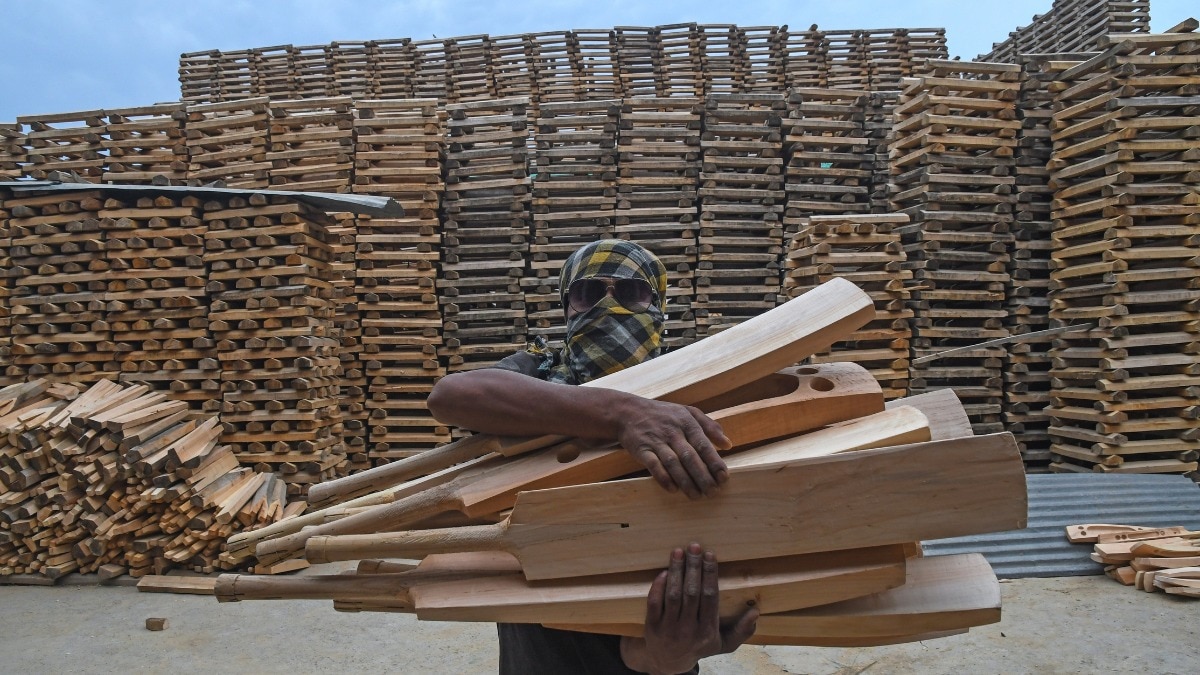
The cricket bat industry, which generates nearly Rs 300 crore in annual turnover and sustains over 100,000 livelihoods, is battling a critical raw material shortage“The first cricket bat in my life came from Kashmir. My elder sister had brought it from there.” Shaheen Ahmad Parray recalls these words he attributes to cricketing legend Sachin Tendulkar.Shaheen says Tendulkar had shared the anecdote while visiting his family’s bat manufacturing unit in Awantipora’s Chursoo, located on the Srinagar-Jammu national highway, in February 2024. Tendulkar was on a personal trip to the Kashmir Valley with his family, had spent time at the factory, and shared a video of the interaction on his social media timeline.That visit and Tendulkar’s endorsement underlined the global trust Kashmir willow bats command. Cricketers from Sri Lanka, Bangladesh and Afghanistan have used them for years. Demand rose further after players from Oman and the UAE wielded Kashmir willow bats during the Men’s T20 World Cup in the UAE (2021) and Australia the following year.To bring professional-grade Kashmir willow bats under a quality framework, the Bureau of Indian Standards (BIS) has included them under the ISI Mark. Yet the industry that generates nearly Rs 300 crore in annual turnover and sustains more than 100,000 livelihoods, directly or indirectly, is battling a critical shortage of the most essential raw material: the Kashmir willow itself. “South Kashmir, in particular, is grappling with a shortage of the Kashmir willow, the raw material that sustains the bat industry,” Shaheen tells INDIA TODAY. “Earlier, most of the willow was sourced from there. Now, manufacturers have to scout for it from north Kashmir. The southern region has faced this shortage for over seven years now.”Shaheen runs the MJ Sports Bat factory. On an average, a factory needs a stockpile of over 100 quintals of finished and seasoned willow clefts to sustain operations and keep production running uninterrupted.While sale of finished bats has been robust—“God has been kind,” notes Shaheen—the industry has repeatedly flagged the raw material crisis to the Jammu and Kashmir government. “If the government does not take this issue seriously, the Kashmir bat industry is doomed. It is an existential threat,” warns Shaheen.Takeover of willow-bearing community landBashir Ahmad Shah Veeri, leader of the ruling National Conference and MLA from Bijbehara, shares the concern. He recently submitted a policy paper to the government, outlining steps to revive the bat manufacturing industry and securing a steady supply of quality willow.“Two factors have driven the shortage,” says Veeri. “First, many farmers, particularly in south Kashmir, replaced Kashmir willow with Russian poplar timber or converted their land into apple orchards, both of which offered quicker or more sustained returns.”“Second, large tracts of willow-bearing community and grazing lands, especially in Anantnag district, were taken over after 2019 (abrogation of Article 370 and withdrawal of J&K’s special status) for setting up government institutions and industrial estates,” he claims.Ironically, in 2017, more than two million willow trees—once a key source of raw material for cricket bat manufacturers in south Kashmir as well as for fruit boxes—were marked for chopping around the Wular Lake in north Kashmir under plans to revive one of South Asia’s largest wetlands and Kashmir’s biggest flood basin.“These willow trees around Wular were planted to act as a buffer against flood waters and to sustain the local economy and farmers, who raised cattle and sheep underneath the willow shade. The wood from these trees would supply local sawmills for the manufacture of apple boxes while the best quality would go for manufacturing bats,” says Ghulam Nabi, a resident of north Kashmir’s Sonawari village, nestled on the southern flanks of the Wular Lake.Like other villages around the lake, Sonawari was once dotted with acres and acres of Kashmir willow trees. Willow plantation around the lake had started in 1924 to provide firewood and sustain the local economy, including animal husbandry and sheep farming. The Wular catchment was brought under the control of the J&K forest department in the 1980s.The cumulative effect of all these actions has been a steep decline in land under high-quality willow suitable for bat-making across Kashmir. Stakeholders also acknowledge that the authorities have not been able to prevent the export of willow clefts outside Kashmir.Veeri argues that instead of acquiring fresh cultivable land for new industrial estates, the government should first assess the utilisation, employment generation and future viability of existing estates.Kashmir has close to 400 functional cricket-bat manufacturing units and cleft dealers, concentrated mainly in the Sangam-Awantipora belt, which falls in the assembly constituency represented by Veeri. These units produce nearly 1.5 million bats a year, which are supplied across sports markets in India. The sector supports a wide network of farmers, willow growers, timber suppliers, manufacturers, wholesalers, retailers and transporters.Revival missionTaking cue from its recent engagement with manufacturers, Veeri suggests that the J&K government launch a comprehensive ‘willow revival mission’ involving the departments of forest, environment, agriculture, industries and commerce, horticulture and sports, along with other stakeholders.He notes that chief minister Omar Abdullah, during his interaction with bat manufacturers at south Kashmir’s Sangam in July, assured a steady supply of quality willow. “The chief minister also agreed with the suggestion to reclaim the Marhama Nambal marshy area, spread over 3,000 kanals (375 acres), and develop it into scientifically planned compartments for water-intensive willow cultivation,” says Veeri.Suitable areas in Ajas (Bandipora) and the catchments around Wular Lake could likewise be developed for Kashmir willow, subject to environmental safeguards and scientific assessment, it was pointed out to the chief minister.Smuggling of willow cleftsMohammad Niyazul Kabeer, director and founder of GR8 Sports, a manufacturing company in Sangam whose willow bats have been used by players from Sri Lanka, Bangladesh and Afghanistan, is sceptical. He says planting new willow trees was a long-term plan and won’t solve the immediate shortage of raw material.“The government should first plug loopholes to completely stop the smuggling of willow clefts from Kashmir,” says Kabeer, adding that despite a ban, thousands of unfinished Kashmir willow clefts find their way to factories in Punjab and Uttar Pradesh.“The government should investigate how the willow is being smuggled out of the Valley,” demands Kabeer. He claims around 300,000 unfinished willow clefts were being smuggled out of Valley every month.Given Kashmir’s limited land resources and closed geography, the stakes are particularly high. Without decisive action on the raw material front, an industry that once put Kashmir on the global cricket map risks fading into memory.Subscribe to India Today Magazine- EndsPublished By: Yashwardhan SinghPublished On: Aug 20, 2026 17:59 IST
Sachin Tendulkar's 'first bat' to a vanishing crop: The Kashmir willow crisis
Full Article
Original Source
Read the full article at Indiatoday →KhanList aggregates and links to publicly available news content. We do not host full articles from third-party sources. Always verify important information with original sources.