
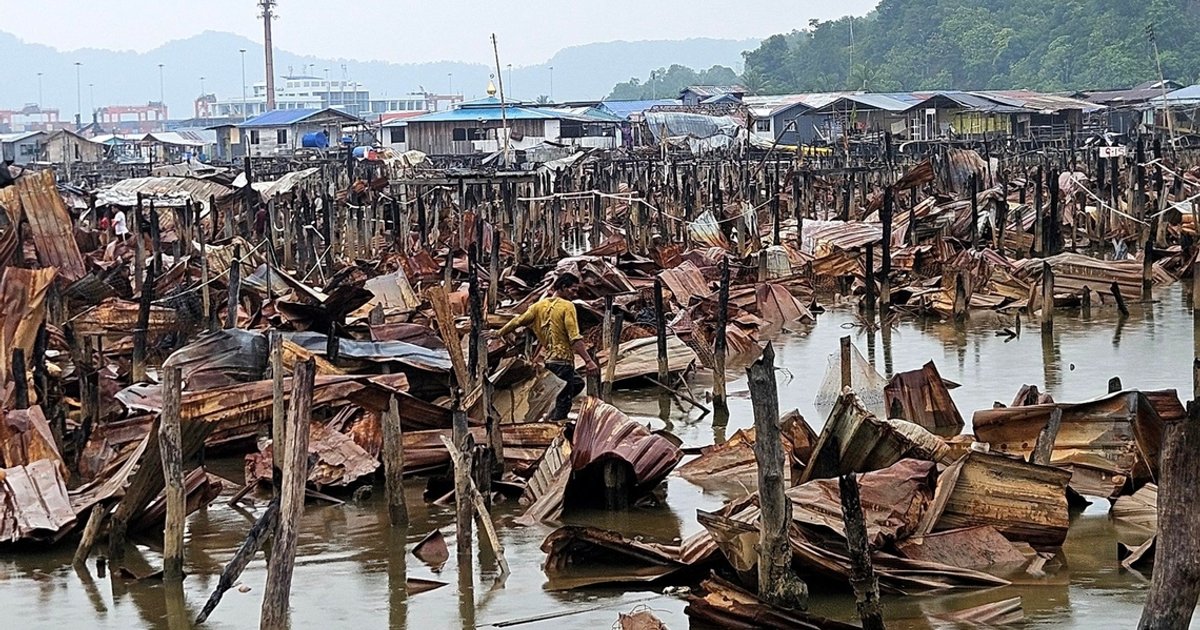
KOTA KINABALU, Sabah – Kampung Numbak villager Adurin Abdul Saris was asleep around midnight on Aug 30 when his brother-in-law, who lived next door, shouted “Fire!” The blaze, which started about 200 houses away, reached his 368 sq ft home, 15km north of Kota Kinabalu, Sabah’s capital, about two hours later.The inferno destroyed more than 200 houses in the water village, where homes are built on stilts over the sea. The cause of the fire remains unknown. Three children died in the blaze.When The Straits Times visited the site nearly two months later on Oct 13, rusted iron roofing and charred wood still littered the site of the fire. Half a kilometre away, rows of wooden stilt houses were being built as temporary shelters for hundreds of fire victims.The Sabah government in eastern Malaysia is considering gazetting some of the state’s 233 squatter settlements, including water villages, as part of efforts to improve fire safety.But making these settlements safer is complicated by questions over land status, identifying residents and determining who qualifies for housing or aid, amid Sabah’s long-running challenges with undocumented migration from the Philippines and statelessness. Narrow wooden walkways that impede access for fire engines and poor sanitation remain immediate concerns.Kampung Numbak villager Adurin Abdul Saris, whose house was lost to the blaze, sleeps at his car upholstery shop while his new home is being built. ST PHOTO: LU WEI HOONGAdurin, 31, who runs a car upholstery business inland, about five minutes’ walk from the water village, recalled the terrifying moment the fire struck.“Firefighters were here, but the water hoses couldn’t reach far enough to put it out. There was a small fire before in 2013, but nobody died. This is the worst,” he said.As ST spoke to Adurin at his house, which was being rebuilt on stilts after it was destroyed in the blaze, wild grass caught fire on a patch of land inland. Nearby, a group of youngsters continued playing badminton, seemingly undisturbed by the flames.“I am staying in my shop for now. Building with wood costs between RM10,000 (S$3,150) and RM15,000 – three times cheaper than a concrete house, which is unsuitable for a water village anyway,” added Adurin, who is of Bajau descent. The Bajau are an indigenous maritime ethnic group found across Sabah, Indonesia and the southern Philippines, with longstanding ties to coastal life and the sea.The disaster in Sabah’s water villages was not an isolated incident. In April, another major fire in Sandakan, Sabah’s second-largest city, engulfed 1,000 water village houses and displaced 9,000 residents.Following the Kampung Numbak fire, Sabah Chief Minister Hajiji Noor announced RM3,000 in cash aid. Prime Minister Anwar Ibrahim subsequently announced an additional RM1,500 for each of the 111 recognised heads of household.Children and teenagers playing near temporary wooden houses as dry wild grass burns nearby, on Oct 13. ST PHOTO: LU WEI HOONGAid and identity disputes after the fireA local non-governmental organisation chief, Rozli Abduri, 32, said that more than 400 households were affected, leaving those outside the official list of 111 households without assistance.“Those who did not get aid have to buy the wood themselves using their small savings. The majority of them are second-generation locals,” he told ST. He was referring to the children of locals, who are also Malaysian citizens.Some of those affected by the recent fire are not registered residents of Kampung Numbak, but a mix of locals and undocumented migrants illegally occupying the land, according to Parti Islam Se-Malaysia assemblyman Aliakbar Gulasan, whose constituency covers the area.“A lot of them claim to be from gazetted (or registered residents of) Numbak, but they actually come from neighbouring illegal squatter settlements,” he told ST.Aliakbar, who holds a doctorate in urban geography, proposes that the government build two separate housing areas – affordable housing for citizens in a gazetted settlement and transit housing for undocumented migrants. He estimates that three-fifths of the wider Kampung Numbak area’s 5,000 residents are citizens, while the remainder are undocumented migrants.“This is to separate them for easy identification. As most citizens work in trade, transport, restaurants and the service sector in Kota Kinabalu, it is better for them not to be relocated far from their current homes,” he said.Fire safety and Sabah’s migration legacyStructured resettlement would create a safer environment for firefighters and help curb the drug and weapon smuggling that has plagued these water villages for decades, said Aliakbar.The influx of Muslim migrants from the southern Philippines to Sabah increased sharply in the 1970s, as fighting between Philippine government forces and the Moro National Liberation Front, which sought greater autonomy for Muslim communities in the south, drove thousands to seek refuge in Sabah.Over the decades, migration has contributed to the state’s complex mix of citizens, non-citizens and stateless residents. Non-citizens comprised 27.3% of Sabah’s population in 2025, according to Malaysia’s Department of Statistics. Stateless residents can face barriers to formal schooling and other services, leaving them particularly vulnerable to social problems.“Schooling is crucial for the stateless to prevent social decay,” added Aliakbar.In December 2025, Sabah Local Government and Housing Minister Mohd Arifin Mohd Arif said 45 out of 233 squatter settlements were proposed for gazettement. The number of settlements has fallen by 18% from 285 in 2023.Rubbish accumulating beneath stilt houses due to a lack of proper garbage disposal services in ungazetted settlements. ST PHOTO: LU WEI HOONGGazettement is one of several measures the state has outlined to address squatter settlements. These include “construction of affordable and low-cost housing on-site and land swops involving titled land affected by squatter settlements”, he was quoted as saying by local paper the New Straits Times.Arifin did not respond to ST’s request for comment by press time.Meanwhile, Adurin hopes to one day build a home onshore near Kampung Numbak, on land that may be gazetted in future.“I hope I won’t have to live in a house in a water village any more, just to be safe from fires. Stateless migrants have given the area a bad name. We, the original locals, suffer from the stigma,” he lamented.Sign up for our weekly Asian Insider Malaysia Edition newsletter to make sense of the big stories in Malaysia.
Sabah’s water village fires fuel calls for safer housing
Full Article
Original Source
Read the full article at Straitstimes →KhanList aggregates and links to publicly available news content. We do not host full articles from third-party sources. Always verify important information with original sources.