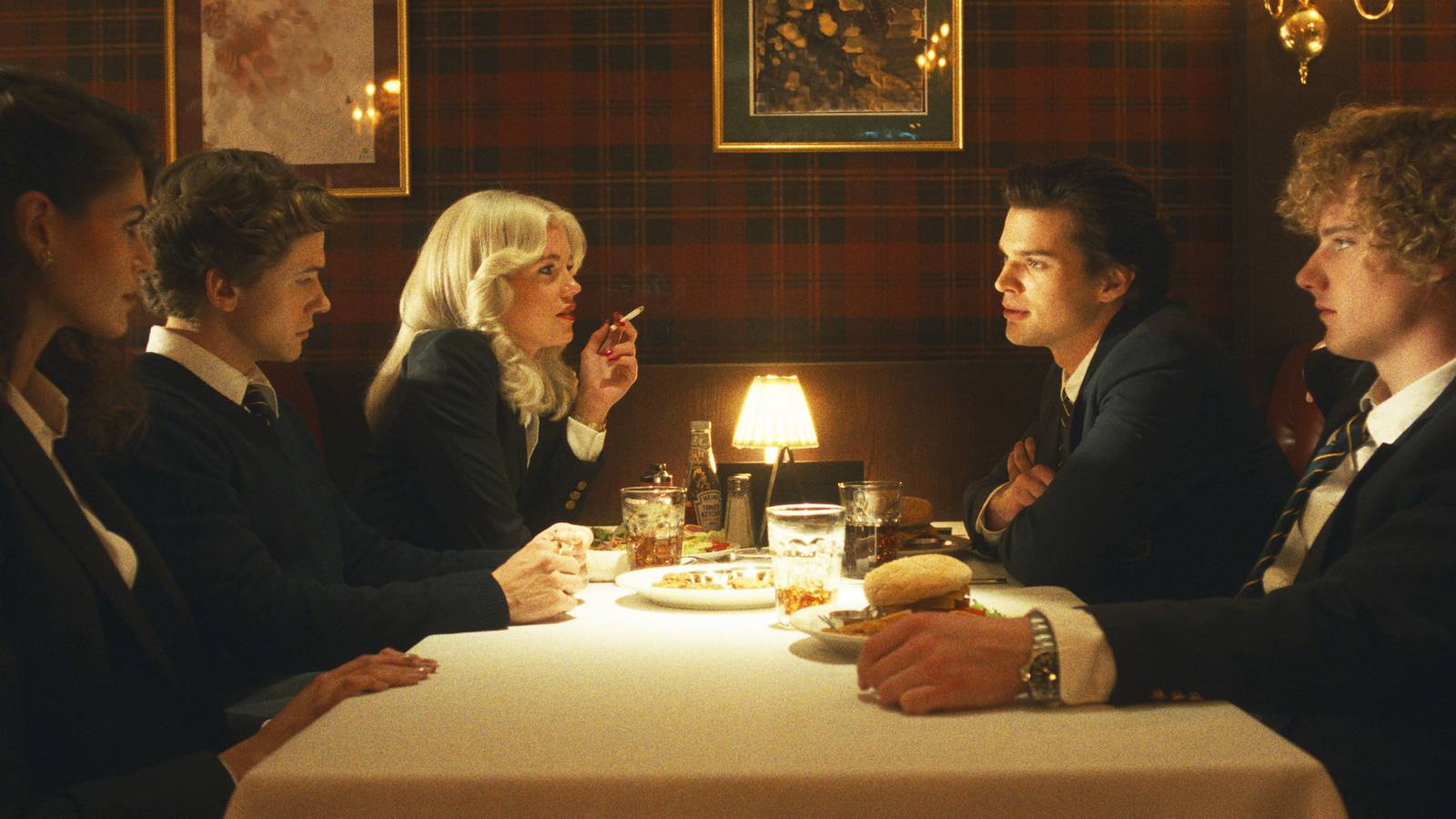
FX Published Aug 5, 2026, 11:00 AM EDT Gabrielle Moss has been writing about pop culture for over a decade, for publications including The New Yorker, GQ.com, Slate, Bustle, New York Magazine, and many more. Her book, "Paperback Crush: The Totally Radical History of '80s and '90s Teen Fiction," was released in 2018, and she was featured in the 2023 documentary "Judy Blume Forever." Sign in to your Collider account It’s tough to believe there’d be a Ryan Murphy without Bret Easton Ellis. Long before the uber-producer was putting out a steady stream of shows designed to push the limits of good taste, Ellis was doing the same in the literary world. A wunderkind whose edgy debut novel, Less Than Zero, was published when he was just 21 years old, Ellis eventually became interested in pushing boundaries — most notably with American Psycho, his famously gruesome horror novel (and inspiration for the 2000 Christian Bale film) that had its initial release cancelled by its publisher. In the decades since, Ellis has produced work of varying success and quality — including The Shards, his bestselling 2023 semi-autobiographical novel that put him back in the spotlight — but the throughline has always been his passion for transgression, even when it doesn’t quite make sense for the story. Sound like anyone else you know? Before he achieved pop culture visibility as the creator of the whimsical sitcom Glee, Murphy had already begun playing with taboos with Nip/Tuck, his frequently graphic 2003 series about a pair of horny, dysfunctional plastic surgeons. Murphy’s love for controversy only fully blossomed with the show that made him a household name: American Horror Story. His horror anthology series, about to debut its thirteenth season, has been on the air since 2011, and has been dogged by public outcry almost non-stop since, regarding everything from the show’s insensitive take on disability to its graphic depictions of every type of violence. Sometimes, Murphy pushes the envelope in service of unique and emotionally resonant storytelling, as in the case of his Emmy-nominated 2024 Monsters: The Lyle and Erik Menendez Story. Other times, boundaries seem to be broken for their own sake (insert your own favorite AHS unearned gross-out moment here). So it’s a surprise that, now that Murphy and Ellis have finally collaborated, the result is a bit… restrained. Though the idea of the two provocateurs joining forces likely sent a chill down the spines of network censors, The Shards is a stylish crime thriller that’s far more interested in the horror of growing up than blood and guts (though, make no mistake, there’s some blood and guts). Think of it, perhaps, as American Horror Story: The Breakfast Club. While it struggles to cohere at times, many of its individual parts are as enjoyable as the crowd-pleasing retro needle drops that fill the soundtrack. 'The Shards' Combines Emotional Torture With... Well, Real Torture At its heart, The Shards tells an old story: a group of friends finds their cozy world torn apart by a handsome stranger with hidden motives. This group just happens to be a clique of wealthy Los Angeles teens in 1981 — one of whom is Bret Ellis (Fall of the House of Usher’s Igby Rigney), an aspiring writer living a double life. At school, he’s the boyfriend of popular bad girl Debbie (Hayes Warner), and best friend to tightly-wound class president Susan (AHS alum Kaia Gerber) and dim-witted jock Thom (Graham Campbell). But by night, he’s secretly hooking up with Ryan, an athlete with a Duran Duran dye job (Daniel Dale), and school stoner Matt (Wednesday’s Owen Painter), about whom Bret feels complicated emotions that are forbidden in upper-crust 1981 California. The stress of balancing these two existences makes Bret so tense, he often looks like a rubber band about to pop, with a desperate-to-appear-relaxed smile-cum-grimace that might not be fooling anyone. Into this situation walks Robert Montgomery (Homer Gere), a leather pants-clad transfer student whose arrival coincides with a series of mysterious serial killings around the city. Bret both lusts after Robert and is convinced that he’s bad news, while Susan is so overpowered with desire that she helps Robert become popular, despite her long relationship with Thom. Soon, it’s clear that Bret isn’t the only person in his orbit with a secret, and as classmates begin to go missing, The Shards occupies itself with questions that go far beyond discerning the murderer’s identity — it wants to talk about innocence and experience, the loneliness of growing up, and the divide between our public and private selves. They’re heady questions for a show that also features a Silence of the Lambs-style basement torture dungeon and at least one decapitated head. But The Shards is at its best when it’s juggling these elements simultaneously: probing the nature of identity and the agony of adolescence while also indulging in the gleefully deranged camp-horror that Murphy is known for. The Cast's Vulnerable Performances Balance 'The Shards' Excesses “We are nice people,” Gerber’s Susan announces in the pilot, a statement that the rest of the series dedicates itself to disproving — not because the kids are catty stock characters found in any teen movie, but because in the world of The Shards, adolescence is a nightmare that turns “good kids” into paranoid, conniving liars, loose cannons, or, perhaps, murderers. This transformation starts slowly — the series begins with a quiet pair of episodes, co-written by Ellis and Murphy, that set up the ‘80s Eden that Robert is here to destroy. They also establish Bret’s premature-seeming suspicion, which seems just as fueled by his worry that Robert might have sussed out his secret as it is by any actual belief that the transfer student is dangerous. By The Shards' midway point, the series comes alive, playing with dark comedy in a way that evokes the best of AHS. Episodes set at a house party, a homecoming rally, and a Hairspray-style teen dance TV show, respectively, descend into entertaining pandemonium, subverting ‘80s teen clichés with venom and moments of surprising insight. Characters, especially Campbell’s Thom, grow in new and unexpected ways. However, the show does lose its way a bit in the final stretch as it moves towards the presumed unmasking of the killer, with abrupt changes in character motivations and new, distracting plotlines that feel a bit like a kid scrambling to do some homework they forgot about. Throughout the series, the cast turns in fine work, especially Rigney, who was a standout in Mike Flanagan’s adaptation of The Midnight Club. His tightly wound Bret is the show’s greatest asset; he communicates the emotions that Bret tries to repress through eyes that often seem on the verge of tears and a body that’s nearly vibrating with tension, whether he’s trying to solve a murder or just convince Debbie that he’s happy to be with her. His deadpan delivery of bon mots and vulnerable revelations alike gives the series all its brightest moments. Boy-next-door Thom goes through a character transformation that could have seemed absurd, but Campbell makes it feel not only natural, but inevitable. Similarly, Warner digs surprisingly deep into Debbie, turning what could have been a one-note party girl into a young woman deeply damaged by her self-absorbed parents. Speaking of those self-absorbed parents, Evan Rachel Wood has a glorious time as Debbie’s miserable mother, Liz, in an over-the-top camp performance that will surely launch a thousand screengrabs. After a quiet start, Broadway producer Jordan Roth becomes a key part of the show’s comedic chemistry as Steven, Debbie's family's put-upon assistant. Wes Bentley, sporting a thoroughly awful era-appropriate perm, makes Terry, Debbie’s predatory movie producer dad, appropriately unpleasant, thoughtless, and smarmy, but he never quite taps into the character's deep menace, whose money has insulated him from consequences so thoroughly that he’s lost touch with his humanity. Collider Exclusive · Horror Survival Quiz Which Horror Villain Do You Have the Best Chance of Surviving? Jason Voorhees · Michael Myers · Freddy Krueger · Pennywise · Chucky Five killers. Five completely different ways to die — if you're not smart enough, fast enough, or self-aware enough to avoid it. Only one of them is the villain your particular set of instincts gives you a fighting chance against. Eight questions will figure out which one. 🏕️Jason 🔪Michael 💤Freddy 🎈Pennywise 🪆Chucky TEST YOUR SURVIVAL → 01 Something feels wrong. You can't explain it — you just know. What do you do? First instincts are the difference between the survivor and the first act casualty. ALeave immediately. I don't need to understand a threat to respect it. BStay quiet and observe. If I can see it, I can understand it. If I can understand it, I can avoid it. CStay awake. Whatever this is, I am not going to sleep until I feel safe again. DConfront it directly. Fear grows in the dark — I'd rather know what I'm dealing with. ECheck everything, trust nothing. The threat might be closer than I think — and smaller. NEXT QUESTION → 02 Where are you most likely to find yourself when things go wrong? Setting is everything in horror. Where you are determines which rules apply. ASomewhere remote — a cabin, a campsite, off the grid and away from people. BA quiet suburban neighbourhood where nothing ever happens. Except tonight. CIn my own head — the most dangerous place of all, depending on what's already in there. DWherever children are — because something about this place attracts the worst things. ESomewhere ordinary — a house, a toy store, a place where the last thing you'd expect is a threat. NEXT QUESTION → 03 What is your most reliable survival asset? Every survivor has a quality the villain didn't account for. What's yours? APhysical fitness — I can run, I can swim, I can outlast something that relies on brute persistence. BSpatial awareness — I always know the exits, the hiding spots, the fastest route out. CPsychological resilience — I've faced my worst fears before. They don't have the same power over me. DEmotional steadiness — I don't panic. Panic is what gets you caught. EScepticism — I don't underestimate threats because of how they look. Size is irrelevant. NEXT QUESTION → 04 What kind of fear is hardest for you to fight through? Knowing your weakness is the first step to not dying because of it. AThe unstoppable — something that will not stop, cannot be reasoned with, and is always getting closer. BThe invisible — a threat I can feel but can't locate, watching from somewhere I can't see. CThe psychological — something that uses my own mind and memories against me. DThe unknowable — something ancient, shapeless, that feeds on the fear itself. EThe mundane — a threat so ordinary-looking that no one will believe me until it's too late. NEXT QUESTION → 05 You're with a group when things start going wrong. What's your role? Horror movies are brutally clear about who survives group situations and who doesn't. AThe one who says "we need to leave" first — and means it, even when no one listens. BThe one who stays quiet, watches the others, and figures out the pattern before anyone else does. CThe one who holds the group together when panic sets in — because someone has to. DThe one who asks the questions nobody wants to ask — because ignoring them gets people killed. EThe one who takes the threat seriously when everyone else is laughing it off. NEXT QUESTION → 06 What's the horror movie mistake you're most likely to make? Honest self-assessment is a survival skill. Denial is not. AGoing back for someone — I know I shouldn't, but I can't leave them behind. BAssuming I'm safe once I've found a hiding spot. That's when it finds me. CFalling asleep when I absolutely cannot afford to. Exhaustion is its own enemy. DLetting my curiosity override my instincts — I always need to understand what I'm dealing with. EDismissing the threat because of how it looks. That's exactly what it wants. NEXT QUESTION → 07 What's your best weapon against something that can't be stopped by conventional means? Every horror villain has a weakness. The survivors are always the ones who find it. AThe environment itself — I use the terrain, the water, the geography against it. BPatience — I wait, I watch, and I strike at the one moment it doesn't expect. CLucidity — if I can stay in control of my own mind, it loses its primary weapon. DCourage — facing it directly, refusing to run, taking away the fear it feeds on. EImprovisation — I use whatever's at hand, however unconventional. Creativity over brute force. NEXT QUESTION → 08 It's the final scene. You're the last one standing. How did you make it? The final survivor always has a reason. What's yours? AI kept moving. I never stopped, never hid for too long, never let it corner me. BI figured out the pattern before anyone else did — and I used it against the thing following it. CI stayed awake, stayed lucid, and refused to give it the one thing it needed most. DI stopped being afraid of it. And the moment I did, everything changed. EI took it seriously from the start — and I never once made the mistake of underestimating it. REVEAL MY VILLAIN → Your Survival Odds Have Been Calculated Your Best Chance Is Against…Your instincts, your strengths, and your particular way of thinking under pressure point to one villain you actually have a fighting chance against. Everyone else — good luck. Jason VoorheesJason is relentless, but he is also predictable — and that is the gap you would exploit. He moves in straight lines toward his target. He doesn't strategise, doesn't adapt, doesn't outsmart. He simply pursues. Your ability to keep moving, use the environment, and resist the panic that freezes most victims gives you a genuine edge. The Crystal Lake survivors were always the ones who stopped running in circles and started thinking about terrain, water, and distance. You think like that. Which means Jason, for all his indestructibility, would face someone who simply refused to be where he expected. Michael MyersMichael watches before he moves. He is patient, methodical, and almost impossible to detect — until it's too late for anyone who isn't paying close enough attention. But you are paying attention. You notice the shape in the window, the car parked slightly wrong, the silence where there should be sound. Michael's power lies in the invisibility of ordinary suburbia — the fact that nothing ever looks wrong until it already is. Your spatial awareness and instinct to map every room, every exit, and every shadow before you need them is precisely the quality Laurie Strode had. You are not a victim waiting to happen. You are someone who already suspects something is wrong — and acts on it. Freddy KruegerFreddy wins by getting inside your head — using your own fears, your own memories, your own subconscious as weapons against you. That strategy requires a target who can be destabilised. You are harder to destabilise than most. You've faced uncomfortable truths about yourself and you haven't looked away. The survivors on Elm Street were always the ones who understood what was happening and chose to face it rather than flee from it. Freddy's greatest weakness is that his power evaporates in the presence of someone who refuses to give him the fear he feeds on. Your psychological resilience — the ability to stay grounded when reality itself becomes unreliable — is exactly the quality that keeps you alive here. PennywisePennywise is ancient, shapeshifting, and feeds on terror — but it has one critical vulnerability: it cannot function against someone who genuinely stops being afraid of it. The Losers Club didn't survive because they were braver than everyone else. They survived because they faced their fears together, and faced them honestly. You ask the questions others avoid. You look directly at what frightens you rather than turning away. That directness — the refusal to let fear fester in the dark — is Pennywise's worst nightmare. It chose the wrong target when it chose you. You are exactly the kind of person whose fear tastes like nothing at all. ChuckyChucky's greatest advantage is that nobody takes him seriously until it's already too late. He exploits the gap between how something looks and what it actually is. You don't have that gap. You take threats seriously regardless of how they present — and you never make the mistake of underestimating something because of its size or appearance. Chucky relies on surprise, on the delay between recognition and response. You close that delay faster than almost anyone. Your instinct to treat every unfamiliar thing with appropriate scepticism — rather than dismissing it because it seems absurd — is the exact quality that keeps you breathing. Against Chucky, not laughing is already winning. You are very good at not laughing. ↻ RETAKE THE QUIZ While Gerber gets a lot of screentime, we don’t necessarily get much insight into what makes her ice queen character decide that she needs to bust loose, no matter the consequences. However, if the show has a weak link — aside from Murphy and co.’s typical wild tonal swings — it is Homer Gere, veteran of the last season of Euphoria and son of ‘80s sex symbol Richard (Gere’s breakthrough, 1980’s American Gigolo, is name-checked on the show). Gere hardly does a bad job — he portrays Robert as a classic smiling-to-your-face back-stabber, the likes of which you might genuinely find in the halls of any high school. But Robert is supposed to be the black hole that every other character gets sucked into (in the pilot, Bret likens him to a “virus” destined to “destroy the very cellular structure of my friends”). The character is framed as a manipulator, a symbol of innocence lost, so exploding with eroticism and menace that it’s easy for us to understand why Bret becomes fixated and Susan re-arranges her life for him. That’s a tall order for anyone, but especially someone so young and with only a few credits under their belt. Pop culture signifiers show that Robert is supposed to be an object of unspeakable desire who’s happy to use that power to malevolent ends: he quotes the baddies in A Streetcar Named Desire and Chinatown, and his arrival on screen is soundtracked by the Cars’ “Moving in Stereo,” the song from Phoebe Cates’s infamous pool scene in Fast Times at Ridgemont High. But while Robert’s sexy malevolence drives the plot, it’s not really fully on display. The show’s production design is also surprisingly restrained; the show uses its ‘80s setting judiciously, never falling into a Stranger Things-style retromania. ‘80s excess, from a visual gag about American Psycho-style haute cuisine to shots of luxury cars and pools that gleam like still-life paintings, is mostly a tool to illustrate how lonely our protagonists are, even with the wealth and power given to them as birthrights. This is a Ryan Murphy show, so, of course, there are some problematic moments: an unnamed disability is handled with a true minimum of sensitivity, and while the show’s running theme of teenagers being targeted by sexually predatory adults is sometimes handled with depth, care, and thoughtfulness, there are also moments when it’s played for laughs. But really, the most shocking thing about The Shards might be how not shocking it is. A few relatively WTF moments aside, the series is most concerned with what will happen to Bret as he enters an adult world that he’s desperate to participate in but not ready to handle. It never quite reaches the coming-of-age peaks it’s aiming for, but it's difficult not to get invested in what's happening to Bret and his friends (even if it isn't always clear what, exactly, is happening to Bret and his friends). The Shards never gets into the over-the-top emotionality that AHS often uses to paper over its flaws. Instead, the show, like its protagonist, plays its cards close to its chest, and hopes you care enough to lean in and read them. The Shards premieres August 5 on FX. The Shards A stylish crime thriller that's surprisingly restrained. Release Date August 5, 2026 Network FX, Hulu Directors Max Minghella, Crystle Roberson Dorsey, Michael Uppendahl, Ryan Murphy Cast Kaia Gerber Susan Reynolds Pros & Cons Excellent performances elevate the material. The series puts more focus on emotions, not outrageous violence. Plenty of campy fun. Some actors feel miscast in their roles. The series loses focus late in the season.
Ryan Murphy's New Crime Thriller 'The Shards' Is 'American Horror Story' Meets 'The Breakfast Club' | Review
Full Article
Original Source
Read the full article at Collider →KhanList aggregates and links to publicly available news content. We do not host full articles from third-party sources. Always verify important information with original sources.