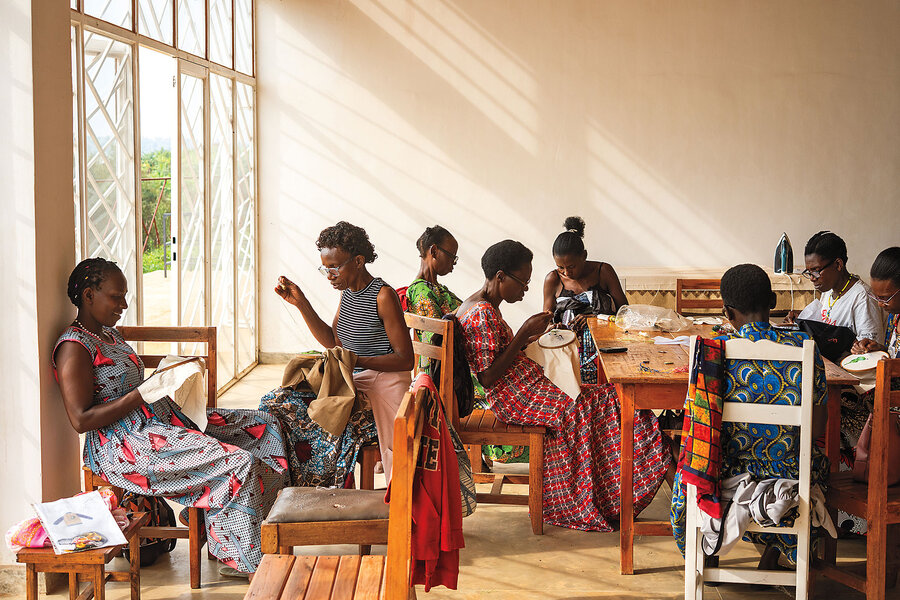
A large, white building sits atop a small hill above the village of Rutongo. Inside, sunlight spills onto the tables where embroiderers sit, their needles dancing in near silence across stretches of fabric. Colorful patterns take shape, revealing the silhouettes of savanna animals, such as lions and giraffes, alongside figures of women and multicolored beetles.This is the workshop for KORUM, an all-female Rwandan cooperative that has given 21 women economic independence and helped them recover from the lingering aftermath of the 1994 genocide. Before that violence ravaged the country, killing an estimated 800,000 people, many of the women in KORUM had been trained in the patient craft of embroidery in a workshop run by Belgian nuns.In 2012, French siblings Véronique and Pascale Gamard and their cousin Solange revived the workshop. They created Ibaba, an embroidery and clothing brand that is KORUM’s main client. Ibaba means “bird wings” in Rwanda’s national language, Kinyarwanda. Why We Wrote This The women of KORUM embroider every weekday, with some walking more than an hour each morning to reach the cooperative’s worktables. In a country where more than half the population lives below the poverty line, the women are able to support their families independently. Though women hold over 60% of parliamentary seats, following quotas and reforms, structural inequalities persist in the country. Women remain concentrated mostly in the low-paying agricultural sector, and struggle to access formal employment and financial services. But the women of KORUM embroider every weekday, with some walking more than an hour each morning to reach the cooperative’s worktables. In a country where more than half the population lives below the poverty line, the women are able to support their families independently. CIRCLE OF OPPORTUNITY: A KORUM embroiderer works on a traditional Rwandan pattern. Many of the patterns reveal savanna animals. On this day, KORUM’s president, Alphonsine Nyiraminani, bursts out of a backroom, her purple dress catching the light. Though she acknowledges her role comes with heavy responsibilities, she speaks of it with pride. She is the main breadwinner at home, while her husband works shifts in a mine. She once farmed for a living but has always had a knack for needlepoint.Ms. Nyiraminani says she discusses openly with her husband how to allocate their income once school fees and food have been covered for their two children. She was able to purchase for her family what she describes as a “big television,” a visible source of satisfaction.As Ms. Nyiraminani prepares to leave the workshop and return to her house, she picks up her bag and says, “The best part is walking home while chatting with my co-workers and friends.”She then hurries after them, and together they amble down the hill. TRAINING GROUND: Belgian nuns once ran an embroidery workshop for women next to the Rutongo Catholic parish. Many of the women who studied there are now part of KORUM. THREADED TOGETHER: Spools of thread sit on shelves in KORUM’s workshop. ILLUMINATING A CRAFT: Judith Bapfaguheka, in KORUM’s light-filled workshop, says, “My specialty in embroidery is giraffes; that’s what I do best.” MOVING MOUNTAINS: An embroidery depicts the landscape of Rwanda, which is nicknamed “Land of a Thousand Hills.” SUCCESS SYMBOL: Pélagie Nyiraneza (seated), who learned embroidery in the nuns’ workshop in Rutongo, says she was able to buy a television because of her work with KORUM, like some of the other women.
Rwandan cooperative allows women to stitch together a livelihood
Full Article
Original Source
Read the full article at Csmonitor →KhanList aggregates and links to publicly available news content. We do not host full articles from third-party sources. Always verify important information with original sources.