
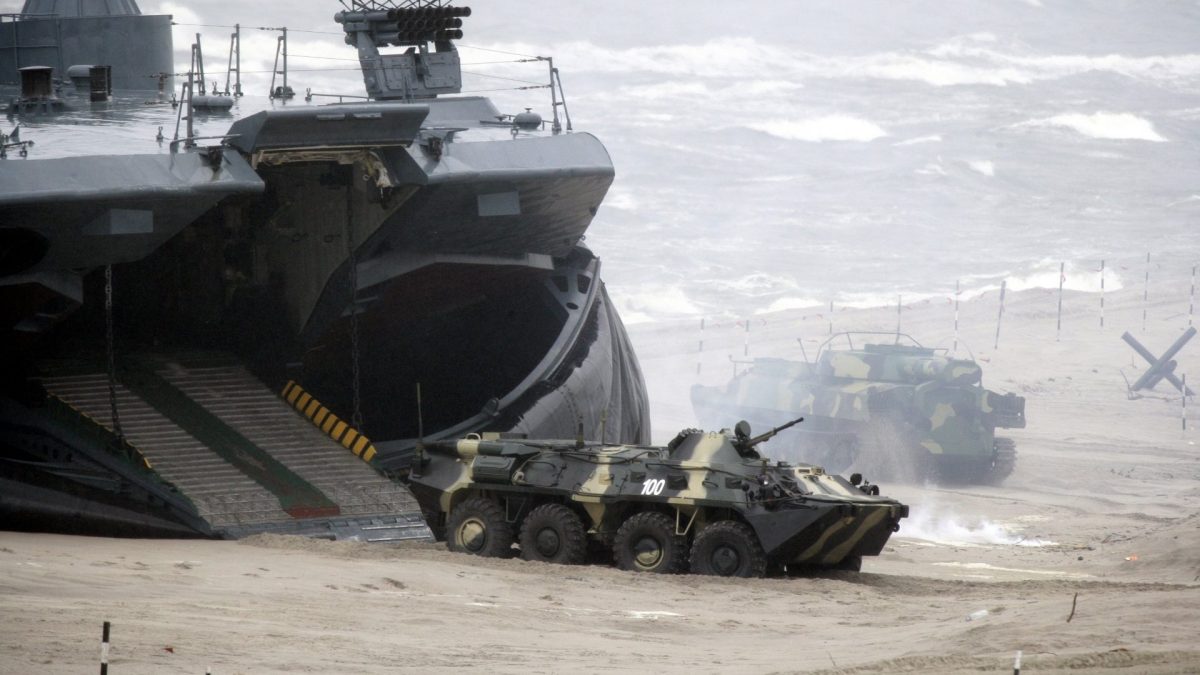
Russia’s Kaliningrad exclave, which sits between Poland and Lithuania deep inside Nato territory, has long been considered a grave threat to European security, with the ‘Suwalki Gap’ that separates it from Belarus often cited as the most likely place for World War III to break out. The Kremlin turned the territory into a fortress after claiming it from Germany at the end of the Second World War, making it a base for its Baltic Sea fleet and the 12,000-strong 11th Army Corps. The exclave has for decades posed a menace to its European neighbours through jamming flights, espionage and weapons testing. But Kaliningrad’s defences have been depleted, with much of its military personnel and firepower reassigned to Ukraine. A territory once seen as a threat to Nato could now be a weakness for Vladimir Putin that is waiting to be exposed, according to officials and security experts. Shorts “Russia knows it’s a vulnerability,” said one former Nato official. A regional security analyst called it “the Achilles Heel of the Russian Federation”. Nato has options for targeting Kaliningrad that could be used to gain leverage over Russia – to compel the Kremlin to curb sabotage attacks on Europe or take peace talks with Ukraine more seriously. The territory could be exposed to economic and supply chain disruption, psychological warfare or grayzone-style attacks that Moscow has increasingly used against Europe. Poland’s foreign minister, Radoslaw Sikorski, suggested earlier this month that Nato should deploy troops around Kaliningrad that would force Putin to pull units from Ukraine to defend it. “We closely monitor, as you may imagine, the Kaliningrad exclave. There are hardly any troops there,” he said at a conference in Kyiv. “We should exercise so aggressively on our side as to make… Putin uncertain of what we will do, and so that he needs to draw forces away from Ukraine.” The once-mighty 11th Army Corps that guarded the exclave was sent to Ukraine in the first weeks of the war, and has suffered heavy losses. What remains of the exclave’s defences are thought to be vulnerable. Map showing the Russian exclave of Kaliningrad and surrounding area (Graphic: Sylvie Husson and Sophie Ramis AFP/Getty) “They’ve got a handful of planes but no hardened runways or bunkers,” Edward Lucas, a British security analyst and founder of the Baltic International Security Centre think-tank, told The i Paper. “They’ve got a handful of ships but the harbour has no air defences. There are no ground troops. Everything has been stripped out to go to Ukraine.” Lucas believes Kaliningrad is “basically defenceless” and Western leaders can leverage this against Russia’s escalating covert aggression against Europe. “The key message from Nato should be: if you try anything, you lose Kaliningrad,” he said. This message could be strengthened by aggressive military manoeuvres around its border, or threats to de-recognise Russian sovereignty, said Lucas, adding that Europe could also respond to sabotage through cyber attacks on Russian financial infrastructure. Nato could also move to isolate Kaliningrad with forms of blockade. There are already strict controls on the movement of goods and people from the territory to neighbouring countries, which the Russian population of about a million could freely visit before the war. The European Union forced a reversal of a move by Lithuania to cut off rail supplies after Russian threats, allowing vital goods to reach Kaliningrad. But Vilnius later imposed further restrictions on sanctioned oil supplies. Lithuania installed photos from the war in Ukraine at train stations for Russians to see when they travel to and from Kaliningrad (Photo: Paulius Peleckis/Getty) European leaders could go further with restrictions, and make clear that changes are contingent on Russian behaviour, said Edward Hunter Christie, a former Nato official and managing director at the Economic Security Forum, a Finnish geo-economic advisory company. “European governments could impose a high degree of lawful economic friction around Kaliningrad and the wider Baltic Sea region,” he said. “This would impose economic costs on Russia. It would also convey the notion that we would be able and willing to interdict all movement, should we so decide.” Hunter Christie added: “The new leverage could be dampened, intensified, or simply removed, depending on Russian behaviour, and that linkage would be conveyed clearly.” Russia is taking such threats seriously. Yulia Zhdanova, a senior Russian diplomat, claimed this month that Nato is preparing to impose a blockade on the exclave, and Putin recently met with its governor, Alexey Besprozvannykh, reportedly to discuss fuel supplies and strategic reserves. But aggressive steps against Kaliningrad would carry risks. Russian officials have made frequent threats in response to proposed actions against the exclave. In December, Putin warned that any such moves would take the current conflict “to a completely different level”. Markus Reisner, an Austrian military official and analyst of the Russian military, said that while Kaliningrad is vulnerable – and Nato leaders would be justified in responding to grayzone warfare by targeting it – there is reluctance to enter a possible escalation spiral. The population of Kaliningrad experienced a more Western lifestyle before the war, with easy travel to the rest of Europe (Photo: Michal Fludra/NurPhoto/Getty) “Are we heroic enough to be willing to take the fight to the enemy?” he asked. “I am sure the Russians will see a blockade as a casus belli (justification for war).” Moscow could also take steps like seeking to impose counter-blockades on the Baltic states, he said. Meanwhile, there may be a more subtle way to press Russian vulnerability in Kaliningrad through messaging to its population, said Milosz Cordes, a Polish academic and former diplomat who previously served at Warsaw’s consulate inside the exclave. The Kremlin has neglected its subjects in Kaliningrad, who were used to a more Western lifestyle than their compatriots in mainland Russia before the war, he told The i Paper. “The social and economic situation is deteriorating at a higher pace than the rest of the country.” Nato governments could therefore seek to “expose Moscow’s inability to provide for their own citizens” to fuel internal dissent, Cordes said. He also believes that the current vulnerability of Kaliningrad could serve as a deterrent at a time the Kremlin is increasing its threat to Europe. “Any large-scale kinetic aggression in the region would trigger an immediate response targeted at Kaliningrad,” he said. “I am sure there is a list of installations that would be subject to such a response,” he added. “The result would be nothing short of scorched earth across the whole of the province.”
Russia’s tiny outpost in Europe could be Putin’s greatest weakness
Full Article
Original Source
Read the full article at Inews →KhanList aggregates and links to publicly available news content. We do not host full articles from third-party sources. Always verify important information with original sources.