
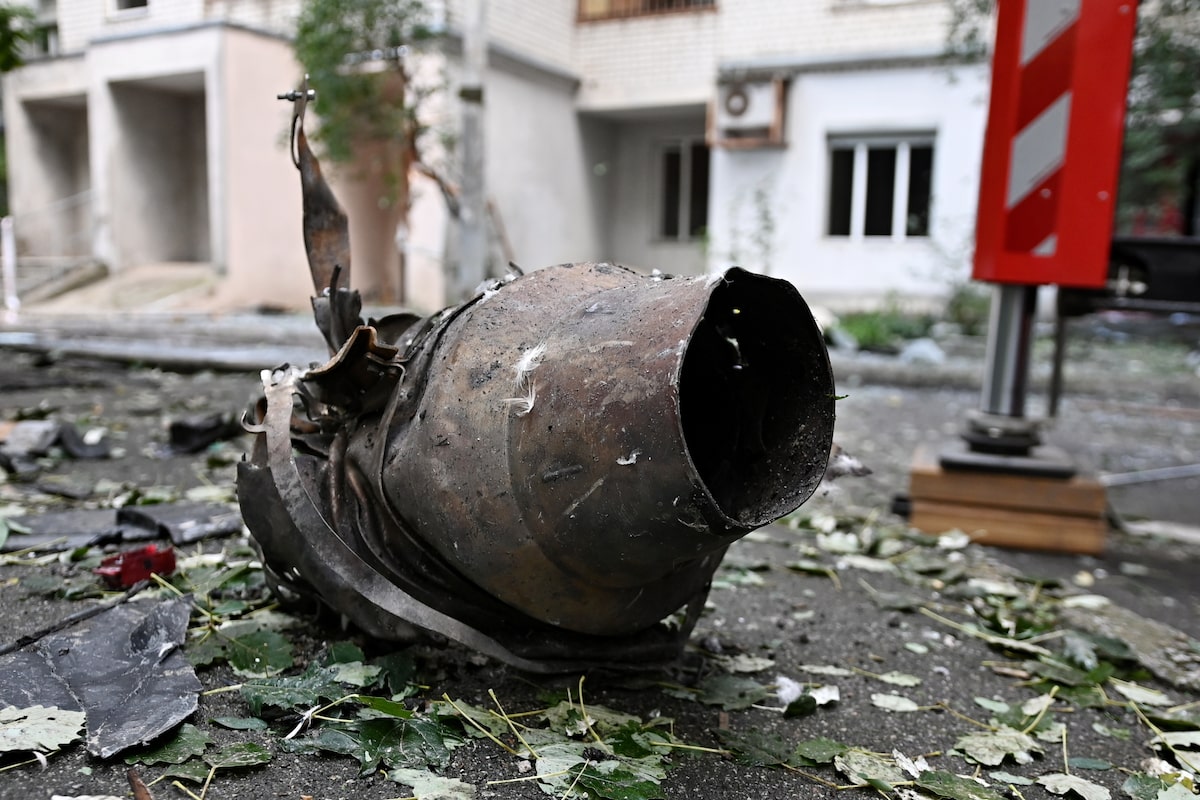
Open this photo in gallery:A close-up view of the jet engine of a Geran-5 type unmanned aerial vehicle at the site where a Russian strike drone hit an apartment building in Kyiv, Ukraine, during an attack last month.Oleksandr Gusev/NurPhoto/ReutersAs drones transform the war in Ukraine, Ukrainian and Russian engineers are racing to outdo each other in developing faster, more deadly unmanned aircraft.The Russians recently gained the upper hand with the introduction of two new versions of their jet-powered Geran drones, which are twice as fast as previous models and soar high above air-defence systems. The Geran-4 and Geran-5 are the latest iterations in Russia’s unmanned aerial vehicle program, which began shortly after the full-scale invasion of Ukraine with cheap Iranian UAVs that were little more than small missiles with preprogrammed flight paths. The new Gerans are not only faster, they have cameras, radio communication capabilities, extra missiles and anti-jamming equipment. They can also climb six kilometres into the air, beyond the reach of machine guns or shoulder-fired weapons. Both models are being deployed to target Ukrainian cities and infrastructure, day and night. Ukraine’s military is working on countermeasures, but so far they’ve had little sustained success with anything but expensive Patriot missiles, which are in short supply. Analysts say the new drones illustrate how the Russian military has evolved from a lumbering, inefficient bureaucracy − evidenced by the heavy casualties of the early stages of the war − into an agile innovator.Russian drone engineers have leapt ahead of their Ukrainian counterparts for now, as military planners in Moscow have managed to get around sanctions and develop intricate supply lines to source thousands of UAV components from the United States, Germany and other Western countries.“Now we see that Russia has the capacity to innovate,” said Marina Miron, a postdoctoral researcher in defence studies at King’s College London. “We’re seeing essentially not just military adaptation, but the institutional adaptation and the industrial adaptation.”What are the Geran drones? The Russian military started using drones to some extent around 2015 through its involvement in Syria. But the weapons were large, expensive and easy to shoot down. Shortly after invading Ukraine in February, 2022, Russia turned to Iranian-made Shahed-131 and Shahed-136 drones. They had first been deployed in 2019 by the Iranian-backed Houthis in Yemen in their war against the Saudi Arabian army.The Shaheds, which means “witness” in Farsi, are effective and cheap, costing about US$20,000 apiece. They can travel as much as 2,000 kilometres and carry a precision-guided missile that follows a preprogrammed flight path.The Russians renamed the UAVs Geran-1 and Geran-2 − the Russian word for “geranium” − and soon developed their own versions. They reinforced the airframe, replaced the 50-horsepower piston engine with a Chinese engine and added a Russian-made anti-jamming antenna system. The Iranian-made warhead was also swapped out for a more explosive Russian one loaded with shrapnel. In the Ukrainian city of Kramatorsk, drones rule the skies and everything belowIn 2023, Russian engineers came up with a way of communicating with the drones, and by 2025 the Gerans featured radio network modems that allowed operators to alter the vehicle’s flight path and monitor troop movements on the ground. Some were equipped with cameras at the front and back and extra payloads for the mid-flight release of decoy missiles, anti-tank mines or air-to-air missiles. “The Geran was no longer purely a preprogrammed munition flying to a fixed coordinate. It had become a remotely-piloted strike aircraft that could loiter, observe, identify targets, and be redirected mid-mission by an operator watching a live video feed,” said an analysis by Kateryna Bondar, a senior fellow at the Center for Strategic and International Studies in Washington. What makes the Geran-4 and Geran-5 so dangerous?In 2024, the Russians replaced the piston engine with a Chinese-made turbojet that doubled the drone’s speed to about 480 kilometres per hour. The first jet-powered Geran-3 had a shorter range − 600 kilometres − than the Shaheds but flew at a higher altitude.The Geran-4 has a more aerodynamic delta shape than the Geran-3 and a Russian jet engine. It can reach speeds of more than 500 kilometres per hour and has a range of about 850 kilometres. The delta shape and the airframe still had difficulty withstanding the stress of high speeds. As a result, the Geran-5 is shaped like a cruise missile. That design makes it roughly 100 kilometres per hour faster than the Geran-4. It also has greater range, around 950 kilometres, and flies at an altitude of about 6,000 metres, much higher than earlier Gerans. Ukraine will hold elections if Russia agrees to 60-day ceasefire, Zelensky saysThe Geran-5 can also be launched from a fighter jet or a helicopter, which increases its range, and its camera system is linked to digital maps that allow the drone to select targets autonomously. Both models cost upwards of US$100,000 apiece − much more than the Shaheds but far less than the US$4-million for one Patriot missile. By some estimates, Russia’s two drone factories are pumping out as many as 3,000 Geran-4s and Geran-5s a month. What can Ukraine do?Throughout the war, Ukraine has been successful in matching Russian drone innovations with inexpensive interceptors and electronic jamming technology. Wild Hornets interceptors cost a few thousand dollars each and were effective in shooting down 97 per cent of incoming Geran-1 and Geran-2s, largely by detecting the distinctive sound of the Gerans’ piston engines. Russia’s switch to jet-powered drones has nullified much of that advantage. And the speeds of the Geran-4 and Geran-5 pose further challenges. Interceptors can’t travel as fast, but Ukraine is testing a low-cost drone called the JetKiller that catches the Gerans when they have to slow down to save fuel. Early detection also allows the JetKiller to cross into the Gerans’ predicted flight path and cause a collision. The Ukrainian military has had some success destroying Geran-5s with automated machine-gun turrets that use artificial intelligence to identify targets. And it is testing a small interceptor rocket called Nika. Dr. Miron said Ukraine’s main issue is scaling up new air-defence systems. “Ukraine has great innovation capacity,” she said. “The problem for Ukraine in general is that a lot of its industry is decentralized and it seems that getting things together and producing them and delivering them is a huge problem.”Russia and Ukraine reach energy ceasefire, Trump saysWhat’s next?Russia is already modifying the Geran-5 by moving the jet engine inside the fuselage to reduce drag and increase its speed and range. The military still faces challenges building enough launch platforms for the new Gerans, which require longer rail platforms than older Gerans. In her analysis, Ms. Bondar cited three key patterns that have guided Russian drone innovation: constant experimentation, changes derived from battlefield feedback instead of document requirements, and rapid turnaround. “None of this is a tribute to Russian engineering brilliance,” she wrote. “Russia’s achievement is not in any particular component, but in its approach to the underlying production and innovation model.”Dr. Miron added that “the mindset, both in Ukraine and in Russia, is very different from the Western mindset.” People in both countries learned to adapt during the Soviet era, and Ukrainians and Russians have a strong engineering culture. “During Soviet times, everybody knew how to modify their radios in order to listen to Voice of America. So people are quite good at inventing things, and there are so many do-it-yourself approaches by both militaries on the battlefield, creating things which no Western military would do.”
Russia’s switch to jet-powered drones has given it another advantage in Ukraine
Full Article
Original Source
Read the full article at Theglobeandmail →KhanList aggregates and links to publicly available news content. We do not host full articles from third-party sources. Always verify important information with original sources.