
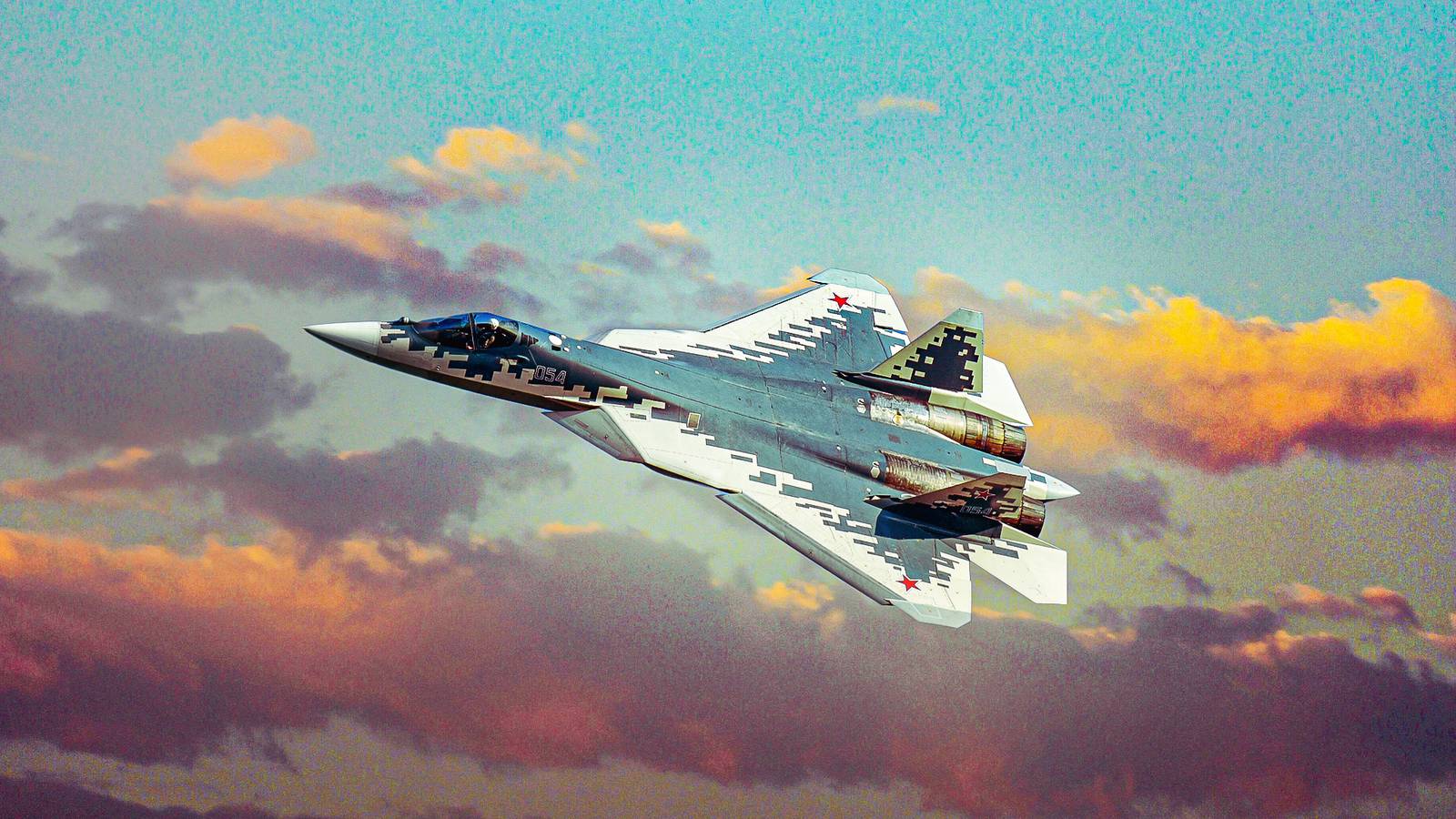
Published Aug 23, 2026, 2:00 PM EDT Aaron is an aviation enthusiast and world traveler with a deep interest in aerospace history and technology. He has traveled around the world numerous times, often incorporating visits to aviation museums and historic aircraft collections into his journeys. A native of New Zealand, he is an expert in aviation and maintains a broad interest in a variety of other subjects. One of the best predictors of a successful fighter jet program is how many units are produced. This is especially true for aircraft that are exported to other countries that select them objectively (as opposed to Soviet-style military aid). There are exceptions, perhaps the most obvious being the US Air Force's F-22 Raptor. The circumstances of that aircraft are different, as it was built for the Cold War, it entered service during GWOT when the need for the fighter had largely disappeared. Congress also banned its export. None of this is true for the Russian Sukhoi Su-57. The fighter was initially developed as a joint Russo-Indian program and was explicitly designed for export. It also entered service at a time of worsening geopolitical security, as Cold War legacy fighter jets are being retired and replaced around the world. It is only a mild exaggeration (explained below) to say no one has wanted to buy it, not even Russia. While the failure to export the Su-57 could be interpreted as a greater vote of no confidence in Russia than the aircraft itself, it's an insufficient explanation in light of Russia's own modest order. MiG-35 & Su-75 Vibes Credit: Shutterstock The Su-57 Felon entered service in 2020, and six years later, its sales are starting to resemble a somewhat better replay of the failed MiG-35. The MiG-35 was a comprehensive upgrade that Russia developed for the MiG-29. The aircraft was developed solely for export, although Russia purchased a token batch of six of them for its Swifts (Strizhi) aerobatic team. This purchase was widely seen as an attempt to kick-start serial production and provide a vote of confidence to facilitate international sales. Russia failed to secure a single international order (possibly influenced by the US's CAATSA). Russia's Sukhoi then announced it was developing the Su-75 Checkmate as the export-oriented successor to the MiG-29. As of 2026, it doesn't appear the project has attracted any firm international interest, while the Russian Air Force is similarly not interested. But the picture of the Sukhoi Su-57 Felon appears more complicated. Russia has ordered 76 examples that were supposed to be delivered by 2027/2028 (likely delayed), while Algeria is currently the only confirmed export customer and has reportedly ordered 14 examples. By the beginning of 2026, it was estimated that Algeria had two examples delivered and the Russian Air Force had between 20 and 30 examples. A Tiny Order For The Russian Air Force Credit: PLA MOD If Russia's air force is considered a power in the league of the US and China, then its planned purchase of just 76 fifth-generation fighter jets is tiny. The US military has so far procured 187 F-22s and received 800+ F-35s; its existing fifth-generation fighter jet fleet is around 1,000 or more fighters. The USAF has a program of record to procure 1,763 F-35s, the Marines 420, and the Navy 273, for a total of 2,456 F-35As. This is not counting next-generation F-47s. China doesn't release its procurement figures or plans. However, OSINT accounts suggest it had procured over 300 fifth-generation J-20s in 2025, and new serial numbers suggest it may have over 500 examples by mid-2026. This is unconfirmed, and it is unclear whether China deliberately changes the serial numbers to give the impression of more fighter jets or whether this is a reliable method to estimate Chinese fighters. The Chinese naval J-35 appears to have entered serial production in 2025. By mid-2026, it is plausible that China's PLANAF has more examples delivered than Russia does of the Su-57. It is also unclear if Russia has plans to increase its order for 76 Su-57 Felons. While that is possible, or even likely, no such plan has been announced. The Same Number As Australia Credit: Department of Defense Australia has a program of record of 100 F-35As, but it has announced it will stop at its current fleet of 72 F-35As equipping three squadrons. This essentially gives Australia the same planned fifth-generation fleet as Russia, while Israel, the UK, Italy, and Japan have plans (some partly unfunded) to purchase more fifth-generation fighter jets than Russia's current publicly known plan. In fact, it may be that Australia will have more operational F-35s than Russia will have Su-57s once its order is complete. The order for 76 Su-57s placed in 2018 explicitly included the first two serial production Su-57s (T-50S-1 and T-50S-2). Of these, T-50S-1 was lost in a mishap in December 2019. Another Su-57 crashed in July 2026 outside of Moscow. Unless Russia adjusts its order, it will only have 74 examples in service by fulfillment. At the same time, Ukraine is claimed to have hit and damaged Su-57s on the ground in two separate incidents in 2024 and 2026. Ukrainian sources have claimed to have damaged up to four Felons; of these, only one has been visually and independently confirmed by the Oryx blog. It remains unclear if the damaged airframe/s will be repaired and returned to service or if they will be written off. Domestic Focus On Flanker Series Credit: Shutterstock It appears that Russia's domestic focus for fighter jet procurement remains its Flanker series, including the Su-34 fighter-bomber and the Su-30/35 multirole fighters. Collectively, these remain the primary tactical aircraft used in the Ukraine conflict. The Su-35S remains Russia's primary air superiority fighter jet. For the period from 2020 (when the Su-57 entered service) to the end of 2025, Rusi's Justin Bronk estimates the Russian Air Force has taken delivery of 55-60 Su-35S jets, four to ten Su-30s, 48-50 Su-34s, and around 20 Su-57s. Open-source estimates for Russian production numbers for 2026 continue to show many more Flanker series built and delivered to the Russian Air Force than Su-57s. It is unclear why, although there are a number of possibilities that are not mutually exclusive. One factor is that the Su-57 is widely considered to be more exposed to Western sanctions than the Su-35S, and it may be lacking some of its key systems. Sukhoi Su-57 customers/potential customers Number planned (per TASS, etc.) Russian Air Force 76 (at least two lost) Algeria 14 India Approx. 100 (canceled) Another issue is that the aircraft remains immature (e.g., lacking its Izdeliye 30 / AL-51F-1 engines). Russia may be supporting a low rate of procurement and plans to increase the orders once it matures, but this is conjecture. The Su-57's principal attraction is its combination of low observability, sensors, and long-range weapons. But Russia has largely failed to establish air superiority over Ukraine, meaning that its tactical aviation is operating within a highly contested environment dominated by long-range SAMs, electronic warfare, and dispersed operations. This forces fighter jets to operate from stand-off ranges, which is a task the Su-34 can do. The Fighter Jet That Won't Sell Credit: Shutterstock A legitimate question to ask is, "If the Su-57 is so good, why doesn't anyone want to buy it?" To the extent the answer is understood, it's nuanced. One factor is that Western sanctions, including CAATSA, have discouraged countries from purchasing Russian fighter jets, with Egypt, Indonesia, and the Philippines canceling orders/plans for fighter jets and helicopters after CAATSA (2017). That said, orders/plans by Egypt and Indonesia were for the Su-35S jets rather than the then-upcoming Su-57. Perhaps most tellingly is India through its FGFA project. India is different from many other countries as it has ambitions to develop its own domestic fighter jet industry and places an extra-high emphasis on worksharing and technology transfer. In the 2010s, India saw the Su-57 as an opportunity and invested in its development. But India later walked away, saying the Su-57 didn't meet its requirements, with concerns about its stealth, avionics, sensors, and engine. CAATSA was also unlikely to be the central issue, as Su-57s would be built in India, likely bypassing the act like India's Su-30MKIs. There were also disagreements as to the extent of work-sharing and technology transfer Russia was willing to provide India. That said, it was probably greater than the agreement India is currently working out with France and Rafales to be partially built in India. In mid-2026, Indian officials confirmed "no more Sukhois" as the country focuses on sustaining its existing Su-30MKI Flankers, purchasing Rafales, and developing its own fighter jets. This leaves Algeria as the only confirmed export customer. The Real Factors That Influence Purchases Credit: Shutterstock Many articles consider factors like the Su-57's super maneuverability, speed, stealth, performance at airshows, and other more relatable factors for general readers. They will also often focus on the costs of different aircraft, often with poor apples-to-oranges price point comparisons. But these discussions often miss mundane but ultimately more important discussions. Purchasing fighter jets is often as much about financing, geopolitical relations, industrial concerns, worksharing, and decades-long confidence in the country providing the jets as it is about the advertised capabilities themselves. A country like Brazil may select the Gripen E, not because it is the most capable fighter, but because it's the best choice to set up a domestic fighter jet industry. Interoperability is also important. Should a small country like New Zealand ever rebuild a fighter jet fleet, it is heavily incentivized to maintain interoperability with Australia (automatically putting F-35s at the top of the list). Modern fifth-generation fighter jets are also defined much more by what happens inside the proverbial cockpit (sensor fusion, awareness, networking, etc.). A fighter jet able to demonstrate impressive maneuvers (like Cobra maneuvers) at an air show reveals nothing about how developed its awareness and sensor fusion are. Meanwhile, with Uzbekistan now reportedly receiving Chinese J-10CE fighter jets, the Su-57 has seemingly lost another of its potential export markets.
Russia's Su-57 Is Supposed To Challenge Western 5th-Gen Fighters — So Why Is Its Fleet So Small?
Full Article
Original Source
Read the full article at Simpleflying →KhanList aggregates and links to publicly available news content. We do not host full articles from third-party sources. Always verify important information with original sources.