
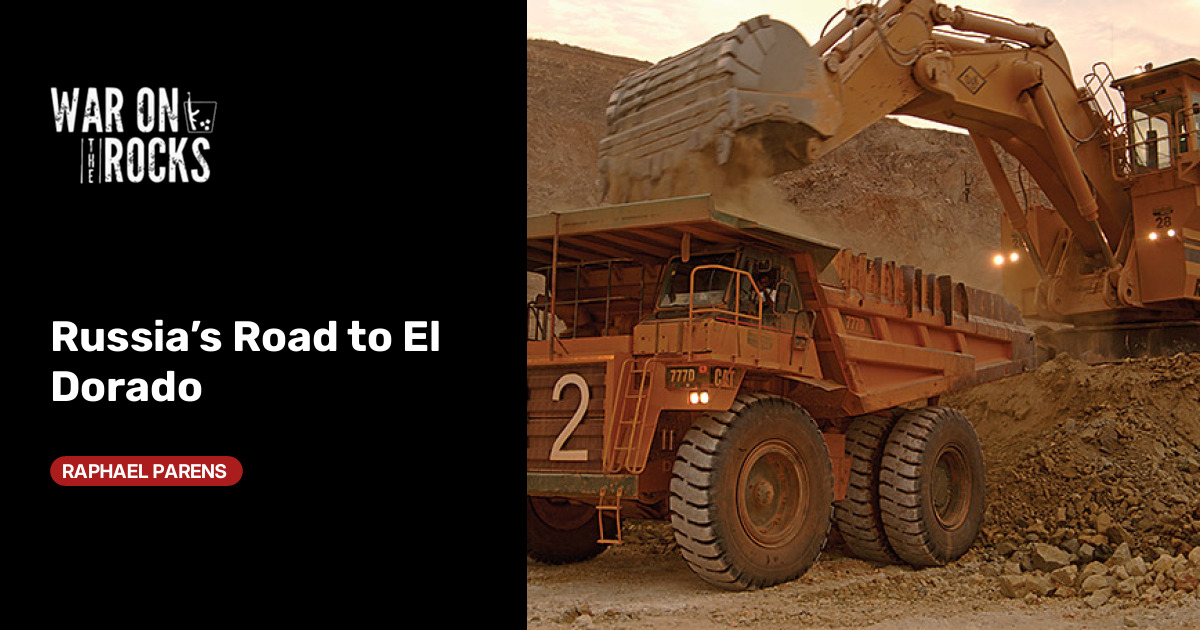
As a new convoy of Russian armored vehicles arrives from the port of Lomé to support Russia’s Africa Corps deployment in Mali, that mission has entered its fifth year. Russia’s investment of blood and treasure urgently demands a return, but what could this return be? What is the Russian end goal in Mali?When the Wagner Group, Africa Corps’ predecessor, entered Mali in December 2021, it was pursuing a resources-for-security deal like the one it had achieved in the Central African Republic. Along with my co-authors Chris Faulkner and Colin Clarke in our book, Moscow’s Mercenaries, I documented Wagner’s lessons learned, including the false hope that future operations would match the ease with which Wagner captured the state in the Central African Republic. There, the organization built a reputation as the guarantor of national security, and in return it gained full access to the state bureaucracy and economic access across the country — from gold and diamond mining all the way to beer and liquor sales. However, as I first argued in 2022, Mali proved a much harder nut to crack. Wagner’s failure to secure extractive resources in Mali was the beginning of the end for the organization, but Africa Corps — an organization directly beholden to the Russian state — has also failed to secure access to Malian gold after taking Wagner’s place.Wagner was unable to gain a foothold in Mali’s gold mining industry itself, a feat it had accomplished in the Central African Republic’s gold and diamond mines and Syria’s oil industry. Wagner was unsuccessful in unlocking Mali’s gold mines from the regime’s clutches, and Africa Corps has yet to demonstrate the business acumen of its predecessor. The Russian failure occurs as the Malian government aims to ensure its own control over gold mining within its borders — albeit requiring the continued investment of existing Western partners. This process began with a new mining code in 2023, which increased the government royalties and ownership stakes in mines, followed by the arrest of four Barrick Gold mining employees and an arrest warrant for Barrick CEO Mark Bristow in late 2024. Barrick and the Malian government then agreed to a settlement where Barrick would pay the state approximately $430 million in exchange for the freeing of its employees, dropped charges, and the renewal of operations. Malian President Assimi Goïta then drove to centralize Malian state gold mining via Sopamim, a state venture established to control all of Mali’s ownership stakes in the country’s mines. These developments have served to push Russia and its military entrepreneurs out of the gold business in Mali, while strengthening the Malian state and maintaining the role of Western mining companies in the country.While Wagner could not secure gold mining access themselves, the Malian government appears to have paid them with gold profits. Several sources cite U.S. intelligence, which claims that Wagner was being paid by the Malian junta government roughly $10.8 million per month. The Malian government was believed to be financing Wagner predominantly through taxes on international gold mining organizations, like Barrick, or directly via gold contributions when payments dried up. These claims are limited by guesswork and anecdotal evidence, and without a clear paper trail, they are very difficult to verify — underscoring the precarious nature of the financial agreements between Mali and Wagner. Regardless, the Royal United Services Institute for Defence and Security Studies argues that “operations in Mali were not profitable for Wagner.” Further, “even if the yearly profits accrued to the Russian state and not to [former Wagner leader Yevgeny] Prigozhin (which seems very unlikely), in all likelihood they would not be enough to pay the costs of only one day of Russia’s fighting in Ukraine.” Instead, the payment structure kept the economic power in the hands of Bamako.Africa Corps and the Kremlin have attempted to keep the pressure on Bamako. Russian conglomerate Yadran Group is partnering with the Malian state to build a gold processing facility, which broke ground in June 2025. However, Polish experts Filip Bryjka and Jędrzej Czerep point out that this facility would need to compete with a Malian-owned refinery, Marena Gold, and makeshift smelters in Bamako’s central market. Further, the timeline for this project is unclear, and West Africa is filled with prospective foreign business projects that have failed or not been completed. Elsewhere, Africa Corps has continued Wagner’s attempts to secure the Intahaka artisanal gold mine, yet they have not managed to control the site. Executive Director of The Sentry Justyna Gudzowska noted to me that, according to local miners, Africa Corps has controlled some roads leading out of the mine, but these occasional attempts at taxation are limited, reflecting an overall failed strategy.So what, if anything, is Russia getting back for its deployment in Mali? Political capital is significant, but competition with outside partners, including Turkey, China, and the United Arab Emirates, continues and could threaten Russia’s unique access. Since 2022, Russia has certainly benefited diplomatically in the Sahel, swinging Mali and its neighbors — Niger and Burkina Faso — away from the West and under Russia’s influence. This has proved useful in Russia’s geopolitical calculus and at the United Nations, where its newfound clients have aligned with Russia in votes around the conflict in Ukraine. While these political victories were useful in the past, they do not explain Russia’s continued involvement to the present day. This evaluation is particularly problematic if the assumption is that Africa Corps is not pursuing material wealth like Wagner was. If this were the case, Africa Corps is continuing Wagner’s deployment with no clear objectives, as France and the United States have already left the Sahel. The West may be out, but Russia is still holding the bag.Instead, these fading diplomatic victories are proving to be a costly ongoing military venture. Wagner saw an estimated 84 troops killed during an ambush at Tinzaouatène in late July 2024, and Africa Corps continues to see its helicopters shot down, its troops attacked, and its bases besieged. Even worse, Africa Corps has been unable to stop jihadists from conducting attacks across the country with near impunity, including in Bamako and along the nation’s highways. Russian operations have not succeeded where the West failed, and its reputation in the country continues to decline.The Kremlin also faces challengers in its diplomatic campaign in Bamako. The arrival of three new medium-range Akinci drones could signal a shift toward Turkish military assistance, following the strategy of fellow Alliance of Sahel States partner Burkina Faso. Burkina Faso has opted for a military strategy overwhelmingly focused on drone strikes against jihadist groups, reflecting the ruling junta’s weakness outside of the capital and its inability to challenge jihadist groups on the ground. Mali has seen significant defeats over the past two years, including a particularly damaging 2025 campaign that saw Al-Qaida affiliate Jama’at Nusrat al-Islam wal-Muslimin establish a fuel blockade on the capital and key cities. A switch to a drone-first strategy, while perhaps logical, would signal a weakened state unable to maintain ground forces across the country. While Mali has already hosted Akinci drones in the past, these changing conditions — alongside the death of pro-Russian junta Defense Minister Sadio Camara — could signal the weakening of Russia’s grip in Mali and the expansion of Turkey.China and the United Arab Emirates are smaller players in Mali, at least in terms of military assistance, but this could change in the future. China’s military investments in Mali have been limited to weapons and equipment sales, particularly Norinco VP11 Mine-Resistant Ambush Protected vehicles captured by Tuareg forces at Tinzaouatène. However, Mali lacks the port infrastructure that China has preferred to pursue in Africa, and the current level of instability in the country does not favor China’s brand of long-term investment. U.A.E. investment in Mali has centered around a $50 million payoff to Jama’at Nusrat al-Islam wal-Muslimin for a kidnapped Emirati prince and another citizen, which a United Nations report recently linked to that group’s offensive and payments to the broader Al-Qaida Network. Emirati investment, this time presumably for the Malian government, will hinge on the conclusion of the Sudanese civil war, where the Emirates is one of the primary backers of the Rapid Support Forces.At this point, Russia may be staying put in Mali due to inertia and sunk cost theory. While the Kremlin appears unable and perhaps uninterested in pursuing gold mining rights in Mali, the only other compelling reason to stay in the country would be to deter the return of French or American forces. Mali’s strategic value as a landlocked country in the midst of the Sahel does not warrant this type of military investment. Its location has been a bane rather than a boon for Russia. Far from providing a base for other operations, Russia has needed to build air bridges from Syria and Libya and establish port agreements in Togo to resupply this deployment, and its imported vehicles and weapons are then used by Africa Corps rather than sold to the Malian army. If Russia’s primary goal is to comprehensively solve the jihadist issue or the separatist issue — which has never been its real priority — it’s unlikely that the Kremlin can shift the balance of the conflict until it concludes its war in Ukraine. Instead, Russia continues to pay lip service to counterterrorism while focusing on coup-proofing an illiberal regime, maintaining a status quo that benefits few in Moscow or Bamako.Policymakers in Washington and Paris should recognize the Russian weakness in Mali and prepare for a potential opening. Another major attack on Bamako, particularly on the airport or governmental buildings, could force Goïta’s hand against Russia. Likewise, another jarring defeat like Tinzaouaténe could see the Africa Corps evacuate on its own terms. Yet, a U.S. or Western approach should be prudent, lest it falls into the same security-for-resources trap that ensnared Russia. Further, while Malian leaders appear open to a host of partners, this willingness will depend on a commitment to lethality — particularly against civilians — that the United States and France refused to offer in the past, and which drove Mali to pursue relations with Russia in the first place.Raphael Parens is a senior fellow at Delphi Global Research Center and a fellow at the Foreign Policy Research Institute. He is an international security analyst focused on Africa and Eurasia. Parens has been published in Foreign Affairs, Foreign Policy, and the Sentinel. His first book, entitled Moscow’s Mercenaries: The Rise and Fall of the Wagner Group and co-authored with Colin P. Clarke and Christopher Faulkner, was published in the spring of 2026.Image: Iamgold via Wikimedia Commons
Russia’s Road to El Dorado
Full Article
Original Source
Read the full article at Warontherocks →KhanList aggregates and links to publicly available news content. We do not host full articles from third-party sources. Always verify important information with original sources.