
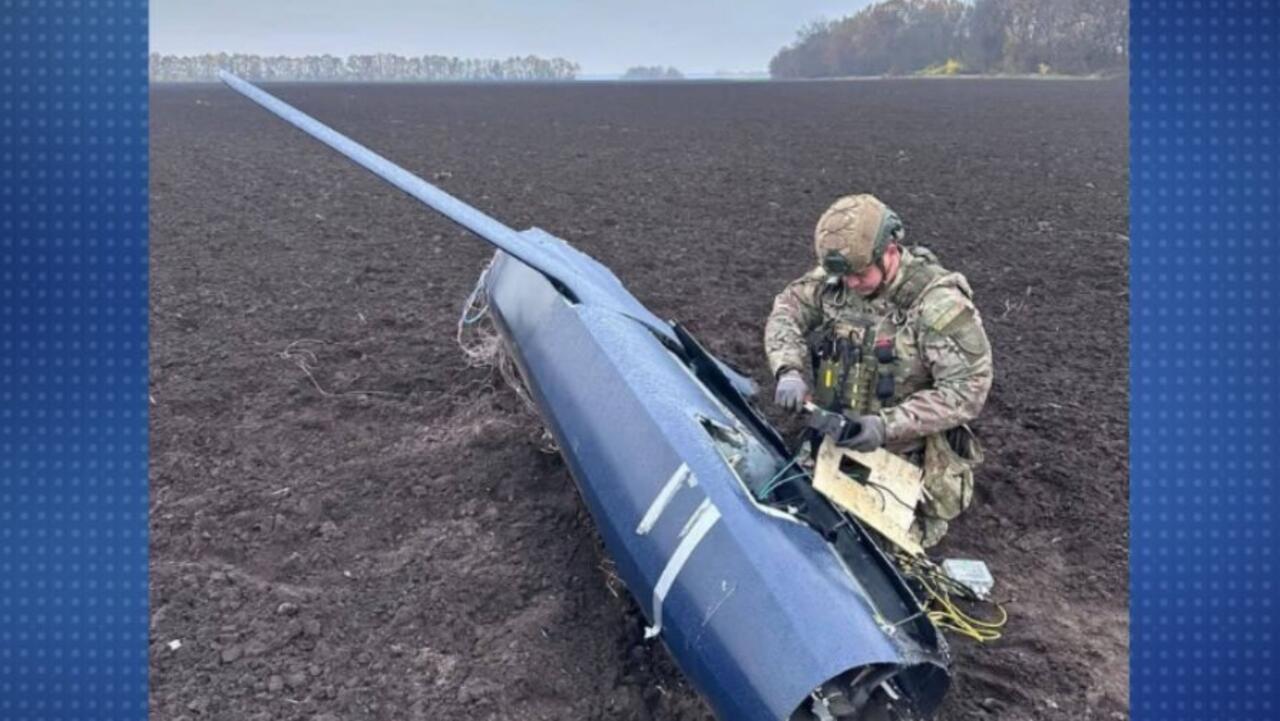
When Serhii Beskrestnov, Ukrainian President Volodymyr Zelensky’s adviser on defence technologies, says something, people in Ukraine listen. Beskrestnov’s job is to monitor the development of Russian weapons – weapons that might soon be falling on Ukrainian homes and energy infrastructure. And in a recent Facebook post, he expressed his mounting concern about the latest generation of Russian munitions. “Unfortunately, today is not just about the new Filin rockets,” he wrote on October 22. "Russia just attacked us with a new version of the Geran-5 drone." Whether you are talking about the Filin or the Geran-5 K5-K, which Beskrestnov mentioned in his post, or the Dan-T or the Banderol, these new Russian weapons are difficult to classify: they aren’t missiles, drones or loitering munitions. Some are calling them quasi-cruise missiles. Their speed enables them to get around the Ukrainian anti-aircraft defences built to intercept slower drones. And the fact that they are cheap to make means that they can be produced en masse – and produced more cheaply than the Ukrainian interceptor missiles used to down them. This chart compares the KH-101 cruise missile with the Russian quasi-cruise missiles Banderol and Geran-5. © Institute for the study of war Fast and cheap Kateryna Bondar, a researcher at the Center for Strategic and International Studies (CSIS), says that these new quasi-cruise missiles are part of the Russian strategy to carry out deep strikes against Ukrainian cities and infrastructure: “For the Ukrainians, it is extremely difficult to intercept all the Russian drones and missiles converging on their cities every day. The Russians have therefore recognised the need to increase their munitions production so they can build more weapons capable of striking Ukraine’s rear areas. This is all the more pressing because, to shoot down a single Russian-launched drone, Ukrainian air defences may have to use three interceptor drones.” This video, published on June 18, 2026, shows two Ukrainian soldiers launching interceptor drones against a Russian drone. © X / rshereme To display this content from X (Twitter), you must enable advertisement tracking and audience measurement. "The Russians have therefore turned to these new missiles because of their low cost and the fact that they can be mass-produced. What’s more, the Ukrainians cannot intercept these new weapons. The Banderol and the Dan-T are too fast for the interceptor drones the Ukrainians currently use. Ukrainian air defences are used to neutralising waves of Shaheds flying at 150 km/h, but it will be much harder to intercept small missiles flying at more than 400 km/h.” The Banderol: made of parts sold on the internet An explosion rang out in the Ukrainian city of Kharkiv at 7am the morning of Sunday, August 9. An apartment building was hit and 16 people were injured. In the wake of the strike, investigators with Kharkiv’s public prosecutor and the NGO Airwars discovered that the weapon used that day was different from those usually deployed. It’s called a Banderol, and it is neither a drone nor a missile. The photo on the left shows firefighters on the scene after an airstrike on an apartment building in Kharkiv on August 9, 2026. In the photo on the right, Ukrainian investigators take photos of the debris of a Banderol. © Telegram / prokuratura_kharkiv Ukrainian intelligence first came across the Banderol eighteen months ago. It was a weapon that did not fit into pre-existing categories. Underneath what appears at first glance to be a cruise missile is a much cheaper weapon. It also has a much smaller range. While the Russian cruise missile the Kh-101 can strike targets up to 2,500 kilometres away, the Banderol only has a range of 500 kilometres. In almost every way, the Kh-101 has superior capabilities to the Banderol. But the Banderol has one advantage over the KH-101: its price. While a Kh-101 can cost up to $2 million, a Banderol is thought to cost between $50,000 and $100,000. The price difference can be explained by the components that make up the Banderol. To cut costs, its manufacturer, the Russian company Kronshtadt, uses civilian components. The motor that powers the Banderol, for example, was originally designed to power model aircraft. It's produced by the Chinese company Swiwin, and you can buy it on e-commerce sites. This photo shows the SW800Pro motor, which is used in the Banderol. © Ebay The Ukrainians often jam the airwaves to prevent drones from being able to navigate. To counter this, the Banderol is equipped with a Kometa antenna, which contains "patches" that enable it to distinguish between real signals and jammed waves. Bondar told us more about this: “To navigate, the drone constantly checks its position using GPS. However, these satellite signals can be jammed. To get around this, the Russians fit an antenna with several patches that can pick up the signal sent by the satellite. The more patches on the antenna, the easier it is to receive the satellite signal despite jamming. At first, Russian antennas had only four patches, which made them less effective. Now, some models can have up to 30.” This photo shows a Kometa antenna equipped with 16 patches, the squares visible on the image. This photo was posted on the Ukrainian online resale site Reibert.info in April 2026. © Reibert.info Ukrainian intelligence has also reported that the Banderol has another advantage: it can make tighter turns than other Russian cruise missiles. Serhii Beskrestnov says the weapon "flies at an altitude of 400 to 2,000 metres, but drops to 200 metres before the impact". Dan-T and Filin, the faster missiles replacing the Banderol The Dan-T missile, produced by the Russian company Rostec, was first reported on in September 2026 and has been described by the Ukrainian Air Force as the Banderol’s successor. Specialist Ukrainian media outlet Militarnyi reported that the Dan-T is 35% cheaper than the Banderol. For the time being, very little remains known about the Dan-T, but Militarnyi also reported that it could be used to target armoured vehicles, fortified positions on the ground and light infrastructure. The Dan-T also shares another feature with its big brother, the Banderol: it can be dropped from an aircraft. Bondar says this enables the Russian command to conserve resources: “The Russian army is also looking to diversify how it launches its drones. Until now, they have been fired from the ground. Russia is trying to use delivery capabilities it already has, such as helicopters and jet aircraft, so it doesn’t need to develop a new launch system for every new munition. For example, the Banderol munitions were originally designed to be launched from the Russian Orion drone. That aircraft, which has become very vulnerable on the front line, is thus getting a second life as a launch platform for the Banderol.” These new, low-cost quasi-cruise missiles can also be launched from the ground. That’s the case for the latest in the series: the Filin. Ukrainian intelligence reported that the Filin is fired from the ground using a launcher. Then, it is guided using a Chinese-made inertial navigation system as well as a Russian anti-jamming Kometa antenna. This photo posted on October 22 shows the low-cost Russian missile, the Filin, after it landed in a field. © Telegram / serhii_flash Ukrainian intelligence has identified 81 components within the Filin. Of these, 35 are US-made, and 22 are Chinese. This newer model is thought to have a higher percentage of Chinese components. The Geran-5: a drone turned missile? The Geran-5 is a first, landing squarely on the border between a drone and a missile. Significantly faster than its predecessors, like the Geran-2, the fifth model in this series is particularly difficult to neutralise. Yuriy Ihnat, the spokesman for the Ukrainian Air Force, quoted in the Financial Times, said that the Ukrainian forces are only able to intercept about 60% of the new Russian drones, compared to their 90% to 95% hit rate for older models. This photo, posted on May 9, 2026, shows a Geran-5 on a launcher. © X / AKamyshin The Russian Geran drones, which were initially modelled after Iran’s Shahed drones, went through a major shift in their third generation. Equipped with a jet-powered motor, the Geran-3 started looking more like a missile. Bondar says that the fifth version is closer to a cruise missile than to the original drones: “The Geran-5 relies on a technology very different from that of the Shahed, even though the Russians have classified it in the same family of drones. In reality, on closer inspection, the Geran-5 looks more like a cruise missile. Its structure is very different from that of its Iranian and Russian predecessors. The Geran-5 delivers markedly better performance than the Iranian Shahed drones that inspired its predecessors. It can fly between 900 and 1,000 kilometers and carries a 90-kilogram explosive warhead.” These images show the evolution of the Geran drones, from the Geran-1, which is similar to the Iranian Shahed drones, all the way to the Geran-5, which is more like a missile than a drone. © uavs.fyi The Geran-5 is constantly evolving. Recent photos, published in late October 2026, show a new variant of the Geran-5, baptised the "K5-K". This photo posted on November 1 shows a Ukrainian deminer working to deactivate a Geran-5 K5-K in the region around Kyiv. © Telegram / UA_National_Police Ukrainian countermeasures being developed Faced with the proliferation of low-cost Russian missiles, the Ukrainian forces have found themselves scrambling and lacking interceptors fast enough to stop these new weapons. They are working to develop a way of combating them. Brave1, a government platform overseeing military innovation, reported that machine guns mounted on automatic turrets were able to shoot down Banderols. The group claimed they were able to destroy about 60 drones, including jet-powered Gerans and Banderols. In this video posted on October 30, 2026, the Ukrainian Government’s defence tech arm Brave1 says they developed an automatic turret that can shoot down Banderols. © X / BRAVE1ua To display this content from X (Twitter), you must enable advertisement tracking and audience measurement. Interceptor drones have also been developed to counter jet-powered Gerans. Some Ukrainian units say they are using the Bars drone and finding it fast enough to intercept and destroy Geran-5s. In this video posted on October 17, 2026, the Ukrainian Armed Forces’ 1021st Anti-Aircraft Brigade intercepts Geran-5 drones. © X / ayraktar_1love To display this content from X (Twitter), you must enable advertisement tracking and audience measurement. It is not possible, however, to independently verify the effectiveness and the scale of the countermeasures being put in place by Ukraine. This article has been translated from the original in French by Brenna Daldorph.
Russia’s new low-cost munitions pose a fresh threat to Ukraine
Full Article
Original Source
Read the full article at France24 →KhanList aggregates and links to publicly available news content. We do not host full articles from third-party sources. Always verify important information with original sources.