
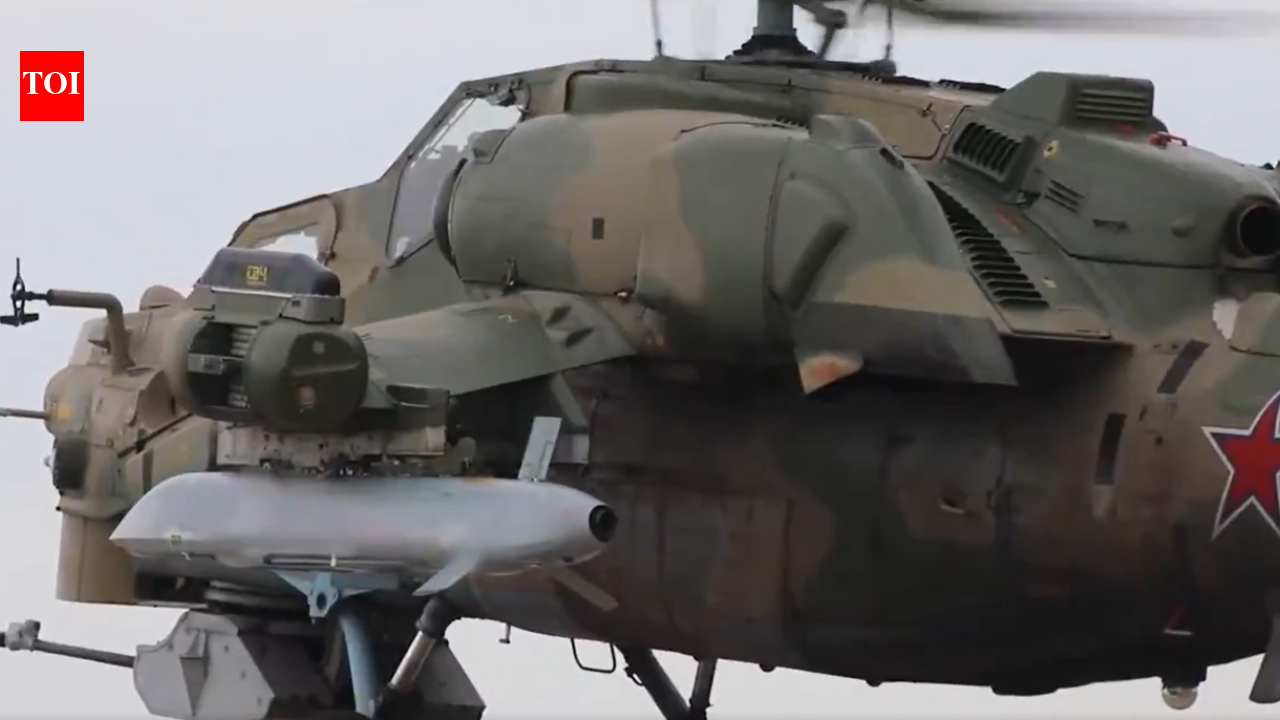
A Mi-28 attack helicopter of the Russian armed forces armed with a cruise missile. (Image credit: Russian MoD)For decades, the attack helicopter has been a short to medium range combatant, working within sight of its targets and relying on the missiles under its stub wings. That is beginning to change, with Russia, the US and India all working on ways to give rotary-wing aircraft much longer reach.Russia's Defence Ministry has released footage showing a Mi-28NM Havoc attack helicopter firing a small, low-cost cruise missile, supposedly during combat operations in Ukraine. One missile is seen leaving a pylon under the left stub wing, and the helicopter returns with another still hanging under the right. The ministry has not given a date, location or target, and has not identified the weapon, which could be either the S8000 Banderol or the Dan-T, two closely related and visually similar designs. It is the clearest official sign yet that Russia is exploring a new launch platform for its emerging family of inexpensive standoff weapons.Ukrainian military intelligence (GUR) first detailed the Banderol, developed by Russia's Kronstadt company, in the spring of 2025. It describes a missile about 5 metres long with pop-out wings and a small turbojet engine, flying at around 500 kmph to a range of up to 500 km with a warhead of roughly 50 kg.Using a helicopter for this is unusual. A slow, low-flying Mi-28 is far more exposed to air defences than a fixed-wing tactical aircraft. The range, however, would let it fire from well away from the target, potentially from Russian airspace across the border. The Kh-38 (LMUR), the farthest-reaching missile otherwise carried by the Mi-28, has a range of a little over 15 km.Russia is not alone. The US Marine Corps is working to give its AH-1Z Viper helicopters a long-range strike capability through L3Harris' modular Red Wolf launched-effects family, which has already been test-fired from an AH-1Z. It is being developed under the Marines' Long Range Attack Missile effort, with a reported range in the low hundreds of miles, and can also be configured for communications relay and electronic warfare. The trend blurs the line between cruise missiles, drones and other launched effects.India's own programmeIndia has been working on helicopter-launched weapons as well. In April, the Defence Research and Development Organisation (DRDO) and the Navy conducted the maiden salvo launch of the Naval Anti-ship Missile-Short Range (NASM-SR) off the Odisha coast in the Bay of Bengal. Two missiles were fired in quick succession from the same helicopter, which the Ministry of Defence described as the first salvo launch of an advanced air-launched anti-ship missile system. The missiles also demonstrated a waterline hit capability.The NASM-SR is an indigenous missile developed by DRDO's Research Centre Imarat in Hyderabad with other laboratories. It is meant to replace the ageing British-origin Sea Eagle on the Navy's Sea King helicopters. The first test came in 2022, and the first guided trial in November 2023.The Russian and US programmes aim for reach, while the Indian one is about firepower from a ship-based helicopter at short range. All three show the same intent: giving helicopters a bigger punch at a safer distance from enemy defences.
Russia's Mi-28 fires a cruise missile: Attack helicopters are getting longer punch
Full Article
Original Source
Read the full article at Timesofindia →KhanList aggregates and links to publicly available news content. We do not host full articles from third-party sources. Always verify important information with original sources.