
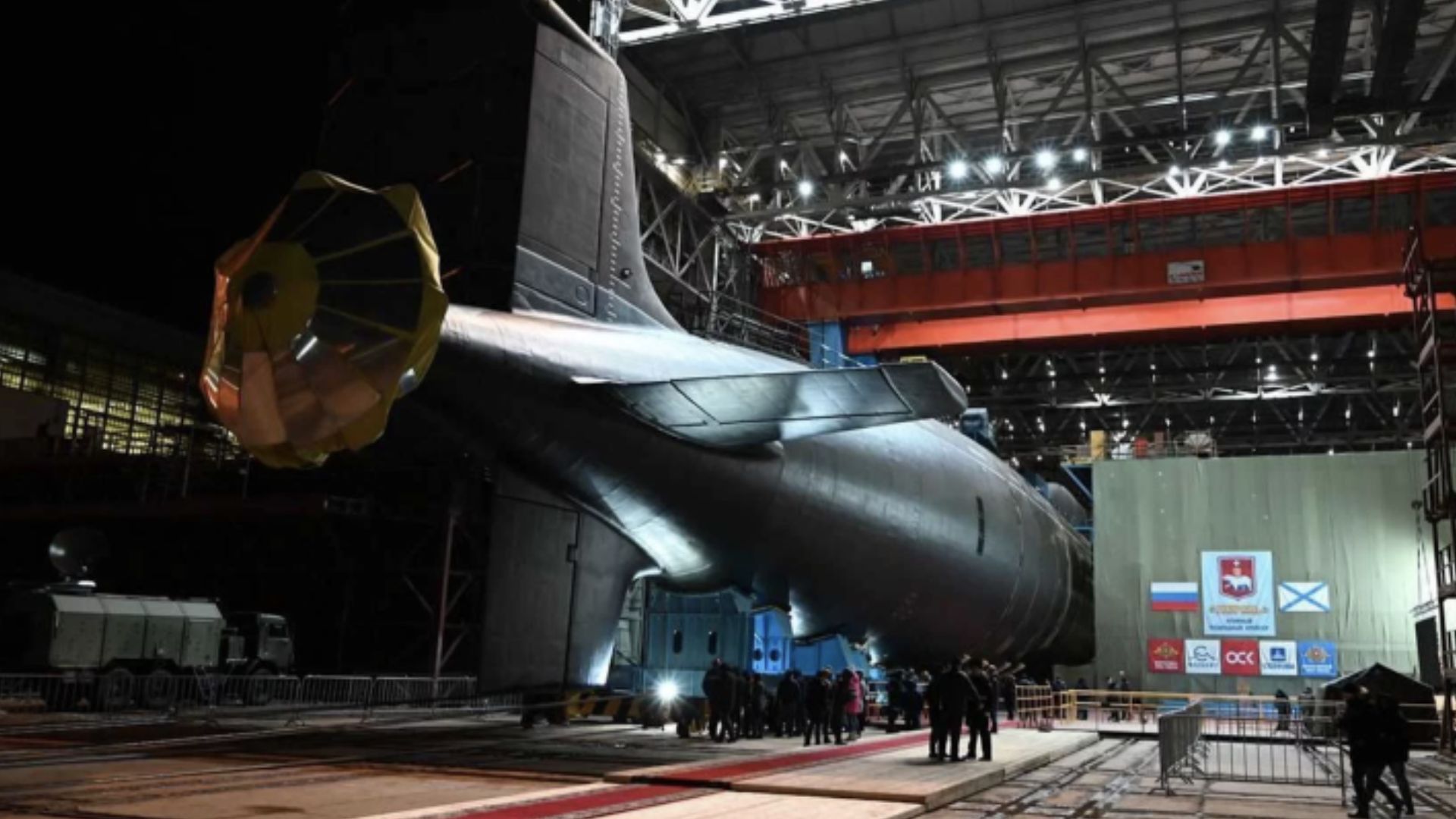
Russia has confirmed that the Perm, the first Yasen-M-class nuclear-powered attack submarine designed from the outset to carry the 3M22 Zircon hypersonic cruise missile, is expected to enter service before the end of 2026. The announcement came during Russia’s Navy Day events, where officials also revealed that the nuclear-powered Poseidon unmanned underwater vehicle (UUV) is approaching operational readiness. The developments underscore Moscow’s continued investment in advanced undersea warfare capabilities despite scaling back this year’s Navy Day celebrations over security concerns linked to the ongoing conflict in Ukraine. Perm to become first submarine purpose-built for Zircon According to Military Watch Magazine, Russian Navy Commander-in-Chief Admiral Alexander Moiseyev confirmed that the Perm will become the first submarine commissioned with the Zircon hypersonic missile integrated into its design from the beginning, rather than retrofitted after construction. The Perm is one of the latest submarines in Russia’s Yasen-M (Project 885M) class, which is regarded as the backbone of the country’s next-generation multipurpose nuclear attack submarine fleet. Unlike earlier boats in the class, the submarine was reportedly designed around the Zircon weapon system, incorporating modifications to its vertical launch system and combat management architecture to support the missile more efficiently. Military Watch notes that Yasen-M submarines can carry up to 32 cruise missiles, alongside heavyweight torpedoes, making them among the most heavily armed attack submarines currently in service. Hypersonic strike capability The 3M22 Zircon is a sea-launched hypersonic cruise missile that Russia claims can travel at speeds of up to Mach 8-9 while engaging targets at ranges of between 500 and 1,000 kilometers. As reported by EurAsian Times, the missile is intended for both anti-ship and land-attack missions. Its combination of high speed and maneuverability is designed to reduce an adversary’s reaction time and complicate interception by existing air-defense systems. Military analysts have long argued that hypersonic weapons launched from stealthy nuclear submarines could present a particularly difficult challenge for naval defenses. A platform such as the Perm could potentially approach high-value targets while remaining difficult to detect before launching long-range precision strikes against warships, coastal infrastructure, or military installations. The submarine is expected to carry a mixed load of Zircon, Kalibr, and Oniks missiles, allowing commanders to tailor its weapons package for anti-ship, land-attack, or anti-submarine missions. Poseidon moves closer to operational service Alongside the Perm announcement, Russian President Vladimir Putin said that the Poseidon nuclear-powered unmanned underwater vehicle is in the final stages of development. As reported by EurAsian Times, Putin stated that the autonomous underwater system is “about to” complete development and be placed on combat duty. Open-source assessments suggest Poseidon is designed as a long-range, nuclear-powered unmanned underwater vehicle capable of carrying a nuclear payload and operating at extreme depths for extended periods. Although many technical details remain classified, analysts generally view Poseidon as part of Russia’s broader effort to strengthen the sea-based leg of its nuclear deterrent. The system is expected to be deployed from specially modified submarines, including the Belgorod, and is widely regarded as a strategic second-strike capability rather than a conventional battlefield weapon. Strengthening Russia’s undersea deterrent The announcements come as Russia continues modernizing its submarine fleet while adapting to changing security conditions. Although this year’s Navy Day celebrations were significantly reduced for security reasons, officials emphasized that naval modernization remains a strategic priority. If commissioned on schedule, the Perm would become the world’s first operational submarine purpose-built to deploy Zircon hypersonic cruise missiles, adding another layer to Russia’s evolving undersea strike capabilities. Combined with continued progress on the Poseidon program, the developments highlight Moscow’s focus on expanding capabilities that it believes can strengthen deterrence and complicate the defensive planning of potential adversaries. Recommended ArticlesGet the latest in engineering, tech, space & science - delivered daily to your inbox.Kaif Shaikh is a journalist and writer passionate about turning complex information into clear, impactful stories. His writing covers technology, sustainability, geopolitics, and occasionally fiction. A graduate in Journalism and Mass Communication, his work has appeared in the Times of India and beyond. After a near-fatal experience, Kaif began seeing both stories and silences differently. Outside work, he juggles far too many projects and passions, but always makes time to read, reflect, and hold onto the thread of wonder.
Russia’s latest 13,800-ton nuclear submarine to carry hypersonic cruise missiles
Full Article
Original Source
Read the full article at Interestingengineering →KhanList aggregates and links to publicly available news content. We do not host full articles from third-party sources. Always verify important information with original sources.