
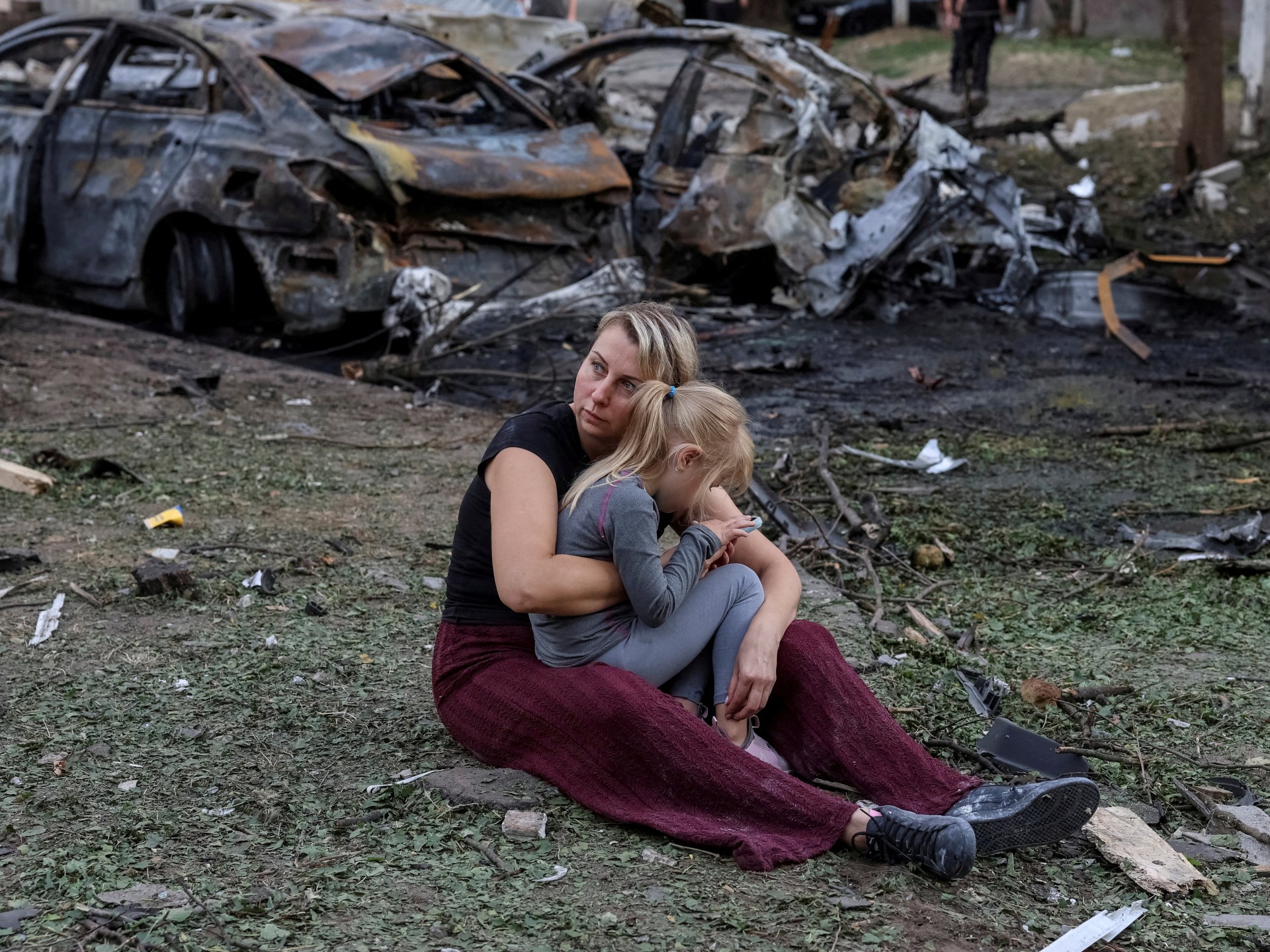
As the war drags on in Ukraine, its civilians are again suffering.Thirty-eight people were killed in the village of Myla on August 29, when a Russian drone attack struck an ammunition depot. Another 12 were killed in attacks across the country on September 1.Recommended Stories list of 4 itemslist 1 of 4US envoys headed to Russia and Ukraine to relaunch mediationlist 2 of 4Ukraine takes the war to Russia’s space programme in tactical shiftlist 3 of 4Ukrainian intel agencies in Kyiv firefight: What happened and why?list 4 of 4Ten injured in Ukraine as Kyiv expects talks with US envoys in coming daysend of listCivilian deaths have sharply increased this summer as Russia is using jet-powered drones, which fly at about half the speed of a passenger jet and are more difficult to intercept than propeller-powered drones.Jet-powered drones numbered about 2,800 in August, said Ukraine Air Force spokesman Yurii Ihnat, compared with about 1,500 in July, several times the number launched in June. Ukraine has an interception rate of more than 90 percent against propeller-powered drones, but only 60 percent against the jet-powered variant, Ihnat said.(Al Jazeera)Ukraine said Russian forces suffered 42,020 casualties last month, as Moscow’s territorial gains dropped to a fraction of last year’s rate of advance.Ukrainian armed forces figures showed Russia’s monthly casualties were only slightly below July’s 42,860 and well above the 39,290 in June.Al Jazeera cannot independently verify casualty estimates by either side, but if accurate, those summer figures – 25.8 percent higher than the casualties Ukraine inflicted in the spring – suggest the high Russian casualty rate is not a passing event.Russian recruitment rates are thought to be well below those totals, estimated by Ukraine at about 32,500 a month this year.An area in Kyiv hit by numerous missile attacks, September 1, 2026 [Gleb Garanich/Reuters]Ukrainian President Volodymyr Zelenskyy has publicly shared intelligence suggesting that Russian leader Vladimir Putin will conscript 300,000 or more troops next month.Zelenskyy has said that up to 80 percent of Russian casualties were inflicted in Kostiantynivka, the southernmost of Ukraine’s “fortress belt” of cities in the eastern Donetsk region, whose capture Putin has repeatedly prioritised.Russian forces are thought to control only a portion of the city, but have infiltrated more than 70 percent of it with scattered individual troops sent to drop supplies and await reinforcements. Ukrainian drone operators have been targeting the troops as Russia replenishes them.This week it was revealed that Ukrainian commander-in-chief, Mykhailo Drapatyi, reinforced the Donetsk front around Sloviansk and Dobropillia, north and south of Kostiantynivka, respectively, but kept the Kostiantynivka front largely unchanged. That suggests Ukraine may be adopting the tactic of fighting a prolonged rearguard in the urban landscape to inflict attritional losses, as it did in the battles of Bakhmut, Pokrovsk and Chasiv Yar.Police inspect the remains of a Russian drone at an apartment building in Kyiv, September 1, 2026 [Gleb Garanich/Reuters]The fight for Kostiantynivka has sapped troop strength elsewhere on the front line, where Ukraine liberated 130sq km (50 square miles) of its land in August, limiting Russia’s overall advance.Russia seized just over 90sq km (35 square miles) in August, estimated the Institute for the Study of War, a Washington-based think tank that assesses territorial gains using open-source geolocated sources.While still a net gain, that is less than a fifth of the land Russia seized in August last year.During June, July and August this year, the ISW assessed that Russia gained firm control of 160sq km (60 square miles), compared with 1,440sq km in the summer months of 2025 (560 square miles) – a 90 percent decrease.Family members attended the funeral on Monday of village leader Taras Didych, who was among 38 people killed in a Russian drone attack on Myla last week, August 31, 2026 [Alina Smutko/Reuters]Ukraine’s responseUkraine has turned its focus from Russian refineries to strikes against Russian air defences, radar systems and drone launch sites.Ukraine’s Unmanned Systems Forces (SBS) destroyed 33 air defence elements in August, increasing the annual total to 263.Ukraine also kept up some strikes on refineries, hitting 12 in August, along with two gas-processing plants and three oil transshipment terminals, according to its defence ministry.During the past week, Ukraine struck the Yanos refinery in Yaroslavl and the Kirishi and Ust-Luga refineries near Leningrad, all 800km (500 miles) from its border.Petro Ionov mourns his son Yevhenii in the town of Bilohorodka, August 25, 2026 [Anatolii Stepanov/Reuters]Those strikes have caused petrol shortages, further hurting Russia’s economy.Ukraine’s military intelligence reported that certain Russian exports had fallen by 80 percent compared with pre-war levels. Oil has been among the hardest hit, as Ukraine has struck terminals and hundreds of tankers carrying Russian oil in the Black Sea and Sea of Azov.Russian oil exports from the Black Sea port of Novorossiysk fell from 800,000 barrels a day in July to 350,000 barrels per day in August, said Ukraine’s Foreign Intelligence Service.“The Russian side acknowledges that its Black Sea Fleet ships are effectively blockaded in Novorossiysk due to our drone strikes and are unable to operate at sea,” said Zelenskyy.“Since the Russian fleet is unable to provide escorts for the commercial and shadow fleet … one of the solutions being considered is to equip civilian ships with small arms, electronic warfare (EW) equipment and military personnel,” he said. “We will prepare appropriate countermeasures.”The strikes on the oil industry have not only reduced exports. They have reverberated across the Russian economy, creating queues at petrol stations and raising prices for motorists.This week, Russia extended its ban on diesel exports to the end of September to keep its army and transport industry supplied and sought to import petrol.Occupied Crimea, where petrol distribution has been restricted to government-owned vehicles, has been hard hit.The Russian-appointed governor of the region, Sergei Aksyonov, said on September 2: “Fuel supplies to the region are currently not fully meeting the needs of the residents. Unfortunately, some residents of Crimea will, at this stage, face limited access to gasoline”.
Russia’s jet-powered drones overwhelm Ukraine, killing dozens
Full Article
Original Source
Read the full article at Aljazeera →KhanList aggregates and links to publicly available news content. We do not host full articles from third-party sources. Always verify important information with original sources.