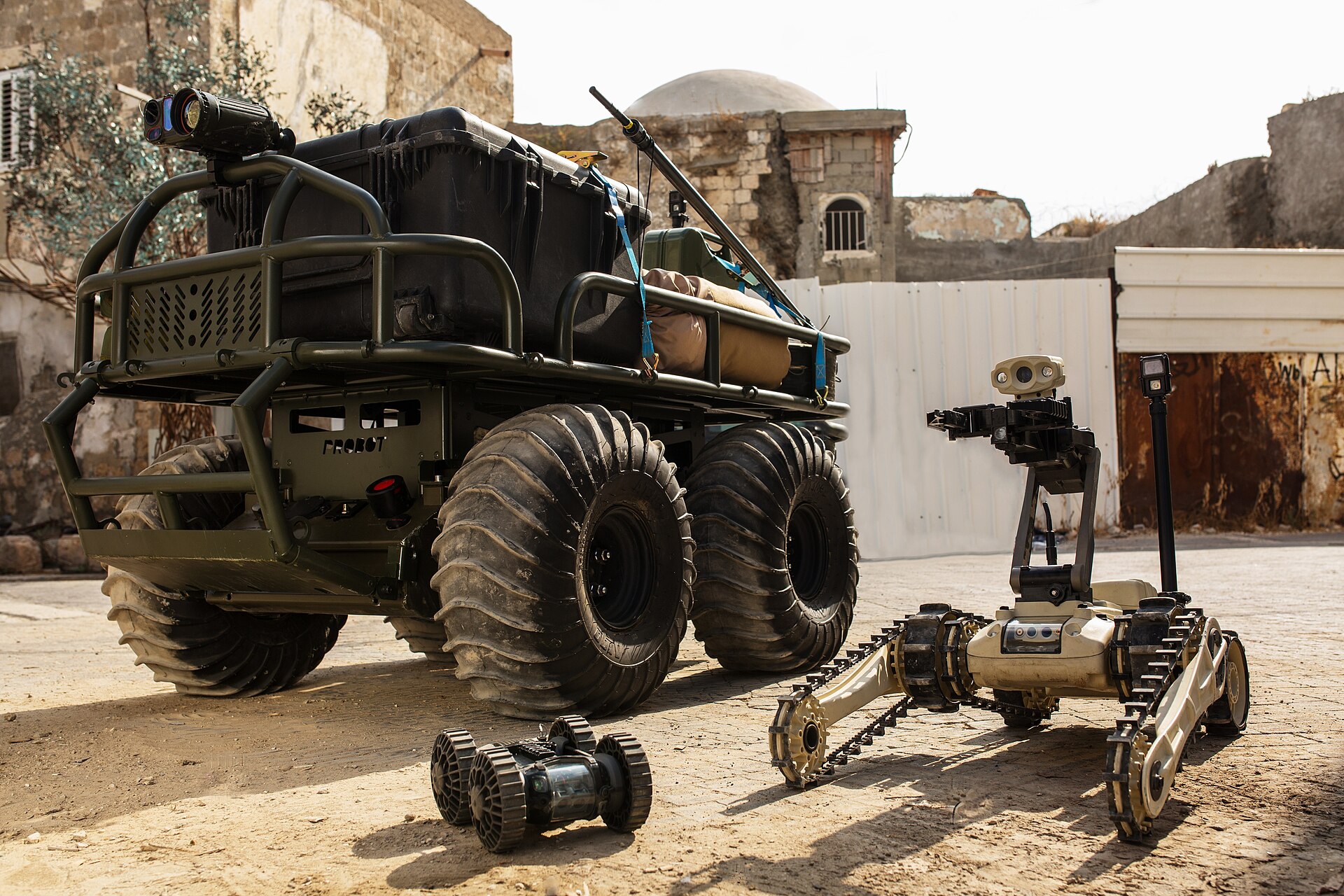
In the current attritional phase of the Russian-Ukrainian war, unmanned aerial vehicles (UAVs, or simply drones) of various types are responsible for 70-80 percent of all casualties and injuries on both sides. The logic of attrition and the growing use of UAVs have created a self-perpetuating cycle. With omnipresent drones now controlling an ever-widening “kill zone”, both armies have shifted to small, mobile groups to advance into or retake territory, making strategic breakthroughs nearly impossible. This, in turn, has accelerated UAV development, driven above all by advances in electronic warfare and the jamming of radio signals between operators and drones. Although neither Russia nor Ukraine invented these technologies, both have developed – or, more accurately, refined – two major responses to jamming. One uses a fibre-optic cable as a guidance link between the operator and the UAV, making it immune to radio-frequency jamming. The other uses AI to select and engage targets without operator intervention. In that case, there is no operator-drone link to jam. The first solution has already caused lasting environmental harm. The second one – called “lethal autonomous weapons systems”, or LAWS – threatens far-reaching consequences well beyond the environmental damage. Both are effectively crimes against humanity’s future, but international law lags behind on both issues, with the absence of international regulation of LAWS being particularly depressing. There is no agreed international definition of LAWS, but the working characterisation used by major international organisations describes LAWS as weapons systems that, once activated, select and apply force to targets on the basis of sensor processing rather than human input. Human Rights Watch (HRW), which introduced this distinction in 2012, made its case for pre-emptively banning “killer robots” because the use of LAWS would erode accountability for lethal decisions, as no software developer, manufacturer, or military officer – let alone the “killer robot” itself – could be fairly held responsible for unlawful killings. Given the technologically revolutionary nature of LAWS, it is tempting to call them the “Oppenheimer moment of the 21st century”, but the challenge they pose exceeds that of traditional weapons of mass destruction. Chemical and biological weapons may be useful in specific conditions, but they are unreliable and double-edged, as they can harm one’s own military and civilians. Nuclear weapons are devastating, but their use amounts to global suicide given today’s scale of proliferation. The distinctive danger of LAWS is not that they are the most destructive of super-weapons – they are not – but that they lack the very properties that made traditional weapons of mass destruction containable, and are for that reason far harder to restrain. They are cheap, and their manufacture need not depend on the state, as nuclear or chemical weapons do. Their underlying technology is dual-use, evading traditional export controls. And, most importantly, their rules for identifying and engaging targets are hidden in software: invisible, deniable, and impossible in principle to count like warheads or chemical stockpiles. The difficulty of introducing international regulation of LAWS is also a story of resistance by the world’s most militarised states. The UN General Assembly (UNGA) adopted three resolutions on LAWS between 2023 and 2025, and the short lists of states voting against them are telling. In 2023, the resolution was opposed by Belarus, India, Mali, and Russia; in 2024 – by Belarus, North Korea, and Russia; and in 2025, those last three were joined by Burundi, Israel, and the US. China abstained in all three cases. It often deploys regulation-friendly rhetoric on LAWS yet effectively converges with Russia and the US in its unwillingness to accept binding limits on “killer robots” Beijing itself is racing to build. Dissonance, defiance, and hypocrisy Despite supporting the UNGA resolutions on LAWS, the EU’s voice on the international regulation of “killer drones” remains not only weak but also dissonant. On the one hand, there is Austria, which became the first Western democracy to join, in 2018, a group of states at the UN Convention on Certain Conventional Weapons (CCW) calling for a ban on LAWS. Austria also introduced the first UNGA resolution on LAWS in 2023. On the other hand, there is France, which has worked hard since 2022 to dilute EU AI regulation and eventually to exclude from it AI systems used solely for military, defence, or national-security purposes – which would, in particular, encompass LAWS. And then there is the EU as an organisation that insists that the CCW is “the relevant international forum” for discussions of LAWS – knowing perfectly well that decision-making at the CCW is consensus-based and that, with Russia among its members, the entire LAWS-related process at the CCW is deadlocked. With Brussels’ insincerity, Beijing’s hypocrisy, and Moscow’s and Washington’s open defiance of the overwhelming majority of the world’s nations, the prospects of agreeing on international regulation of LAWS look poor. Worse still, the Russian-Ukrainian war, in which drones with autonomous functions are already being employed to lethal effect, provides perfect ground to train AI systems in the killing of human beings. The use of chemical weapons was banned as a direct reaction to the horrors of the First World War, but one can hardly be that “optimistic” with “killer robots”: if they malfunction, the LAWS-optimists among the global powers will simply treat the malfunction as a software problem to be fixed in some newer model. This is precisely Russia’s position – that LAWS “can demonstrate far more effectiveness than [a] human operator in addressing the goals set out, including to mitigate the likelihood of miscalculation and error”. But miscalculation and error are not the wrong here. The underlying problem is not how reliably a machine can select a human being to kill – it is the mere fact of delegating that decision to a machine at all.
Russia’s faith in ‘error-free’ killer robots and global divisions expose the moral vacuum in AI warfare
Full Article
Original Source
Read the full article at Euobserver →KhanList aggregates and links to publicly available news content. We do not host full articles from third-party sources. Always verify important information with original sources.