
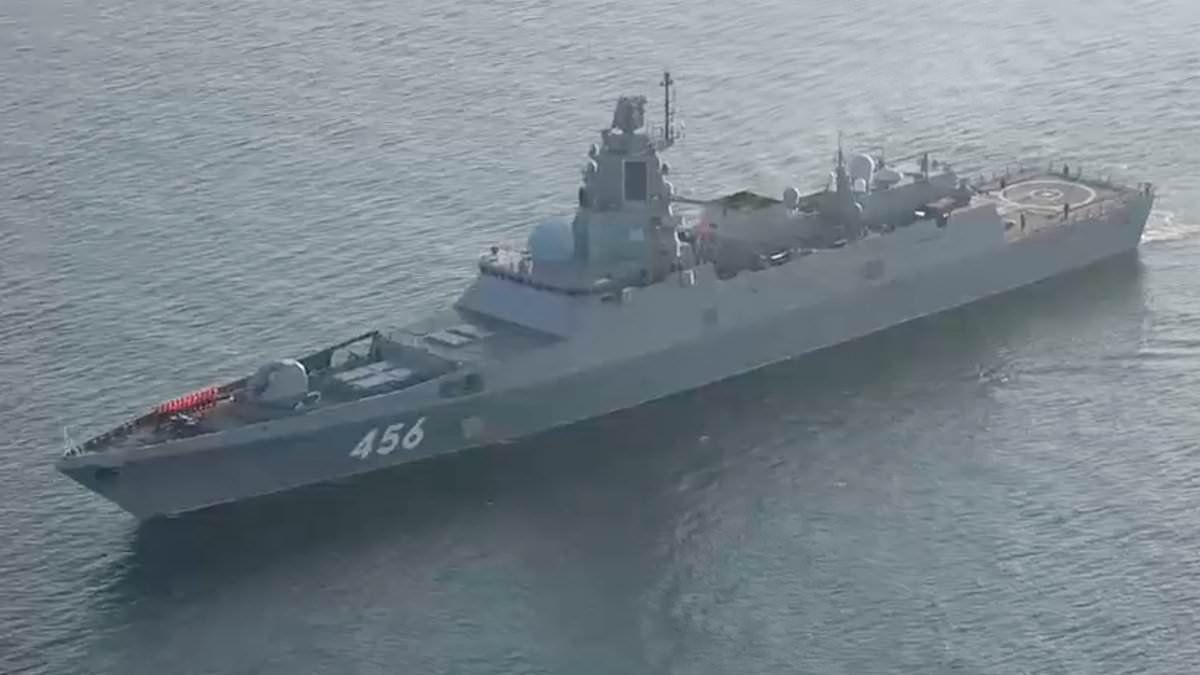
Published: 10:30 EST, 24 November 2026 | Updated: 11:08 EST, 24 November 2026 A Russian warship has been accused jamming the GPS signals of dozens of flights from the UK.The Admiral Golovko was escorting an armada of sanctioned Russian cargo ships off the English coast when the navigation blackout began on November 9.At the same time, flights from Edinburgh, Manchester and London Heathrow were among the 140 trips reportedly affected by the mysterious outage.Experts later pointed the finger at the 443ft Russian warship, which is equipped with high-power electronic warfare tech that can jam radar and GPS.The Government has not commented on the allegation. However, a senior defence source today rubbished the claim, telling the Daily Mail it was 'b****cks'. Jamming uses powerful radio signals to scramble a GPS system, preventing it from working out where it is.The outage this month reportedly affected thousands of passengers, with a Ryanair plane from Edinburgh to Rome, an easyJet flight from Manchester to Hurghada, Egypt, and a British Airways trip from London to Stockholm among those hit.According to analysis by Hexbird, an aviation intelligence group based in America, some of the flights lost GPS navigation for 20 minutes, the i newspaper reported. The Admiral Golovko was escorting an armada of sanctioned Russian cargo ships 190 miles of the English coast when the mayhem began on November 9Analysts claimed to have tracked the source of the suspected attack to around 190 miles off the British coast where a Russian naval vessel was travelling through the North Sea.The Lady R, Lady D and Maia-1 – all of which are said to be linked to the transport of military cargo – were reportedly being escorted by the frigate at the time. The Admiral Golovko, one of Vladimir Putin's newest warships, was later shadowed through the English Channel on November 9 by HMS Iron Duke and RFA Tideforce.The Russian convoy is believed to have since travelled south and was last spotted off the coast of north Tunisia over the weekend, maritime monitors claimed. The alleged jamming incident off the English coast is not linked to a spate of bomb hoaxes to airlines at the same time that caused flight chaos across Europe.Dr Thomas Withington, an electronic warfare specialist, said if Russia were responsible, it would be 'an intensification of the disruption that we've seen so far'.He told the i newspaper: 'It's the first time to my knowledge, first time we've seen anything this far west. But equally, I don't think it'll be the last time.'James Droxford, a former British naval intelligence officer, believed the warship was 'almost certainly the origin of the GPS jamming, not the merchant vessels'. The Lady R (pictured), Lady D and Maia-1 – all of which are said to be linked to the transport of military cargo – were reportedly being escorted by the frigate at the time.He claimed it may have been in retaliation to the fleet being monitored by Nato at the time.Ramsey Faragher, the chief executive of the Royal Institute of Navigation, added the GPS outage was 'likely' to have originated from a 'dedicated military platform'.'The UK is quite lucky that it was as far offshore as it was, because we wouldn't have wanted that sort of level of GPS jamming to be flooding things like our mobile phone networks and our DAB digital radio stations,' he said.However, American data analyst John Wiseman, who runs Hexbird, concluded the analysis 'neither identifies the convoy as the source [of the jamming], nor rules it out'.The Government insisted UK aviation was 'amongst the safest in the world' and that pilots are 'trained to handle GPS interference'. A spokesman added: 'We do not comment on operational security or intelligence matters.'The Russian embassy did not respond to a request for comment.
Russian warship off UK coast 'jams GPS on dozens of aircraft'
Full Article
Original Source
Read the full article at Dailymail →KhanList aggregates and links to publicly available news content. We do not host full articles from third-party sources. Always verify important information with original sources.