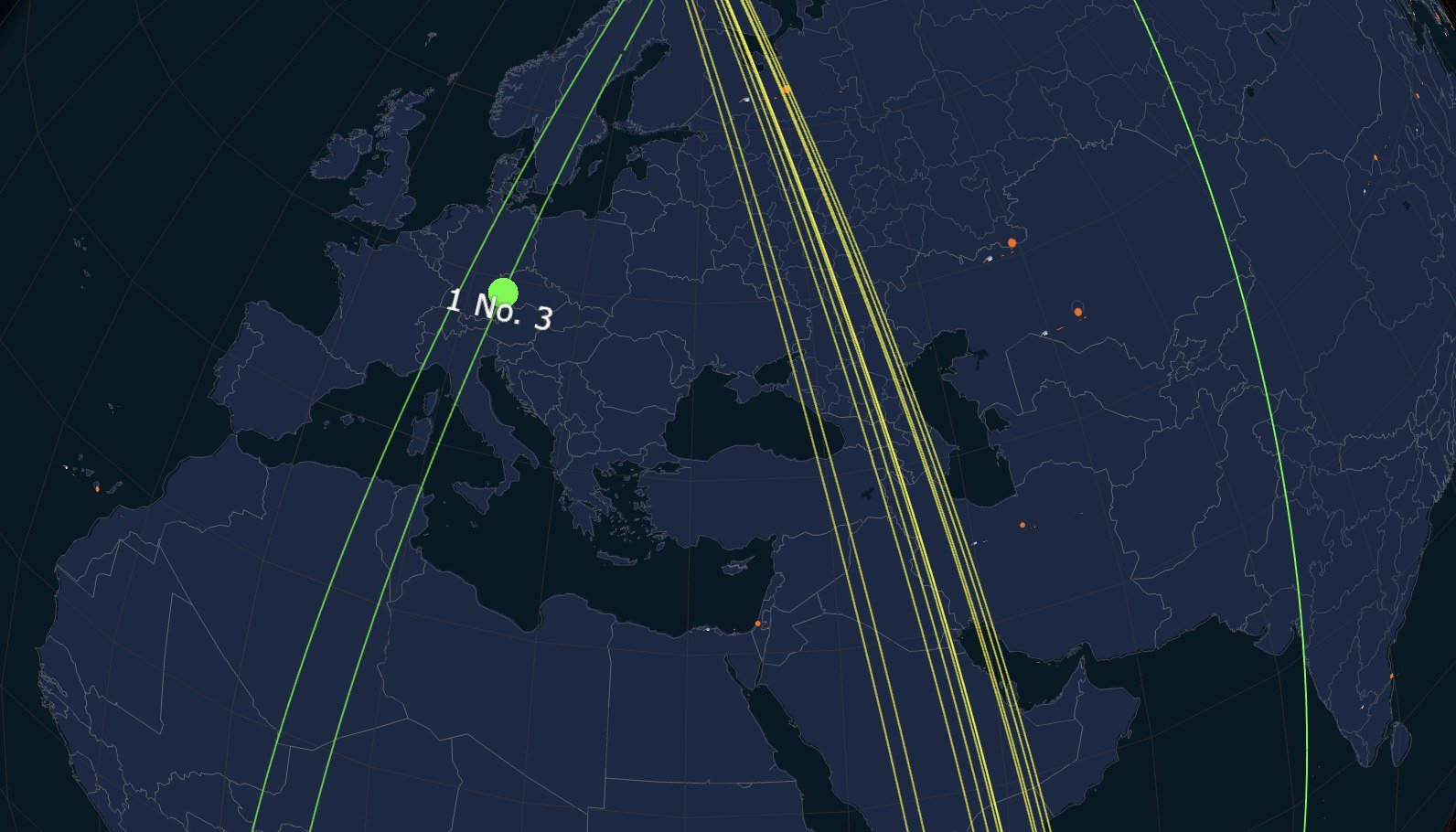
Every day, the Ukraine Battlefield update newsletter offers a clear look at how the war is unfolding on the ground. Subscribe for free here to get the full text delivered to your inbox. Russia’s Rassvet satellite internet system has only a few satellites in orbit, but an expert says it already provides a brief communications window over Ukraine. Why the “Russian Starlink” matters and how the Russian military could use it. A Ukrainian website examines whether Russian satellites can be shot down. Russia is increasingly attacking Kramatorsk and Sloviansk, which are becoming cities where it is impossible to live. Videos of the day: drone warfare in the Black Sea, a close-up of a collapsed Russian bridge, and a Wildberries warehouse one day after the attack. On Wednesday, we wrote about how Ukraine would benefit if it could use the Starlink system over Russian territory as well. Elon Musk, the head of SpaceX, has so far disagreed. Starlink is therefore used only over Ukraine. Hornet drones, for example, can attack Russian vehicles in occupied Ukrainian territory thanks to this connection. Russian forces also used the Starlink system in Ukraine until the spring, but Ukrainians, together with SpaceX, took action against this. In recent days, discussion has resumed about the Russian Rassvet (Dawn) system, intended as Russia’s alternative to Starlink. Some also call it Temu Starlink. It is a project through which Russia hopes to overcome this disadvantage, and it has been given priority. Russian blogger Kirill Fyodorov recently compared the importance of Rassvet to the creation of the atomic bomb in the last century. “Back then, we could not have existed without a nuclear umbrella, and today Russia needs its own satellite communications and artificial intelligence in order to continue existing as a sovereign great power, rather than a third-world banana republic,” Fyodorov said. These words may be exaggerated, but the better-known Russian war channel Rybar also wrote that if the project is completed, it will be “the greatest achievement of Russian space exploration since the collapse of the Soviet Union and one of the most significant in its entire history”. Russia sent its first test satellites into orbit in 2023. In March, it launched the first batch of 16 satellites, followed by a second batch in July. That is considerably fewer than the roughly 200 to 250 needed for stable coverage. Over the weekend, the Ukrainian website Militarnij wrote that, despite this, Russia already has “communications windows” during which the system covers Ukraine. There are at least two such windows, each lasting around one to one-and-a-half hours. In theory, Russia could use the system at those times. Satellite communications expert Volodymyr Stepanets told Militarnij: “We can see that a chain with good coverage has effectively already been formed, which provides this level of coverage about twice a day, but in reality there are more passes”. According to the Satellitemap website, they have a total of 21 operational satellites in orbit. In July, Russia launched another 16 satellites, which could reach orbit in October or November. Earlier Russian plans envisaged launching 250 satellites by next year, with 730 planned by 2030. However, this would require a much faster pace than at present, when satellites are launched once every three months. Militarnij writes that even at the current pace, if the fourth batch were launched in March 2027, Russia could have continuous coverage over Ukraine roughly a year later. “This could have serious consequences for the armed forces unless they introduce effective countermeasures by then,” the website wrote. However, in late May, Ukrainian communications expert Serhii Beskrestnov said that “200 to 250 satellites in orbit would be needed for continuous and stable data transmission”. In time, the Russian military could use Rassvet in a similar way to how Ukrainians use Starlink. The possibility most often mentioned is that Geran or other drones could be equipped with small terminals — which Russia apparently does not yet have — allowing better communications and, for example, eliminating the need to use signal boosters in Belarus, against which the Ukrainian government has protested. According to the Russian channel Two Majors, however, it could have a much wider range of applications. “It makes it possible to connect reconnaissance assets into a single network, allowing, for example, an artillery crew to receive real-time data from all radar stations, unmanned aircraft or electronic reconnaissance assets operating in its sector,” it wrote. The satellites’ positions and trajectories can be viewed here. Rassvet cannot, of course, compete with Starlink, which, according to SpaceX, already has nearly 11,000 satellites in low Earth orbit. Russia plans to have nearly one thousand by 2035. However, Russia does not need to compete with Starlink. “Rassvet does not need to compete with Starlink; its task is to cover the Arctic, military units, transport, occupied territories, and Ukraine,” the Telegram account Black Swan wrote. Can they be shot down? The system is not yet operational — in addition to satellites, Russia must also equip its units and equipment with terminals — but Ukrainian media have already begun discussing the need to prepare for this possibility. The Ukrainian website Defense Express published an article speculating on whether such satellites could be shot down. According to the article, technology for shooting down enemy satellites has existed since 1968, while options that Ukraine could use have existed since 1985. “Jet-powered drones could theoretically be adapted for this. However, it is not that simple,” Black Swan wrote. Shooting down modern satellites carries risks. According to Defense Express, if a network consists of numerous satellites, disabling several of them may not cause system outages. Moreover, shooting down satellites would create large amounts of debris in orbit, which could strike other satellites. “The most realistic approach is therefore not to shoot down satellites, but to selectively suppress the signal in a specific area, block terminals or disable ground gateways, of which there should be no more than 10. It is a relatively inexpensive and potentially highly effective system. We must develop countermeasures now, without waiting for its full deployment,” Black Swan wrote. Kramatorsk and Sloviansk are becoming cities where it is impossible to live. The situation is deteriorating in the two largest free cities in Donbas — Kramatorsk and Sloviansk. Russian forces are slowly but steadily approaching the two cities. This map by Black Bird Group shows that in some places the red lines are already only 10 km from the first houses in this urban area.
Russian ‘Starlink’ creates first coverage windows over Ukraine, raising concerns about future drone command and control (Ukraine Battlefield update, Day 1,624)
Full Article
Original Source
Read the full article at Euobserver →KhanList aggregates and links to publicly available news content. We do not host full articles from third-party sources. Always verify important information with original sources.