
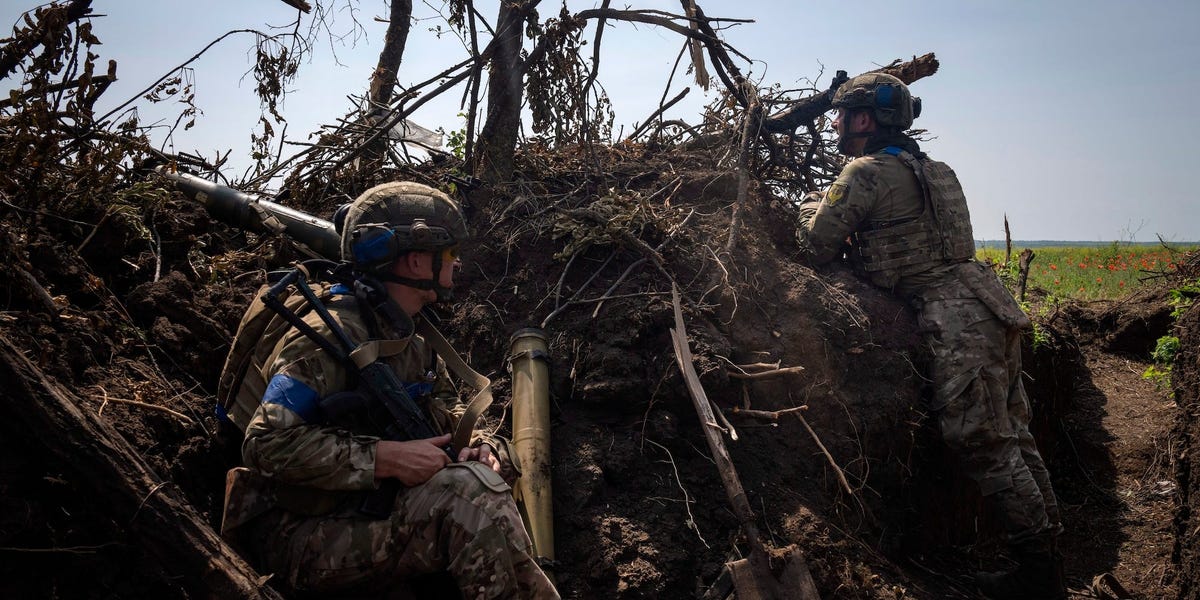
Ukrainian soldiers can get stuck in frontline positions for days and months due to factors like Russian drones and small infiltration groups. AP Photo/Efrem Lukatsky Russia's small infiltration groups are making it harder for Ukrainian soldiers to rotate out of their front-line positions, sometimes leaving troops stuck for weeks.Russian troops are slipping between Ukrainian fighting positions in small groups, threatening the routes that soldiers rely on for rotations and resupply. Their presence can make it dangerous to move even through territory Ukraine still controls.A Ukrainian sergeant who uses the call sign Yankee told Business Insider that Russia's tactics have evolved toward "massive infiltration."He described it as "a big problem" for troops in front-line positions because they don't know when or if those groups will arrive. He described being in a front-line position on one deployment. "I had about 12 Russians infiltrating my back," he said, "and I couldn't get out of there for a month because of that."A dangerous journey outRegularly rotating troops off the line is necessary to give exhausted soldiers time to rest and recover between combat. Russian drones, however, have made moving between positions increasingly dangerous. Some soldiers have described being stuck in positions for almost a year.Rotations pull soldiers out of concealed positions and onto routes exposed to enemy surveillance and strikes. But that isn't the only challenge. Russian infiltration teams are also a problem. Needing to move out of concealed positions and into the open makes rotating positions a dangerous task. Kostya Liberov/Libkos via Getty Images Yankee said Russia's infiltration groups make going out on rotation "mentally hard," because "you don't know at what step to expect the ambush."Yankee serves as a battery sergeant in a front-line unit that uses man-portable air-defense systems, or MANPADS. His unit uses shoulder-fired missiles to provide air defense for infantry operating near Russian positions.Oleksandr Yabchanka, head of robotic systems for Ukraine's Da Vinci Wolves Battalion, told Business Insider that "one of the most difficult tasks right now is the rotation of personnel." He said that rotations are disrupted by drones and small groups. He described Russia's tactic as "infiltration by small or very small infantry units — often consisting of just one or two soldiers. They attempt to slip between our positions undetected and reach our rear."He described it as a growing tactic, with Russia "increasingly relying on attempts to stealthily penetrate our combat formations" rather than large-scale assaults. Ukraine employs similar tactics against the Russians.Small groups, outsized disruptionUkraine's 3rd Army Corps, a major formation in Ukraine's ground forces, said small groups of infiltrating Russian soldiers were an issue during its Operation Vivaldi, a major counteroffensive that took back 106 square miles before it ended in October. Ukrainian troops can be caught off guard by Russian groups that approach their positions and dugouts from behind. Khrystyna Lutsyk/Global Images Ukraine via Getty Images The corps described infiltrators slipping between Ukrainian positions, sometimes disguised as civilians, to disrupt logistics and launch attacks from behind.The problem was serious enough that the corps established a joint headquarters to coordinate efforts to identify and eliminate the infiltrators.Ukrainian soldiers described these groups to Business Insider last year, characterizing them as an increasingly common tactic that causes chaos behind Ukrainian lines, with Russian troops seemingly appearing from nowhere.Jack Watling, a land warfare expert at the UK's Royal United Services Institute, wrote last year that Russia's infiltration groups, which often consist of two to five soldiers at a time, gradually build up enough forces to disrupt Ukrainian resupply efforts and prevent neighboring positions from supporting one another.Beyond disruption, these groups also gather intel while forcing Ukrainian troops to expend resources tracking them, setting the stage for larger assaults.Ukraine has acknowledged the difficulty of rotating troops in this drone-saturated environment with chaos in the lines.Then-Commander-in-Chief of the Armed Forces Gen. Oleksandr Syrskyi said in July that replacing some soldiers in the front-line "kill zone" can require complex special operations involving drones, battlefield intelligence, and useful factors like bad weather and darkness to help protect and conceal moving soldiers. He said around two dozen soldiers had been in front-line positions for 200 days or longer.Trying to ease the burdenThe military has identified improving troop rotations as a priority. Syrskyi said in April that soldiers should typically spend no more than two months holding a front-line position. After that, commanders must arrange for their rotation within the following month.But battlefield conditions can still make those timelines difficult to meet, particularly in areas of intense fighting and heavy drone activity.Ukraine has been responding to Russia's small-group tactic, including by deploying more drones and ground robots to carry out dangerous tasks that would otherwise need to be done by a human soldier.Yabchanka said that to address the issues with rotation, "we try to minimize the time a soldier spends in the open and delegate as many tasks as possible to unmanned systems, both aerial vehicles and ground-based robotic platforms."Units have also described using dedicated search-and-strike teams to hunt infiltrators. The 66th Separate Mechanized Brigade said in August that its drone operators detect and destroy small enemy groups, preventing Russia from amassing enough infantry to conduct assaults. Read next Business Insider tells the innovative stories you want to know Business Insider tells the innovative stories you want to know Business Insider tells the innovative stories you want to know Business Insider tells the innovative stories you want to know Sinéad Baker is a Military and Defense Correspondent based in Business Insider's London bureau, writing about Russia's invasion of Ukraine and NATO actions.Sinéad most often covers soldiers' experiences, military strategy, battlefield developments, weapons systems, the defense industry's response, and the impact on NATO and European security, and geopolitical decisions that surround the Ukraine war. She has reported from NATO’s frontlines and around Europe, has interviewed multiple prime ministers and defense ministers, has appeared on BBC News and The Guardian's politics podcast, and has been cited by Congressional hearings.Sinéad has also extensively covered US politics and previously led Business Insider's breaking news coverage from London.Sinéad previously completed a master's degree in investigative journalism at City, University of London, and has written for The Guardian, The Observer, and TheJournal.ie. Sinéad is the former editor of the multi-award-winning The University Times in Dublin.ExpertiseExperiences of soldiers in Ukraine, including battlefield developments and tacticsWestern military responses to the war, and lessons they should learnNew weaponry built for and in response to the war Email Sinéad at sbaker@businessinsider.com or find her on X. Ukraine Russia
Russian infiltrators are trapping Ukrainian troops in front-line positions, sometimes for weeks
Full Article
Original Source
Read the full article at Businessinsider →KhanList aggregates and links to publicly available news content. We do not host full articles from third-party sources. Always verify important information with original sources.