
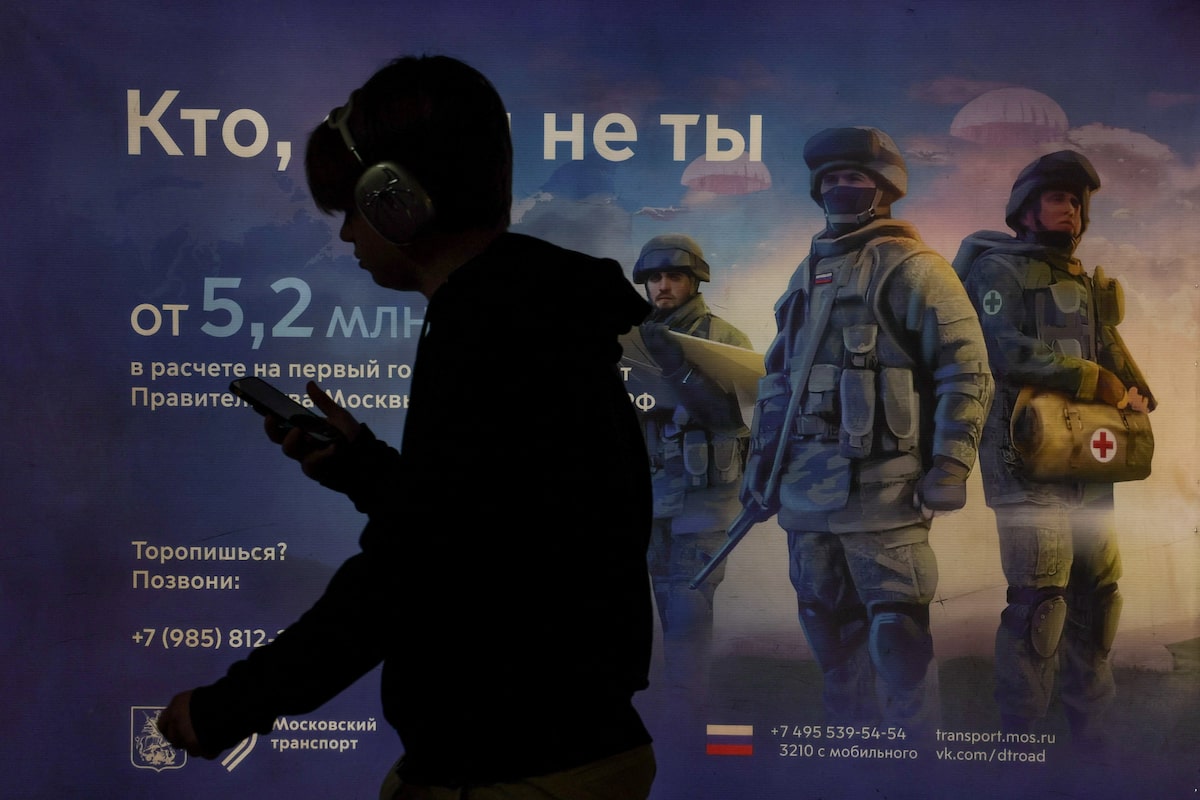
Open this photo in gallery:A pedestrian walks past a board promoting contract-based military service in the Russian Armed Forces, in Moscow, Russia, Sept. 7.Ramil Sitdikov/ReutersRussia has been deceiving and exploiting foreign nationals by luring them with the promise of jobs and then sending them to fight in Ukraine, a situation that in many cases can be defined as human trafficking, Amnesty International says in a new analysis. The international human-rights organization says in a report released Thursday that Russia has recruited thousands of vulnerable people from low-income countries, as well as migrants and refugees living in Russia. It says many recruits were promised high-paying civilian work, legal status or Russian citizenship but instead were sent to the front line in Ukraine. Some knew they were signing up for military service but were told they would be cooks or drivers, only to be sent to fight. “Amnesty’s research demonstrates how Russia’s Armed Forces are bolstering their ranks with economically vulnerable foreign nationals and using them as cannon fodder in the war of aggression against Ukraine. The level of exploitation and coercion involved led us to conclude that in many cases this amounts to human trafficking, as defined under the UN’s Palermo Protocol,” said Agnès Callamard, Amnesty International’s secretary-general, in a news release. Researchers made six visits to prisoner-of-war camps in western Ukraine between 2024 and 2026 and interviewed dozens of people, among them 15 captured third-country nationals from Brazil, Colombia, Cuba, Egypt, Sierra Leone, Sri Lanka, Somalia and South Africa. Only three people they spoke with said they knew they had signed a military contract and would be sent to fight. “Third-country nationals are trafficked into Russia’s armed forces through deception, coercion and fraudulent recruitment and then are exploited while being used as soldiers in the Russian war of aggression against Ukraine,” said Anna Wright, Amnesty International’s regional researcher on Eastern Europe.Russia does not rule out restart of peace talks with Ukraine and U.S., Kremlin saysThe researchers say people signed contracts they did not understand, in some cases had their passports and phones taken, were not provided adequate training before going to war and were threatened if they tried to leave. “Russia abuses people basically all over the globe to maintain its war effort. And that’s just another indication of the effects of this aggression − it’s not just in Ukraine, but far beyond its borders,” Ms. Wright said. A prisoner of war from Sri Lanka told researchers that a friend introduced him to another Sri Lankan, an employment agent who arranged his trip to Moscow. The POW said he was promised a civilian job as a security guard and that there were 58 other Sri Lankans on his trip. But upon his arrival he was hurriedly instructed to sign a document in Russian. It was a military contract, and after rudimentary training, he was sent to the front line. The report says foreign nationals outside Russia are recruited by local agents and online through misleading job advertisements. Many recruits told researchers “they were lied to or deliberately misled,” the report says, adding that “economic vulnerability was key.” It says that while some recruits were paid, many were not. A Colombian man told researchers that he saw an online ad and, after calling a local number, was promised a civilian job in Russia. He travelled to Ufa, Bashkortostan, in southern Russia. There, he was told to sign paperwork, which was in Russian, and was taken on a three-day bus trip, the report says. Upon his arrival, he was given a military uniform and assault rifle and found himself in the trenches. At one point, he ran through the woods and saw so many dead bodies he “thought they were mannequins.” Eventually, he and a wounded Colombian were taken prisoner by Ukrainian forces. Inside Russia, migrants and refugees, often with precarious immigration status, have also been targeted. People there told researchers they’d been approached by acquaintances or informed by immigration officials that they would have to join the military or face detention and deportation. A man from Sri Lanka was working at a Burger King in Russia when his work visa expired. The police issued him a fine. Shortly afterward, someone he knew from India suggested he sign a contract with the Russian army; in exchange, he was promised money and Russian citizenship. He trained for just two weeks before being sent to the front line. A Brazilian IT professional told Amnesty International that he was recruited while working in Australia with the promise of a lucrative job in his field. Instead, he was taken to a military centre, where he didn’t understand anything. He asked if he could leave but was threatened with jail or even death. He was sent to the front, the report says, and didn’t receive any payment. Some recruits knew they were joining the Russian Armed Forces, the report says, but were misled about what they would be doing. It says three Sri Lankans who were already in Russia thought they would be working as cooks. One of them described the fighting as “unimaginable.”“In these circumstances, the issue is the extent to which deception, misinformation, and the exploitation of vulnerability undermined the possibility of fully informed and genuinely voluntary consent,” the report says. Ms. Callamard said in a statement that if Russia does not put an end to this human trafficking, “other states must do everything in their power to stop this crime.” “There must be full accountability for all those directly involved and all those complicit, whether as private recruiters or intermediaries, state officials or military commanders.”
Russia ‘trafficking’ foreigners to fight in Ukraine, Amnesty International says
Full Article
Original Source
Read the full article at Theglobeandmail →KhanList aggregates and links to publicly available news content. We do not host full articles from third-party sources. Always verify important information with original sources.