
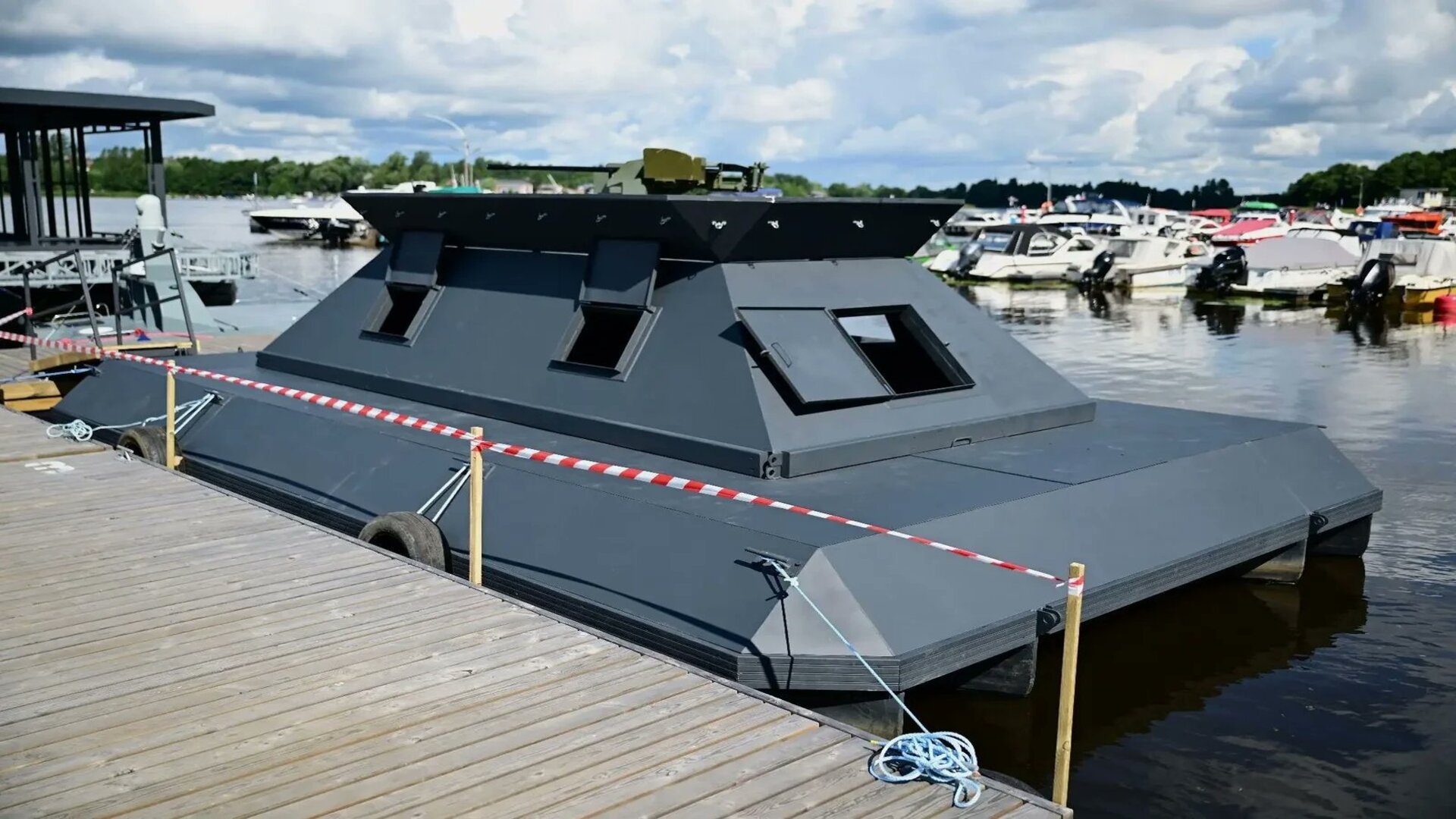
Russia appears to be testing a new floating defense platform designed to protect ports and anchorages from Ukrainian drone attacks, as increasingly sophisticated unmanned systems force both sides to adapt their tactics at sea. The platform, identified as the PLOT-40 or PLOT-47, resembles a small floating pillbox rather than a conventional patrol vessel and appears to carry an automatic cannon. Its emergence follows repeated Ukrainian attacks against Russian maritime targets, including the major Black Sea port of Novorossiysk. The unusual platform offers another example of how cheap drones are pushing militaries toward improvised and layered methods of protecting valuable coastal infrastructure. A floating pillbox with a cannon The PLOT platform appears to be a simple pontoon measuring approximately 15 feet by 8 feet and resting on four cylindrical floats. A small structure with sloping walls sits on top, giving it the appearance of a compact pillbox. Mounted above the structure is what appears to be either a 12.7 mm heavy machine gun or 20 mm autocannon, accompanied by a guidance system that could be used to detect and engage incoming targets. The platform has openings on its sides, as well as at the front and rear. Images, as reported by The Maritime Executive, also appear to show benches inside, although it remains unclear whether the system is designed to be permanently manned or how much of its targeting process is automated. The craft does not appear to have its own engine, suggesting it may need to be towed or positioned by another vessel. It also appears to have little or no armor, leaving the platform vulnerable if it is directly targeted. Its apparent lack of mobility means the system is better understood as a floating defensive position than a conventional naval vessel. The development comes as Ukraine has increasingly used drones to attack Russian naval assets, ports and vessels linked to the country’s energy exports. The vulnerability of Russian ports was particularly visible during attacks on Novorossiysk on August 11 and 12, when hundreds of drones were involved. New front in the battle against maritime drones For Russia, defending major ports presents a difficult problem, as large maritime facilities can cover extensive areas and contain ships, fuel infrastructure and other high-value assets. Shore-based air defenses, however, may not provide complete coverage of the approaches to ports and anchorages. Analysts argue that a floating weapons platform could provide an additional layer of protection by placing guns and sensors closer to potential attack routes. Its relatively simple construction could also make it cheaper to deploy than conventional naval vessels or more sophisticated air-defense systems. At the same time, the system showcases the increasingly improvised nature of counter-drone warfare. A platform without propulsion or substantial armor could itself become an easy target, particularly against larger or more capable unmanned systems. The PLOT-40 could therefore be just one part of a solution to Russia’s maritime drone problem. Additionally, it also illustrates how the war in Ukraine is pushing militaries to experiment with combinations of guns, sensors, electronic warfare and low-cost platforms. Get the latest in engineering, tech, space & science - delivered daily to your inbox.Bojan Stojkovski is a freelance journalist based in Skopje, North Macedonia, covering foreign policy and technology for more than a decade. His work has appeared in Foreign Policy, ZDNet, and Nature.
Russia tests floating gun outposts to shield maritime bases from drone attacks
Full Article
Original Source
Read the full article at Interestingengineering →KhanList aggregates and links to publicly available news content. We do not host full articles from third-party sources. Always verify important information with original sources.