
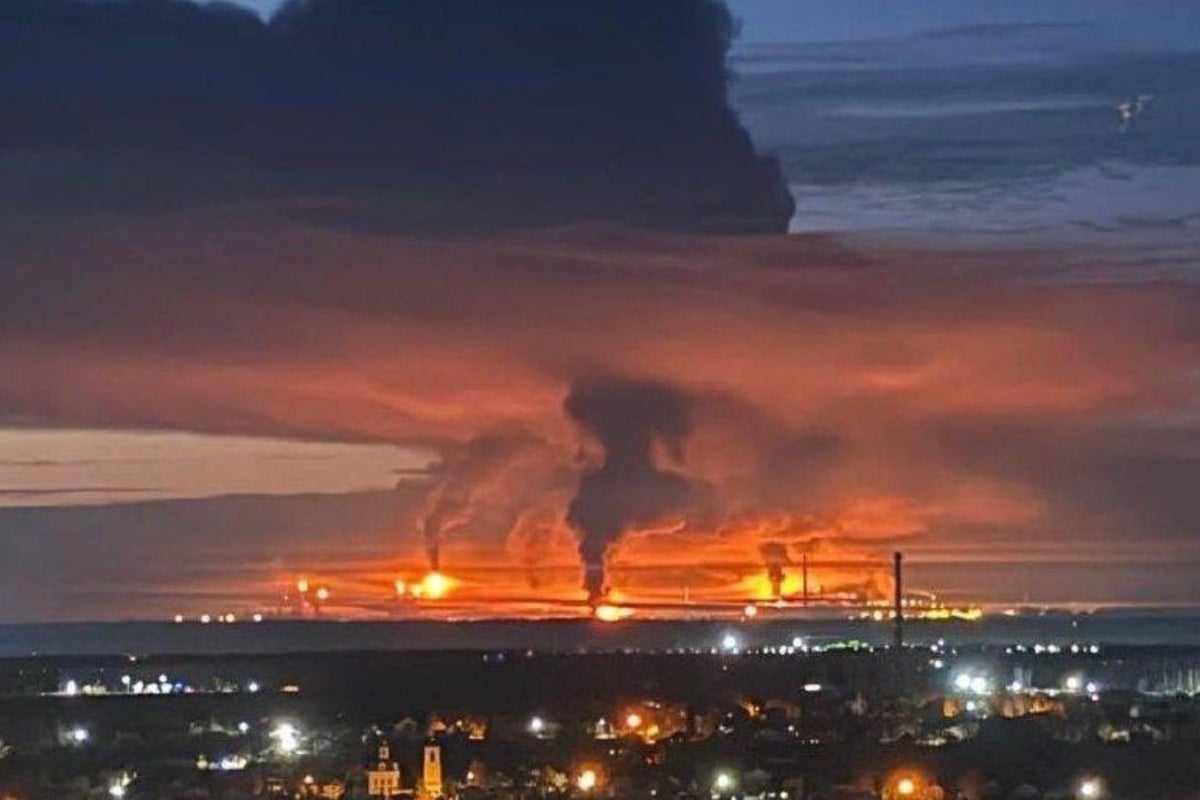
Russia has suffered its deadliest month of the war in Ukraine since it began four years ago, according to figures released by Kyiv, as Ukrainian forces launched overnight strikes against a major Russian missile plant.Ukrainian military officials have said throughout October, Moscow sustained 54,400 casualties. The figure surpasses the previous monthly high of 48,670 recorded in December 2024, with military planners warning that Russian frontline losses are now outweighing the Kremlin’s recruitment pipeline.The claims coincide with deep-strike operations inside Russian territory overnight. Long-range Ukrainian drones targeted a facility manufacturing solid propellant and air-defence systems in the southern Rostov region, while more than 100 drones struck the industrial hub of Kstovo, east of Moscow, which processes five per cent of the country’s crude. The aftermath of a Ukrainian strike on Kstovo oil refinery on Saturday (X/@ukraine_map)Russian forces launched retaliatory overnight barrages targeting Ukraine’s energy grid, firing 433 drones in a concentrated wave. The strikes severed power lines across several regions, leaving 280,000 households without electricity or heating.Ukrainian president Volodymyr Zelensky said the intensity of the Russian bombardments aimed to “take maximum advantage of the shortage of ballistic missile interceptors”, warning that critical civilian infrastructure remains under severe strain.“Each month of the war is becoming increasingly costly for Russia's armed forces,” the Ukrainian general staff said in an update posted on social media. While neither side publishes regular, verifiable accounts of their own casualties, current estimates place total Russian losses at more than 1.5 million personnel since the start of the conflict in 2022.The casualty spike highlights Moscow's willingness to trade mass infantry losses for incremental territorial gains in the east.Ukrainian emergency workers extinguishing a fire at the site of a Russian attack on an industrial facility (Ukrainian Emergency Service)Military analysts warn that exhausting manpower faster than regional recruitment bonuses can replace it leaves Russia vulnerable to strategic depletion, forcing greater reliance on foreign munitions and blunt mass destruction over tactical gains.In the south, attention has turned to the humanitarian crisis in Oleshky, a Russian-occupied town on the eastern bank of the Dnipro River. Situated as a strategic gateway to occupied southern territories and the approaches to Crimea, Oleshky's surrounding marshlands and river channels have become an entrenched amphibious battleground.Civilians prepared on Saturday for the expiry of a rare six-day local truce – the most significant ceasefire between Kyiv and Moscow since the full-scale invasion began – which the White House said was brokered with the assistance of US first lady Melania Trump.The brief window allowed hundreds of starved and exhausted Oleshky residents to evacuate via humanitarian convoys after supply routes collapsed under months of heavy drone and artillery fire. Families from Oleshky reunite after being evacuated from the occupied town (Getty)Trapped for months in the crossfire of drone strikes and landmines, an estimated 2,000 residents had been pushed toward starvation before evacuees were bused out to both Ukrainian and Russian-controlled territories. The acute plight of civilians trapped in the Dnipro basin prompted an intervention from the Vatican, with Pope Leo XIV raising the situation during his address and appealing for an immediate cessation of violence.Local officials in nearby Kherson warned on Saturday that Russian forces had used the corridor’s quiet to reposition weapons and personnel, raising fears that heavy artillery shelling across the river would resume the moment the six-day truce expired on Sunday evening."Ukrainian units have continued to strike Russian troop concentrations and logistics routes with precision drones and artillery.The military escalation and relief efforts unfolded alongside high-level diplomatic activity in Ankara, where Zelensky held talks with Turkish president Recep Tayyip Erdogan.Discussions focused heavily on Black Sea shipping security, with both leaders warning that disrupted maritime corridors and looming grain shortages are threatening the world's most vulnerable populations. A container ship that sank after being hit by naval drones in the Black Sea on Wednesday (French Armed Forces)Ankara is seeking to leverage its ties with both Nato and Moscow to broker upcoming trilateral talks that could restore safe commercial transit, facilitate prisoner exchanges, and establish a formal de-escalation framework.Speaking after the meeting, president Zelensky insisted that any diplomatic resolution must respect Ukraine's territorial integrity, warning that formalising Moscow's territorial claims would invite future aggression. Erdogan reiterated Turkey's support for Ukrainian sovereignty while offering to host negotiations, warning that a protracted war of attrition risks broader regional destabilisation.The meeting followed comments from US secretary of state Marco Rubio, who welcome the idea of a ceasefire in the Black Sea.Marco Rubio has stressed that assistance for Ukraine must be paired with realistic action to end the conflict (Reuters)“This is threatening the world for food security and some energy security as well,” Rubio said. “We'd like to achieve it. It doesn't solve the war, but at least it solves a unique aspect of it."Rubio warned that the war cannot continue indefinitely as a battle of attrition and stressed that Western military assistance must be paired with realistic objectives. His remarks reflect growing pressure in Washington for an exit strategy. By combining high-casualty frontline resistance and deep industrial strikes with localised humanitarian pacts and trilateral diplomacy, Kyiv and its partners are attempting to build maximum leverage before any formal negotiations begin.
Russia suffers ‘deadliest month of war so far’ as Ukraine strikes missile plant and oil refinery
Full Article
Original Source
Read the full article at Independent →KhanList aggregates and links to publicly available news content. We do not host full articles from third-party sources. Always verify important information with original sources.