
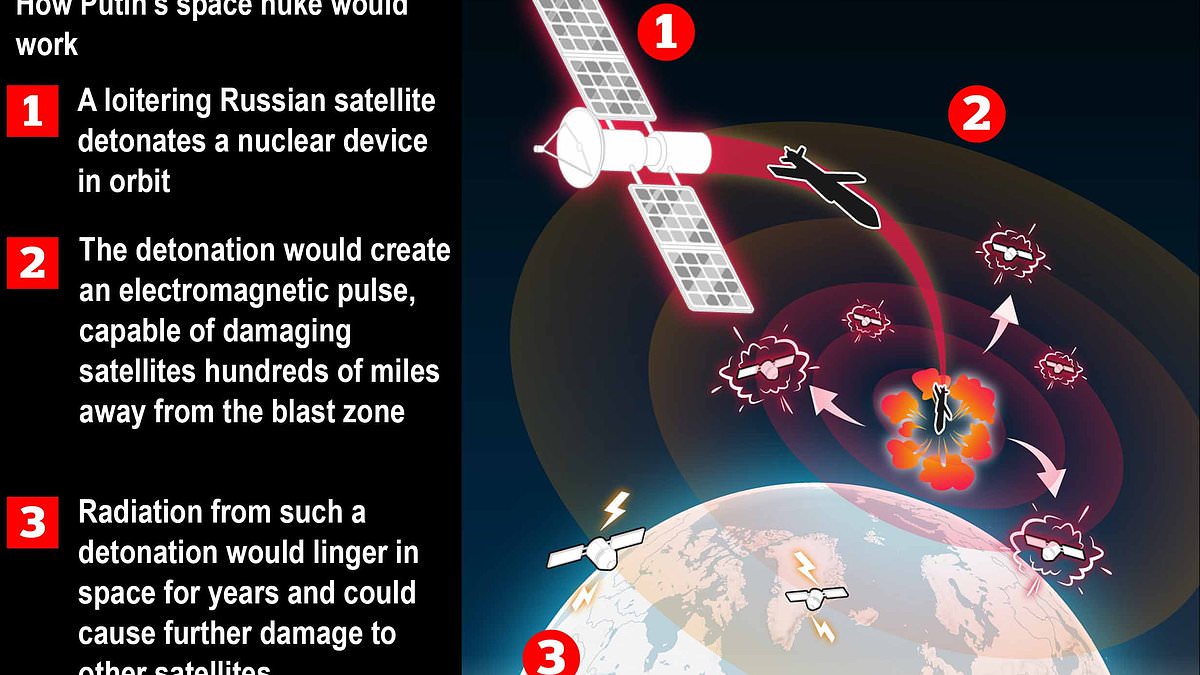
Russia is preparing to launch a nuclear-armed space weapon by the end of this year, according to Western intelligence agencies.The satellite with a nuclear warhead is said to be called 'Sputnik-S', has been fully constructed, and has been stored in the greater Moscow area for several years. In the event of it being launched, Western precision munitions would be affected, as would military drones and communication between soldiers, aircraft, tanks, and command centres.Following a widespread satellite failure, navigation systems, power grids, and food deliveries would also be impacted.The German Space Command believes the 'Sputnik-S' could be launched into space as early as December. The Russian embassy said it had no information regarding the described events and categorically rejected 'all unfounded allegations concerning the space activities of the Russian Federation'.These allegations were 'part of a propaganda campaign', it said, adding that Russian measures for the exploration of space were in 'accordance with international obligations' and served 'exclusively peaceful purposes'.To simulate a scenario, the German Wargaming Centre at the Helmut Schmidt University of the Federal Armed Forces in Hamburg gathered representatives from administration, business and disaster relief in the former government bunker in Bad Neuenahr. Russia is developing nuclear space weapons that could destroy thousands of satellites, US intelligence has warned (stock image)After a short time, the wargame encountered serious problems supplying the population.Project manager Philipp Jan Schäfer said: 'In the worst-case scenario, there will be looting or riots, the likes of which we probably only know from disaster movies.'The German Wargaming Centre concluded that the country lacks an 'immediately available' plan for the 'long-term failure of space-based services', reported Westdeutscher Rundfunk (WDR).'We are far from prepared for a "spaceout" scenario, where many satellites fail,' said Enrico Fels, a security and space expert at the Centre for Advanced Security, Strategic and Integration Studies at the University of Bonn. He added: 'The problem is, as a society, we currently don't even know exactly where our dependencies on space lie.' There are currently no contingency plans for such a scenario at the federal, state, or local level.As a result of the investigation, the Federal Ministry of the Interior is planning to publish guidelines for crisis management in the space sector.In February 2023, the US first issued an internal warning that Moscow was working to place a nuclear weapon in space. US lawmakers, who had been briefed by intelligence agencies at the time, described a 'serious threat to national security'.Last October, the US Defense Intelligence Agency (DIA) published a space situation report claiming: 'Russia is developing a satellite designed to carry a nuclear weapon.' The report added that the Kremlin would thereby be violating the 1967 Outer Space Treaty, which prohibits 'placing objects carrying nuclear weapons or other types of weapons of mass destruction into Earth orbit'.Once such an armed satellite is in Earth's orbit, there are hardly any effective countermeasures, according to the DIA, and the use of such a weapon could probably not be prevented. Experts agree that the consequences of a nuclear explosion in space would be detrimental. The head of US Space Command, Stephen Whiting, recently predicted that 'probably about a third of all satellites in low Earth orbit would fail immediately, within the first hours to days. And then, over the following months, the remaining satellites would gradually fail.'As well as the failure of civilian and military satellites, the detonation of a nuclear bomb in space would likely create a debris cloud that would also endanger satellites not directly affected by the explosion. The strong electromagnetic pulse of a nuclear explosion in space could also lead to widespread failure of technical systems on Earth. Major General Armin Fleischmann of the Cyber and Information Space Command (CIR) said that if the device was detonated, 'the consequences for life in Germany would be immense: power outages, severe restrictions on communication or navigation.'But sufficiently 'hardening' one's own systems would be 'very expensive,' Tagesschau reported.Fleischmann proposed an alternative: Berlin could develop 'counterspace capabilities,' meaning defensive capabilities to 'engage with enemy satellites, including nuclear-armed ones, and ideally neutralise them'.A widespread satellite failure would impact GPS systems for navigation, banking, power grids, and mobile networks. In the military sphere, some weapons systems would be barely operational, and reconnaissance and communication within the armed forces and with allies would be severely reduced.According to investigations by WDR, NDR, and SZ, Western militaries are far more dependent on satellites than those of the Russian military. Therefore, detonating a nuclear weapon in space could give Moscow at least a short-term military advantage in the event of war.In 1962, as part of the military project 'Starfish Prime,' Washington detonated a nuclear bomb in space at an altitude of 400 kilometers above the Pacific Ocean. The explosion produced a flash in the sky, and the electromagnetic pulse caused streetlights in Hawaii to fail, as well as telecommunications systems and other technical equipment.Furthermore, multiple satellites were destroyed, including the first British satellite and the first US civilian satellite. But given the tens of thousands of satellites in operation today, the consequences would have been far more serious.
Russia 'is preparing to launch nuclear-armed space weapon by the end of this year' - capable of devastating Western technology and communications
Full Article
Original Source
Read the full article at Dailymail →KhanList aggregates and links to publicly available news content. We do not host full articles from third-party sources. Always verify important information with original sources.