
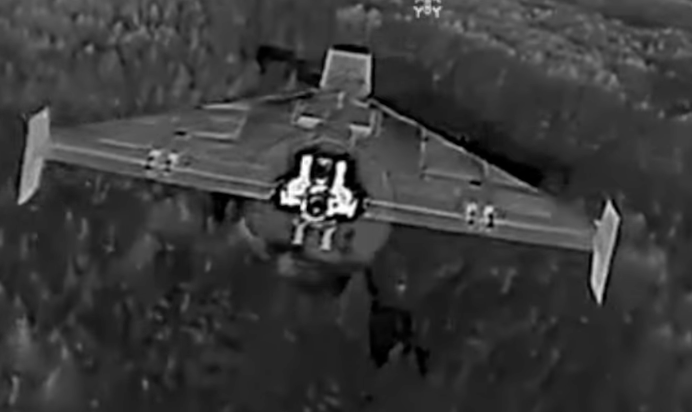
Every day, the Ukraine Battlefield update newsletter offers a clear look at how the war is unfolding on the ground. Subscribe for free here to get the full text delivered to your inbox. There are growing numbers of jet-powered Shaheds, and they are far more dangerous. Why they are difficult to intercept. Without Western components and Chinese engines, Russia would not have been able to build them. A jet-powered “drone-missile” also crashed in Moldova. The British crossed another red line and angered the Kremlin. Photo and map of the day: destroyed Kupiansk. Videos of the day: capture of 30 Russian soldiers; a harsh summer in the Odesa region. There are growing numbers of them, they are far more dangerous, and much more difficult to neutralise. Although Russian ballistic-missile attacks are currently causing Ukrainians the greatest concern, as they face a critical shortage of Patriot interceptor missiles and the situation is expected to deteriorate significantly by winter, attack drones remain Russia’s most widely used weapon against Ukrainian cities. However, since Ukrainians have significantly improved their air defences with their own interceptor drones and have increasingly struck deep inside Russian territory, Russia has also been deploying growing numbers of new ‘Shahed’ drone variants, called Geran-4 and Geran-5. They are far more difficult to neutralise and cause even greater damage and civilian tragedies. One of the most thoroughly documented uses of a Geran-4 was the attack on a supermarket in Chernihiv on 27 July, which killed two people — including a nine-year-old girl — and injured another 25. The drone was fitted with a camera, so the attackers probably struck the shop deliberately. Ukrainian intelligence linked the attack to a specific unit from the third combat group of the GROM “Cascade” separate unmanned systems brigade. The jet-powered drone was launched by “privileged individuals” from the Bryansk region. According to HUR, these are officers, lawyers, officials and regional commanders who terrorise Ukrainian civilians under short-term contracts, thereby gaining war-veteran status without risking deployment to combat zones. Another dangerous Russian innovation in drone warfare is the hybrid Banderol, which apparently crashed in Moldova this week and which we examine in more detail below. Ukrainian air force radars can distinguish jet-powered drones more easily from older types because they are faster. Instead of propellers, they have jet engines and their design resembles that of conventional guided missiles, but at a far lower production cost. The approach of jet-powered Shaheds towards Ukrainian cities is also evident from the air force’s increasingly frequent social-media warnings flagging the new variant: Ukrainian military experts now speak of a new phase in the air war. Mykhailo Fedorov, the recently dismissed Ukrainian defence minister, has even referred to a change in military strategy in the air. “Our response must be swift if we are to continue defeating Russia in every technological cycle,” he wrote on Telegram. “Shaheds remain the primary instrument of Russian terror, and their share is far higher than that of missiles. We can shoot them down, but they pose a problem both in terms of numbers and technological development,” Odesa-based military expert Oleksandr Kovalenko also told us. According to him, Russia can produce around 130 to 140 jet-powered drones a day. According to the Militarnyi website, the figure could be as much as twice that. “They have constantly modified them, changing their navigation and fuel systems. They have even repeatedly changed the material used in their production, although the overall architecture has not fundamentally changed. It is still a flying wing, but the material from which it is made changes,” Kovalenko, the Ukrainian expert, explained, adding that Russia makes the drones lighter or more robust depending on its needs. The two main types Russia uses are the Geran-2, an analogue of Iran’s Model 136, and an analogue of Model 238, the jet-powered version. The new Geran-5, introduced in 2026, has a range of around 950 km and, according to HUR, carries a 90-kg explosive payload. By comparison, the first Shaheds carried 20-kg warheads. Russia is seeking to expand the production of jet-powered drones, which Kovalenko currently estimates account for around 20 to 25 percent of all variants of these kamikaze drones. According to Ukrainian air force spokesperson Yurii Ihnat, jet-powered drones accounted for as much as two-thirds of the total in some attacks. “It appears that the Russian command has chosen this as its main task and the key direction for drone development,” Kovalenko said. Why they are difficult to intercept. Kovalenko also said that jet-powered Shahed variants had recently become the main challenge for Ukraine’s short-range air defence. The main reason is that they can reach speeds of up to 600 km/h. Wild Hornets units, for example, showed what the destruction of a Russian jet-powered drone looks like. Soldiers from Ukraine’s 81st Air Assault Brigade showed the same. “When they fly at maximum speed, it is relatively difficult to intercept them using standard anti-aircraft, or interceptor, drones. The drone operator has to wait until the Shahed starts manoeuvring. It slows down while manoeuvring, which makes it possible to intercept it at that point. When they are approaching their target, they reduce their speed and become more vulnerable,” Kovalenko said. As he added, the difficulty is that interceptor drones can neutralise them only by waiting for a specific and rare moment. Anton Zemlianyi, an analyst at Ukraine’s Centre for Security and Cooperation, made a similar point to RBC-Ukraine. However, he warned that Russia’s arms industry cannot manufacture jet-powered drones on the same mass scale as older variants. They are more technically complex, while their components are less readily available and more expensive. He cited the more demanding manufacture of jet engines in particular, a problem Russia addresses mainly through imports from China. According to Zemlianyi, the composite materials from which the drones themselves are made are another challenge. He described jet-powered drones as an intermediate category — between conventional long-range drones and cruise missiles. Ukraine is seeking to respond to the new challenges by developing its own jet-powered interceptor drones with similar speeds, which, according to former defence minister Mykhailo Fedorov, are currently undergoing combat testing. According to him, Ukraine has one of the world’s most advanced “small-scale” air-defence systems, from which other armies are also drawing lessons. “The task now is to make ten times the effort to counter the threat of jet-powered drones as quickly as possible,” Fedorov added. It would not be possible without Western components. When Ukrainian military intelligence (HUR) analysed downed Geran-4 drones — and the same applies to the Geran-5 — it found dozens of foreign components, according to a published 3D model. For example, China supplies engines disguised as industrial cooling units in order to circumvent Western sanctions. In the case of the Geran-5, HUR found at least nine US electronic components and a German transistor, in addition to Chinese components. These were not old stockpiles but new devices, showing that Russia has been successful in circumventing Western sanctions. “When it comes to the range of Western components, Russia remains dependent on smuggling, predominantly via China,” Kovalenko said. This particularly concerns microchips and microcircuits. If Russia did not have access to these technologies, it would lack the capacity to manufacture these Shaheds, which only confirms the importance of tightening the sanctions regime against Russia. Banderol crashed in Moldova. Another example of a Russian jet-powered drone is the S8000 Banderol, which some describe as a cruise missile. It is a hybrid of a cruise missile and a drone, developed by the Russian company Kronstadt. It was apparently this Russian weapon that crashed in a field in Moldova earlier this week, where Russia controls the unrecognised republic of Transnistria and has so far unsuccessfully sought to reverse the pro-European course of this small country between Romania and Ukraine. Moldovan police footage. According to the Moldovan police, fragments of a jet engine were found near the crater. This is already the second similar incident this month. In protest, Moldovan diplomacy recalled its ambassador from Moscow for consultations after the first incident. Ukrainian intelligence had previously identified components from around 30 foreign companies — from China, Japan and the US to South Korea — in a Banderol following a Russian attack. Russia also used this weapon to attack Kyiv on 2 July, killing 30 people. This drone-missile can fly at speeds of around 600 km/h and carries an even heavier warhead than the Geran-5. Notably, it does not launch directly from the ground; it is primarily carried by Russia’s Kronstadt Orion reconnaissance and strike drone. In the future, Russia would also like to integrate it with Mi-28N helicopters. According to Moldovan president Maia Sandu, such incidents occur deliberately on Moldovan territory so that Russia can test its ability to respond. According to the Institute for the Study of War, the Kremlin is demonstrating a willingness to risk its weapons striking countries neighbouring Ukraine. Ukraine’s Centre for Countering Disinformation counted at least 12 probably Russian drones and missiles that entered European airspace between 15 July and 15 August. Infographic — Ukraine’s Centre for Countering Disinformation According to ISW, this is part of Russia’s “Phase Zero” campaign, intended to create the informational and psychological conditions for potential future provocations against Nato. “This also includes Russian false-flag provocations, drone incursions, sabotage, electronic warfare jamming and overflights,” the US think-tank added. The British crossed a Kremlin red line. We have regularly reported in the Ukraine Battlefield update on how Ukrainians have fundamentally changed the dynamics of the war with their own jet-powered drones and missiles, which they use to strike major warehouses, refineries and arms complexes. It is estimated that attacks on Wildberries alone caused damage of up to 878bn roubles over two months, which, according to Vazhnyye Istorii, is comparable to the revenue that oil and gas brought to the Russian budget in April, when prices were driven up by the Israeli-American war against Iran. In recent days, however, reports have caused a stir that Ukrainians are also using the British jet-powered Nyan drone, made by Callen-Lenz, a subsidiary of arms giant BAE Systems, for strikes deep inside Russian territory, as well as another unnamed, longer-range type that is also of British origin. The Times reported this, for example, while aviation expert Valerii Romanenko confirmed it to NV. He said they had targeted, for instance, refineries in Volgograd and Yaroslavl, as well as the aforementioned Wildberries warehouses. Their range is up to 250 km, and up to 960 km in the case of the second drone. They are similar in size to Russian Shaheds, but have a much lighter warhead than the most advanced Geran variants. Until recently, London officially supplied Kyiv only with Storm Shadow guided missiles, which are highly effective but cost more than £750,000 each to manufacture — roughly 10 times more than the new drones mentioned above. The current British approach is another indication of how profoundly the nature of drone warfare has changed. London has also crossed another unwritten red line set by Moscow. By the end of the year, it is due to supply Ukraine with 160,000 drones of various types. The Kremlin responded to the reports as expected, accusing London of deliberately escalating the Ukrainian crisis and describing it as an accomplice to bloody crimes. But the UK ministry of defence told the BBC that it stood alongside Ukraine. “Russia should be in no doubt about this government’s resolve to confront Russian aggression in Ukraine, as well as against the United Kingdom and our allies,” the UK ministry said, adding that it was prepared to provide Ukraine with the equipment it needed to defend itself against Putin’s illegal invasion. Photo and map of the day Destroyed Kupiansk. The list of towns in eastern Ukraine completely destroyed during Russia’s invasion is very long. This is how operators of unmanned systems from the 41st Separate Mechanised Brigade see Kupiansk, on the banks of the Oskil river in the Kharkiv region. “Life once thrived on these streets, filled with children’s laughter and the bustle of adults — until the horde came and turned this picturesque, welcoming town into a nest of death and darkness,” they wrote in a post about the town, where the situation has again become very tense this summer and Russian forces are intensifying their attacks. Illustration — DeepState Videos of the day Liberation of the village of Andriivka-Klevtsove. A video by the third regiment shows the course of an operation on the Oleksandrivka axis in the Donetsk region, near the border with the Dnipropetrovsk region, during which 30 Russian soldiers were captured. This was estimated to be around half of the deployed force. The village was formerly called Iskra; it was renamed after the adoption of the so-called decommunisation law. We reported yesterday in the Ukraine Battlefield update on the successful Ukrainian operation in this part of the front. Since the start of the year, Ukrainians have retaken 745 square kms and 26 villages across the Dnipropetrovsk, Zaporizhzhia and Donetsk regions. Russia currently holds positions in the Dnipropetrovsk region only near the village of Dachne. The liberation of the village of Andriivka-Klevtsove (formerly known as Iskra) by soldiers of the 3rd Regiment and one of the Psychological Operations Centers of Ukraine’s Special Operations Forces. During the operation, 30 Russian servicemen — roughly half of the Russian… pic.twitter.com/9s9KDbNDIX— Yigal Levin (@YigalLevin) August 17, 2026 Harsh swimming in the Odesa region. Russia is responding to Ukrainian strikes with heavy attacks on Ukrainian ports in the Odesa region. This video shows, for example, what summer 2026 looks like on the beach in the village of Prymorske. What are the losses No changes on Tuesday morning. By Monday (17 August), Russia had verifiably lost 24,005 pieces of heavy equipment (23,982 on Monday, 10 August). Of these, 18,977 (18,957) were destroyed by Ukraine, 997 (995) were damaged, 1,193 (1,193) were abandoned by their crews, and 2,838 (2,837) were captured by the Ukrainian army. This includes 4,437 (4,437) tanks, of which 3,343 (3,343) were destroyed in combat. Ukraine had lost 11,916 (11,828) pieces of equipment, of which 9,333 (9,286) were destroyed, 695 (695) damaged, 692 (691) abandoned and 1,196 (1,196) captured. This includes 1,450 (1,450) tanks, of which 1,111 (1,111) were destroyed in combat.Note: Neither side regularly reports its own dead or destroyed equipment. Ukraine publishes daily figures for Russian casualties and destroyed equipment, which cannot be independently verified. This overview uses data from the Oryx project, which has compiled a list of equipment losses documented exclusively by photographs since the beginning of the war.
Russia is adapting its drone-warfare strategy, with faster and deadlier ‘Shaheds’ (Ukraine Battlefield update, Day 1,636)
Full Article
Original Source
Read the full article at Euobserver →KhanList aggregates and links to publicly available news content. We do not host full articles from third-party sources. Always verify important information with original sources.