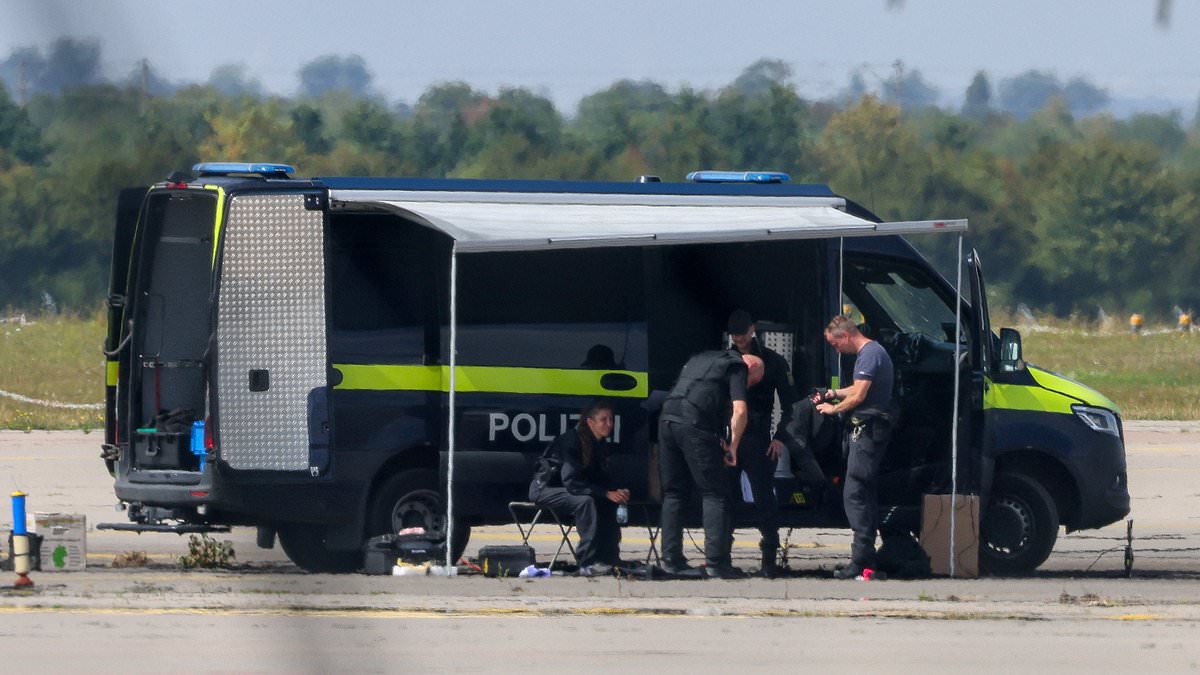
Russia has denied being involved in a suspected drone attack at a major German air freight hub this week. The Russian embassy in Berlin called the drone incident a 'fabricated provocation', saying it was another example of accusations against Russia without evidence.'The embassy is expressing its concern about a new wave of anti-Russian hysteria in Germany,' said a statement published on its website on Friday. The Russian embassy's comments come after German federal prosecutors launched a probe this week into what they described as a serious attack that could have impacted foreign and domestic security.Airport workers discovered the drone late on Tuesday at Leipzig/Halle airport, an important civilian freight and NATO logistics hub in eastern Germany that is also a base for several giant An-124 cargo planes operated by Ukraine's Antonov Airlines.The drone was equipped with explosives and a detonator, according to prosecutors.The suspected drone attack was foiled by a hero bus driver at the airport after he kicked it out of the air, according to German MP Detlef Seif. The bus driver at Leipzig/Halle Airport saw the drone flying low close to a Ukrainian cargo plane when he halted it. Police officers work in the vicinity of an Antonov cargo plane, near which a drone was found, at Leipzig/Halle Airport in Schkeuditz, Germany, August 5, 2026'A bus driver kicked the drone away while it was flying low. It then crashed and came to rest on the ground,' Mr Seif said. 'The bus driver's action was very daring and courageous, but also very dangerous. It is possible that his intervention prevented the intended attack.'Additionally, a cargo plane that performed a go-around due to a runway closure near the airport collided with an object that prosecutors believe was another drone. The jet, operated by logistics group DHL, sustained slight damage and was eventually diverted to Hanover in northern Germany.German government members and other officials have not blamed any foreign countries publicly for the incident, but some lawmakers have pointed the finger at Russia, which launched a full-scale invasion in Ukraine in 2022.'It is obvious that this hastily fabricated provocation only serves the interests of Kyiv and the militarist wing of the European political class,' the Russian embassy said in its statement.In the past, German officials have often blamed Moscow for what they call hybrid attacks – incidents of aggression that fall short of acts of war.Russia could send an armed group to occupy NATO territory within weeks, US intelligence has warned NATO members believe Putin is already conducting probing attacks to test and fracture the alliance. Pictured: A Russian 220mm heavy multiple launch rocket system firing at an undisclosed location in Ukraine A Russian serviceman intercepting Ukraine drones with a machine-gun at an undisclosed location in Ukraine on August 7It comes amid warnings from US intelligence services that Russia could send an armed group to occupy NATO territory in Europe. Officials believe that Putin could launch a small land incursion into a disputed Eastern European outpost such as the Estonian city of Narva, or launch a cyber attack to test the alliance's resolve.Until now, US intelligence believed the Kremlin dictator would not risk provoking NATO while fighting in Ukraine.But this assessment changed this year as Russia comes under increasing pressure from Ukrainian drone attacks on oil refineries and logistics hubs, according to The Wall Street Journal.NATO members believe Putin is already conducting probing attacks to test and fracture the alliance.Western fighter jets have been scrambled three times in the last few weeks to shoot down drones, while Ukraine recently intercepted a drone that had earlier crossed into Romanian airspace.And fighter jets were scrambled over 250 per cent more in July compared with a year ago as Russia continues to probe the West's defences.The sharp increase in the monthly figure for July compared with the same month in 2025 highlights Putin's aggressive stance. File image: A still image taken from a handout video provided by the Russian Defence Ministry press service on 07 August 2026 shows a Russian self-propelled gun firing at an undisclosed location in Ukraine Until now, US intelligence believed the Kremlin dictator would not risk provoking NATO while fighting in Ukraine. File image shows a Russian soldier in an unknown location in Ukraine'The numbers do not lie,' said a post by NATO's Allied Joint Force Command Brunssum.'The possible threats range from a cyberattack on a NATO country or sending unmarked armed groups to occupy territory to a limited incursion on the alliance's eastern flank,' said the WSJ report.The time frame for a Russian move is between this autumn and 2029, according to US intelligence assessments.One theory is Putin could grab a city or region in Poland or one of the three Baltic states - Estonia, Latvia and Lithuania, all NATO members which have strongly backed Ukraine.Lithuanian President Gitanas Nausėda warned recently: 'I cannot deny that we have such information and that it concerns kinetic operations.'Not on a large scale, but targeted kinetic operations that are very likely to be directed against critical infrastructure.'Russian opposition politician and chess grandmaster Garry Kasparov said: 'I think the chances [are] that he'll cross NATO borders — Estonia, Latvia, Lithuania, Poland, just a small incursion using drones.'I think the chances are growing because Putin needs a winning narrative and Ukraine doesn't offer it.'All three Baltic states have strengthened their border defences against Russia and close ally Belarus.The Baltic states have some of the highest defence spending in all of NATO in relative terms - Lithuania directs 5.3 per cent of GDP to defence, the most of NATO's 32 members. File image: A fire breaks out following massive Russian ballistic missile strikes in the Ukrainian capital of Kyiv on August 5, 2026, amid the Russian invasion in Ukraine File image: Smoke billows from a warehouse, after deadly Ukrainian drone attacks, as per regional governors, in Elektrostal, Moscow Region, Russia File image: A man walks past burned-out cars and a residential building that went up in flames during a recent Russian strike are scattered in a residential area, amid Russia's attack on Ukraine, in Zaporizhzhia, Ukraine, July 30, 2026Last month, Washington warned the Kremlin could be planning an armed incursion on Polish land to test NATO's response.The provocation could see Putin's troops cross over into Poland, and vital infrastructure could be targeted by missiles and drones.Sources close to Polish President Karol Nawrocki told news outlet Onet that the US had been warning Warsaw about the plan for a while.Russia's plan aims to start a crisis to scare Western nations into stopping their support for Ukraine.Polish security experts also warned that Russia and Belarus might send a small number of troops across the NATO border.Power stations could also be targeted in the incursion, through air strikes that would force Poland to activate its air defence systems.Moscow's strategy relies on the assumption that the US would compel Poland to negotiate rather than engage militarily.It also comes as four people, including a child, were killed in Russian attacks on the Ukrainian capital, Kyiv, and the surrounding region, local officials said on Saturday. Residents endure regular drone and missile barrages that Kyiv's depleted air defences are struggling to counter amid Moscow's 4-year-old full-scale invasion, while repeated Ukrainian strikes on oil facilities have caused fuel shortages and rattled Russians.Two grandparents and their 3-year-old grandson were killed after multiple Russian drones destroyed their home in the Brovary district of Kyiv region, northeast of the Ukrainian capital, Kyiv, early Saturday. Three other members of the same family and a neighbour who came to their aid were hospitalised, local authorities said. The attack reduced the house to rubble and wrecked outbuildings and cars. Four people, including a child, were killed in Russian attacks on the Ukrainian capital, Kyiv, and the surrounding region, local officials said on Saturday This handout photograph taken and released by Ukrainian State Emergency Service on August 8, 2026 shows firefighters putting out a fire following Russian ballistic missile strikes in the Ukrainian capital of Kyiv, amid the Russian invasion in UkraineIn the city of Kyiv, Ukrainian President Volodymyr Zelenskyy said at least one other person died in a 'strike involving six ballistic missiles against civilian infrastructure.'In its daily report, Ukraine's air force said it had downed or intercepted 135 of 151 drones launched by Russia overnight. The attack also involved six ballistic missiles and other guided missiles.Russia has relentlessly pounded civilian areas of Ukraine, even though Moscow insists its forces target only military facilities.Moscow is exploiting Ukraine's critical shortage of interceptors for the U.S.-made Patriot systems, the sole air defence weapon in its arsenal able to shoot down ballistic missiles.Zelenskyy has pleaded with other countries, especially the U.S., to send more of the ammunition made scarcer by the Iran war. Failing that, he wants to make Patriot ammunition in Ukraine or win permission from Elon Musk to use his Starlink satellite communications system to guide strikes inside Russia that can hit its missile launchers.Following the latest attacks, Zelenskyy appealed on X for more sanctions to 'prevent the production of these ballistic missiles,' along with 'anti-ballistic capabilities' and 'interceptor missiles.' Ukraine’s air defences shot down around 5,300 drones and missiles last month, Ukraine’s defence ministry said Friday, just under 60 per cent of the around 9,000 attack drones and missiles Russia fired in the same period.
Russia denies it was behind bomb drone attack on German airport foiled by hero bus driver - as fears grow that Putin could launch new Nato assault
Full Article
Original Source
Read the full article at Dailymail →KhanList aggregates and links to publicly available news content. We do not host full articles from third-party sources. Always verify important information with original sources.