
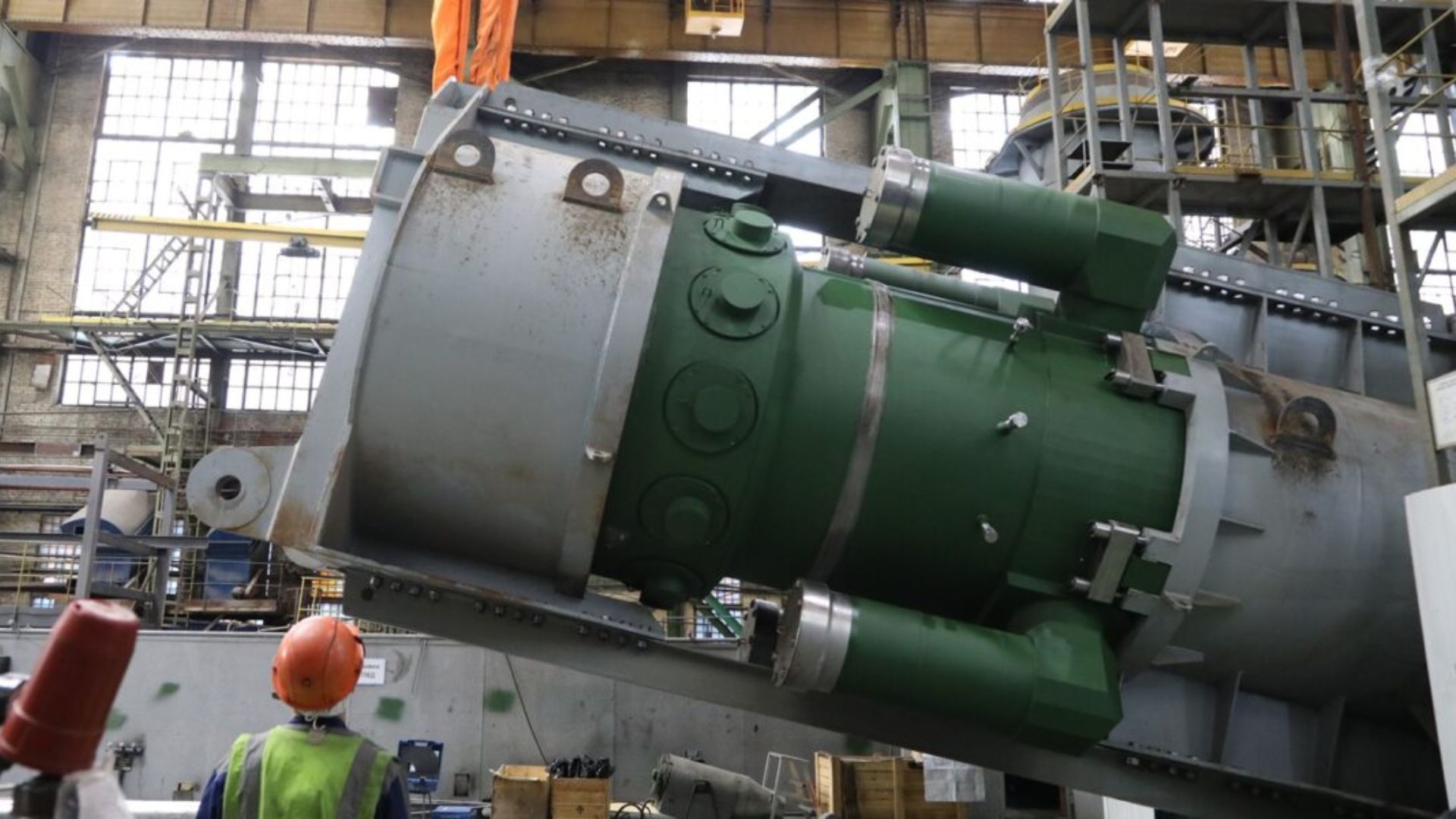
Russia has completed the first RITM-200 reactor unit for its new nuclear icebreaker, the Leningrad. Rosatom chief Alexey Likhachev outlined plans to use these small-scale systems for broader energy needs during a government meeting on nuclear infrastructure. He reported that Russian factories have manufactured 15 of these reactors so far, while workers are building 13 more. The technical baseline of this program is the RITM-200 pressurized water reactor. According to Rosatom, each unit produces 175 megawatts of thermal power and offers an operational lifespan of at least 40 years. In terms of dimensions, the system measures 7.3 meters (24 feet) in height and 3.3 meters (11 feet) in diameter. “They are particularly suitable for hard-to-reach, isolated areas. Only in Russia are such units being mass-produced,” noted Likhachev. RITM-200 comes with integrated layout The key engineering advance in the RITM-200 is its integrated layout. Traditional marine reactors place steam generators and coolant pumps outside the main vessel, linking them with large pipes. In the RITM-200, engineers placed the core and steam generators inside a single pressure vessel. This design is aimed at cutting the total footprint of the system by around a third compared to older units. As a result, the reactor delivers about 1.5 times more power relative to its physical size. This compact machinery directly changes how the Project 22220 icebreakers operate in icy waters. Because the reactor saves weight and internal space, ship designers could build a dual-draft hull. Adapting the reactor for civilian grids The vessel can take on water ballast to sit deep in the ocean, where it uses its mass to crush sea ice up to three meters thick. In shallow areas, the ship pumps out ballast to decrease its draft. This change in buoyancy allows it to enter the mouths of Siberian rivers without running aground. Engineers are now adapting the same marine reactor for civilian energy grids on land and along coastlines. The land-based version is called the RITM-200N. Construction has started on a plant using this design in the Yakutia region of eastern Siberia. Once running, the station will supply electricity to the Kyuchus gold and mineral deposit and power local settlements. For coastal industries, Rosatom developed another variant named the RITM-200S. These units will sit on floating barges rather than fixed land foundations. The company is assembling a fleet of these floating power stations to run the remote Baimsky mining site in Chukotka. Testing reactors for minimal power needs Rosatom is also testing micro-reactors for remote areas with minimal power needs. These projects include the Shelf micro-reactor and the Elena thermoelectric power unit, developed by the Kurchatov Institute. The Elena unit generates both heat and electricity using thermoelectric materials rather than moving steam turbines. This mechanical design eliminates many moving parts, which allows the plant to run autonomously for decades without regular maintenance. “The RITM-200 is also entering the international market,” concluded Rosatom in a press release. “The first international project for a Russian-designed small nuclear power plant is being implemented in Uzbekistan.” Get the latest in engineering, tech, space & science - delivered daily to your inbox.An active and versatile journalist and news editor. He has covered regular and breaking news for several leading publications and news media, including The Hindu, Economic Times, Tomorrow Makers, and many more. Aman holds expertise in politics, travel, and tech news, especially in AI, advanced algorithms, and blockchain, with a strong curiosity about all things that fall under science and tech.
Russia builds 15 small marine nuclear reactors with 175-MWt capacity for icebreakers
Full Article
Original Source
Read the full article at Interestingengineering →KhanList aggregates and links to publicly available news content. We do not host full articles from third-party sources. Always verify important information with original sources.