
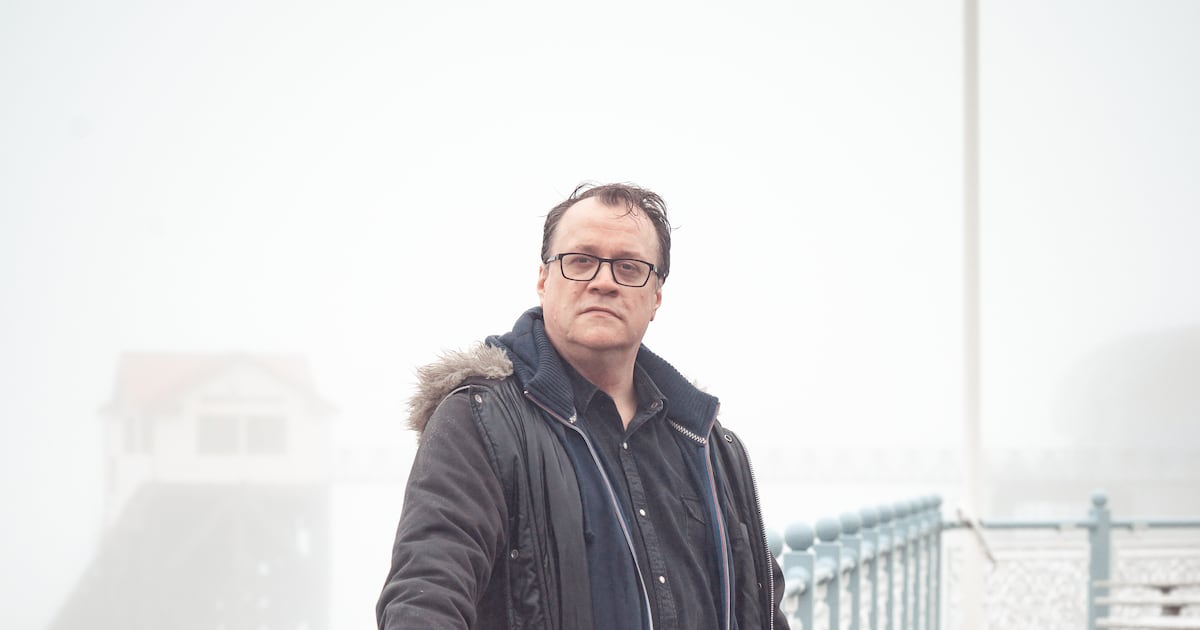
Russell T Davies keeps a kitchen knife by his front door at his home in Swansea. The Welsh screenwriter and television showrunner doesn’t want to go into detail, but there have been “a couple of instances” where people have worked out his address, and though in one case it was someone who wanted to give him a Doctor Who script, other things have happened to alarm him as a gay man in the public eye.“I laugh at myself for having a knife by the front door. I would probably just stab myself and drop it and be a complete idiot. But it just psychologically made me think, right, I could be ready for trouble at my front door. The point is I don’t think trouble at my front door is impossible now.”Davies reveals these fears in The Queerest of Folk, a memoir of his five-decade television career written with Boyd Hilton, a journalist who voiced support for Queer as Folk at the Channel 4 drama’s feverish press launch in 1999. With his second stint overseeing Doctor Who now over and his searing state-of-the-nation drama Tip Toe arriving earlier this year, it seemed “a nice moment to take stock” of his time in the industry he loves.Davies is speaking from his other home, in Manchester, where a small Dalek is visible on the bookshelves behind him. He didn’t want to give the memoir a “Doctor Who-ey” title because he thought it was “quite important to make it more adult in feel”, so he opted for a spin on the “fine old northern phrase” he employed for his career breakthrough. “I’ve got to say, it was Manchester Pride this weekend, and I went out on those streets for three days running, and I am not the queerest of folk!”READ MOREDavies is funny, but he didn’t always know how to be funny in drama. He got his start in television as an assistant producer on the BBC children’s magazine show Why Don’t You? before moving into children’s dramas and soap operas. When Granada, the Manchester-based ITV franchise holder, recruited him to write a 1920s period drama called The Grand, he devised a string of dark storylines about postwar trauma, domestic abuse and revenge murders.His “entire writing life” changed course when his friend Sally Watson said, “over a cheese sandwich or something”, that he was a laugh, so why didn’t he write a laugh? “I believed that drama equalled tragedy. That was my mistake. They’re two very different things,” he says.Queer as Folk, which aired when I was a student, was a laugh, but it was, of course, more than that. As “the first gay drama” on television – a stark sentence to read now – it was a daring statement. Davies says he was lucky to be on “the crest of a wave”. Gay characters had been added to Coronation Street, EastEnders, Byker Grove and Grange Hill, while the BBC sitcom Gimme Gimme Gimme was just starting and ITV’s Bad Girls, “with its fantastic lesbian stories”, was on its way.Cynical insiders expected Queer as Folk would be “boring and worthy”, but the series, set in the gay clubs of Manchester’s Canal Street, was confident and new. It featured a controversial age gap – one character, Nathan, was 15, reflecting what Davies was seeing on Canal Street at the time – and sex scenes that were rendered more explosively abrupt in the edit by a Channel 4 higher-up’s request for “less of that”.Davies remains proud of it all, and says his heart was lifted when Jacob Tierney, who adapted Rachel Reid’s novels into last year’s smash-hit gay ice-hockey romance Heated Rivalry, wrote to him to say he was inspired by Queer as Folk. The Canadian series is “a lovely, sexy, successful show”, while his own work remains “shocking to this day”, he thinks. “The radicalness of it and the explicitness of it still stands up. Actually, everything’s calmed down slightly now, and no one goes as far as we did.”Russell T Davies in Swansea, Wales: 'I’m not just a writer; I’m a viewer as well. I need to be capable of sitting down and watching a drama.' Photograph: Francesca Jones/The New York Times He recalls the volatile atmosphere at the launch. “The straight journalists were appalled by what they’d seen, and the gay journalists were appalled by what they’d seen, because we didn’t do enough to represent HIV or Aids or safe sex, and we had people taking drugs and having sex promiscuously. They were furious.”But Davies understands that people will always have their own ideas of what a show should be. “I’m not just a writer, I’m a viewer as well. I need to be capable of sitting down and watching a drama and going, ‘Oh, I don’t like that gay man,’ ‘I don’t like that lesbian,’ or ‘I don’t like that version of trans representation: I think that’s wrong.’”It was Nicola Shindler, his long-term collaborator and the founder of the production companies Red and Quay Street Productions, who encouraged him to become a showrunner before that term was in common usage in the UK. From Queer as Folk onwards he tended to be part of the casting, the shoot, the edit, the music, “everything”, though he has “a slight regret” that he never directed, and thinks, at 63, that he’s too old to do it now. Davies’ list of writing credits includes some of the best and cleverest television of the past 30 years, from Bob & Rose (2001) and The Second Coming (2003) to Years and Years (2019) and It’s a Sin (2021). A Davies script is, by turn, emotional, thrilling, hilarious, unnerving, joyful and incendiary, and it will often showcase his penchant for a big speech – Helena Bonham Carter has a brilliant monologue in Nolly (2023), his drama about the Crossroads star Noele Gordon being sacked by angry male executives, while Paul Rhys delivers a spellbinding one in Tip Toe.“Yes, I love my speeches. Nicola always says, ‘Oh, you’re writing speeches again.’ It’s probably how I talk. I probably don’t let anyone else get a word in edgeways,” he says. “But also I like being on the nose about things. People get very timid in drama.”No one queries big speeches in theatre, he points out. “It’s, like, why is television not allowed that art form? I love it.”Helena Bonham Carter has a brilliant monologue in Nolly (2023), Russell T Davies' drama about the Crossroads star Noele Gordon being sacked. Photograph: PA Davies has done “an awful lot of shows” that didn’t work, but he doesn’t dwell on the disappointments too much. “Every show that didn’t work I wish had worked, but then you love all your children. You don’t love the ones that fail their exams less.”He tends to move on from shows but not from people. Being hired by lofty Old Etonians to write A Very English Scandal (2018), his entertaining account of a bizarre 1970s scandal involving the former Liberal Party leader Jeremy Thorpe, wasn’t an entirely comfortable process, but when he works with trusted friends, they share a shorthand. He would “rather die than deliver a bad script” to Shindler.“The day will come when she phones up and says, ‘Sorry, I really don’t think this works.’ Oh my God, I’ll die. I’ll die. Whereas if it was a complete stranger, or if it was those Old Etonians, who I didn’t like at all, I would just think, ‘Oh, you’re idiots.’”A Very English Scandal coincided with a period when Davies was caring for his husband, Andrew Smith, who was diagnosed with an aggressive brain tumour in 2011. Working on “this mad old tale from 1979” did him good, but as Smith’s health worsened, Davies increasingly stayed at home.A low career ebb came in 2017 when he was writing both Years and Years – a dystopian thriller pitched to the BBC the morning after Donald Trump was elected – and the devastating 1980s Aids drama It’s a Sin. He had wanted to do both shows for ages, but it seemed no broadcaster was in the market.“It was the same time that my husband was very ill with brain cancer, and it was an odd moment. I remember standing in my kitchen at Christmas, wondering if that was it. I’m a constant storyteller, so maybe I’ve exaggerated, maybe it was October. It's a Sin: Olly Alexander in the 2021 drama by Russell T Davies. Photograph: Channel 4 It's a Sin: Ken Christiansen, Neil Ashton, Olly Alexander and Lydia West in the 2021 drama by Russell T Davies. Photograph: Channel 4 “But in my mind it was Christmas and the wind was whistling, and the snowflakes were falling, and I was like the Little Match Girl. To have two big ideas like that turned down, it made me think, ‘Oh, maybe you’ve had your time.’”He rallied. The BBC greenlit Years and Years after a rewrite, and the final episode is dedicated to Smith, who died in 2018. It’s a Sin eventually found a home on Channel 4, but Davies thinks the BBC should have commissioned this piece of history – instead, one of its executives asked if he knew Elton John and pondered whether it would be better as a musical. “At that moment, you very clearly think, ‘I don’t want to work with you.’”The chapter in Davies’ memoir on Disney’s short-lived backing of Doctor Who contains illuminating nuggets about how little it understood the show. A whole season’s worth of scripts remain unmade following the streamer’s exit from the series, which the BBC has now put out to tender.I declare my lifelong Doctor Who fandom and say I try not to get involved in the online discourse. “It’s a pit you might never get out of,” Davies says, laughing. “If I was to go into that discourse, I’d just vanish!”Episodes such as Turn Left, Midnight and 73 Yards rank among his finest hours of television, but is it simply being the person to spearhead the revival of Doctor Who in 2005 that he’s most proud of when it comes to the BBC’s science-fiction flagship?“I think it’s probably the Daleks, actually. Everyone lined up to say the Daleks won’t work,” Davies says. He was under pressure to “completely reinvent” the villains and turn them into “modern-day CGI droids”, but he insisted on using the original 1960s mouldings, paying private collectors to obtain them. It felt “like such a victory” when their “little darling” Daleks became the top-selling toy in Britain soon after.Tip Toe: Alan Cumming as Leo in Russell T Davies' new drama. Photograph: Ben Blackall/Channel 4 Tip Toe: David Morrissey and Alan Cumming in the 2026 Russell T Davies drama. Photograph: Channel 4 The BBC-Disney era of Doctor Who was “expensive”, but most of his shows have had “very ordinary budgets”, and Channel 4’s Tip Toe was cheap, he says. This was by design. Tip Toe “was so opinionated about Trump, the rise of the radical right and populism” that they were sure they wouldn’t get any American money for it anyway.The same fractious political climate that prompted Davies to install a kitchen knife by his front door is explored in this five-parter, which deals with how “the porous wall between our online lives and our real lives is becoming more and more breakable”. It begins by showing the strung-up body of Leo, a gay man played by Alan Cumming, in a flash-forward.“It’s a tough piece of work,” he says. He has friends who have never watched the final episode, which depicts the lead-up to Leo’s horrific murder with sickening tension and escalating brutality. But he felt he had to write it. “I was looking at the world and thinking, ‘This is where we’re heading.’”Davies is delighted that Tip Toe had a “nice and noisy” reception. As for his public profile, there are upsides. It means he can have “a go on that big spinning thing” on the BBC gameshow The Wheel, which he loves. And when writers “pop up everywhere”, it tells children that it’s not a job done by “remote, impossible people” but something they can do too.In the book, he writes that Oliver Cole, his boyfriend of a year, recently persuaded him to go on his first holiday in 14 years. Indeed, British tabloids now report on Davies’ holidays with the 27-year-old – that’s “very, very strange” – but he takes the view that it will be forgotten about tomorrow. “I said to Oliver, there might be 500 comments underneath, but that’s all, out of a population of 60 million. It’s nothing.”He’s not ill, and he’s not retiring, Davies says. Writing is the kind of job he can’t stop. Stories, characters, lines of dialogue follow him around the house, and his imagination is populated by people from dramas that don’t yet exist. “I think I’ll die without getting to write them all,” he says. “Which is fine. I’m glad to have that big storehouse of ideas burning away.”The Queerest of Folk: A Life in Television, by Russell T Davies, is published by Transworld
Russell T Davies: ‘I keep a kitchen knife by the front door’
Full Article
Original Source
Read the full article at Irishtimes →KhanList aggregates and links to publicly available news content. We do not host full articles from third-party sources. Always verify important information with original sources.