
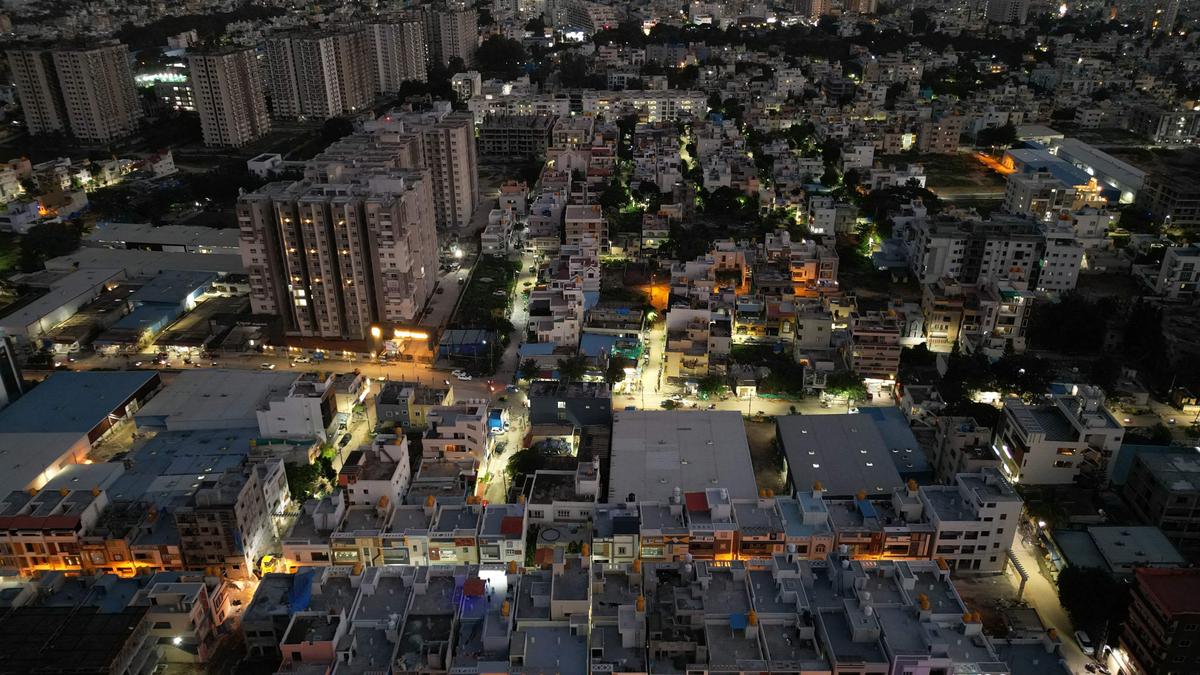
According to the report, the Bengaluru Metropolitan Region will see its population increase from the current 1.4 crore to 2 crore by 2047. | Photo Credit: File photo Karnataka’s population is projected to grow from the current 6.9 crore to between 7.4 crore and 7.9 crore by 2047, with a significant increase in the urban population. Meanwhile, the rural population is expected to decline from the current 3.6 crore to 2.4 crore by 2047, according to the Karnataka State Regional Urbanisation Plan-2047 report.The growth will be driven by migration and the transformation of several towns into cities. The government plans to ensure that infrastructure and development keep pace with this growth through seven regional plans, each anchored by a growth node (a district). An estimated investment of ₹5 lakh crore will be required over the next 20 years.Population growthAccording to the report, the Bengaluru Metropolitan Region will see its population increase from the current 1.4 crore to 2 crore by 2047.Apart from Bengaluru, the report identifies seven growth nodes: Mysuru, Mangaluru, Hubballi-Dharwad, Belagavi, Kalaburagi, Ballari and Shivamogga. These growth nodes currently have a combined population of 0.6 crore, which is projected to increase to 1.1 crore by 2047.Further, city municipal corporations, town municipal councils and town panchayats across the State, along with other urban centres such as Tumakuru, Hassan, Davangere, Raichur, Vijayapura and Bidar, collectively have a population of 1.3 crore. The report projects that their combined population will grow to 2.3 crore by 2047.In contrast, the report projects that the rural population, which currently stands at 3.6 crore and accounts for 52.17% of the State’s total population, will decline to 2.4 crore by 2047. Compared with the projected overall population of 7.9 crore, rural residents will account for just 30% of the State’s population. This decline is also driven by urbanisation, meaning the extent of rural areas will shrink by 2047.Regional plansThe State has been divided into seven regions, each designated with growth nodes. These nodes will anchor the development of their respective regions through innovation hubs, industries and investments in other sectors. For example, Mysuru will be developed into a large-scale industrial cluster for electronics, mid-tech manufacturing and avionics to attract global investment.The seven regions are Kalyana Karnataka, with Kalaburagi as its growth node; Kittur Karnataka, with Hubballi-Dharwad and Belagavi; Central Karnataka, with Ballari; the Extended Bengaluru Metropolitan Region, with Bengaluru; the Old Mysuru Region, with Mysuru; Coastal Karnataka, with Mangaluru; and the Malnad region, with Shivamogga as its growth node.InvestmentThe implementation of the plan will require the government to invest over ₹1.5 lakh crore. Of the total amount, up to ₹45,000 crore will be required between the financial years 2026-27 and 2028-29. A further ₹50,000 crore will be needed between 2029-30 and 2032-33. For the 15 years after 2032, the State government will have to invest approximately ₹5,000 crore annually.According to the report, the government plans to mobilise funds through a mix of debt, value-capture financing and asset monetisation. Published - October 31, 2026 08:12 pm IST
Rural share of Karnataka population to fall to 30% by 2047
Full Article
Original Source
Read the full article at Thehindu →KhanList aggregates and links to publicly available news content. We do not host full articles from third-party sources. Always verify important information with original sources.