
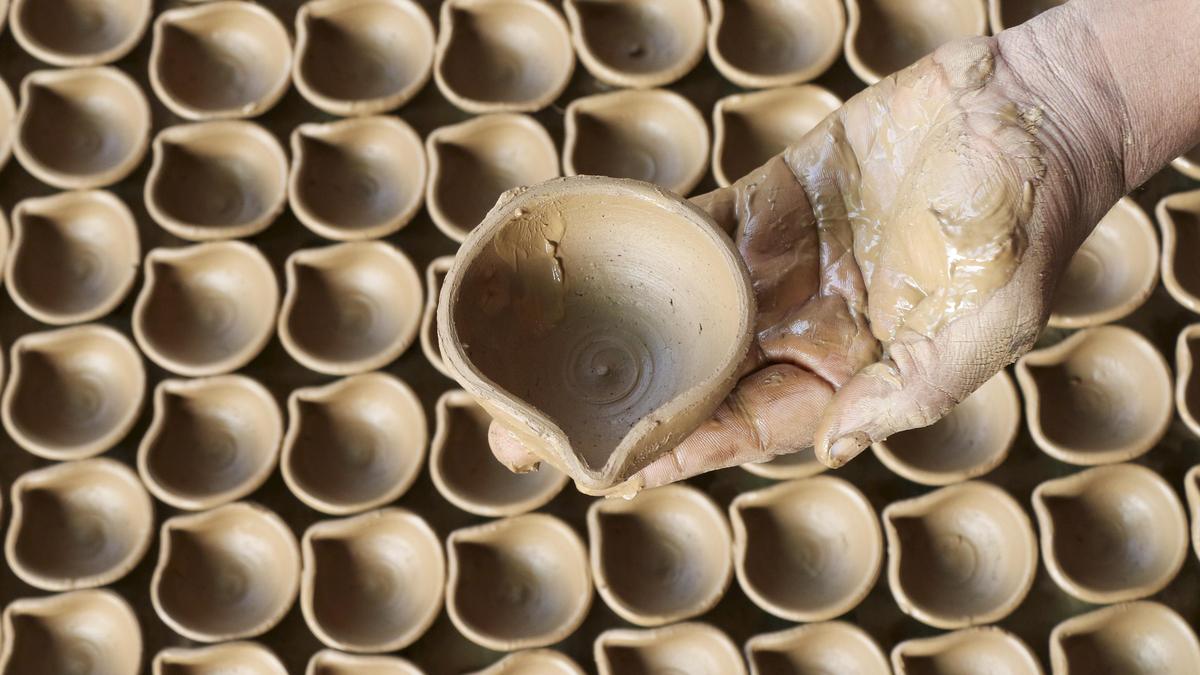
An earthen clay lamp in the process of being made. | Photo Credit: - For two weeks now, the shelves at shops selling earthen pots and other things earthen have worn a rejigged look, “minions” occupying the front rows and heavyweights gulping down an ego-crushing relegation to the rear section. This new composition of goods would persist for another two weeks. The pint-sized items taking centre stage are earthen lamps targeting Karthigai Deepam rituals essentially focussed on spreading light in the nooks and crannies of homes. At Kodambakkam High Road, a part of which derives its character from shops that sell earthen ware, a shopkeeper gives a timeline for the flavour of the season, agal villaku.“They begin to be sold in the run-up to Deepavali, and their sale would continue till Karthigai Deepam,” he notes. A simple mathematical calculation, and you know it is a seasonal business lasting four weeks. The preparation for it, however, spans four months, multiple districts, and a vast number of individual homes. One might call it a cottage industry, one that draws upon skills often languishing in obscurity. Talk to any seller of earthen lamps in Chennai, and if they present the picture as it is without any embellishments, they would mention artisans from the rural hinterlands of Tamil Nadu who make these lamps. Names that come to the fore include Periyapalayam, Thiruvanamalai, Vridhachalam and Cheyyar. Manufacture of these lamps would largely be missing from the urban milieu; among exceptions is Thiruneermalai near Chromepet. Colourful lamps representing various things (examples include a lotus flower, an elephant and a tortoise) on sale for Karthigai Deepam at Kodambakkam High Road. Stringent enforcement of anti-pollution norms targeting firing of clay has meant that shops that once had a fire-claying unit at their back end now have only the front end, the showroom. Usha Vadivelu of K. Janaki Clay Pots on Kodambakkam High Road has a legacy business on her hands. She points out the shop at this address stopped firing clay long ago. There are two other outlets managed by the family on East Coast Road, and a firing unit out there also had to end operations. “The government has asked us not to do firing here,” remarks Usha, adding that a firing unit later set up on ECR to make up for the shutdown of the one in Kodambakkam High Road also closed down six years ago, amid pollution concerns. So, the dependence on manufacturing units (many of them attached to homes) in rural areas is total, and she reaches out not only to districts in Tamil Nadu but also beyond to get lamps at competitive prices. For decades this industry has been defined by craftsmanship, the deft use of hands. But now raw craftsmanship has to co-exist with technology, which manifests in machine-cut agal villakugal. In this context, she mentions Vridhachalam as a reliable source. Earthen lamps come wearing the bare minimum or bedecked in colours and defined by representative shapes. On display at this shop are lamps designed as lotus flower, elephant, cow, tortoise and so on. The handmade traditional lamps with a bewildering variety of designs remain the most sought after. Usha also says that they work with around five trusted families in Chengalpattu who make pottery exclusively for the shop. Customised pieces are available if customers share designs in advance; they take time to complete. Designs need not always be loud to get passers-by to rubber-neck into attention. Even lamps without colours are shaped in elaborate representational forms can be captivating for the neat shapes they come in, as is evident from what is on display at Ranganatha Udaiyar Flower Pots, another shop on Kodambakkam High Road. K. Parthiban notes that diyas come from different parts of Tamil Nadu, and the cost of a diya starts at as low as Rs. 1. There is no dearth of choices. From traditional earthen lamps to ceramic ones, the collection caters to different preferences. Parthiban notes that the inventory at shops like his is not tied to one festival alone. The time is not far when preparation of Pongal pots will be in focus.Generational businessBoth where these earthen lamps are made and where they are sold, the leaven of generational business commitment makes the challenges palatable. For the manufacturers, the difficulty sourcing clay can be debilitating, not to mention the barriers to timely availability of labour at a cost that does not upset the overall economics of the business. Usually, to keep costs down, manufacturers depend entirely on their family for labour. For the retailers, buying lamps at competitive prices is crucial. Despite the uncertainties and ordeal of dodging these problems, both constituencies persist with this line of business because there is a sense of legacy attached to it.For Usha Vadivel, her shop, K. Janaki Clay Pots, carries a family legacy of more than a century. Its name honours her mother, Janaki Kanniyappan, the previous owner. The present building is about 40 years old; before becoming a shop, it functioned as a pottery unit.Similarly, a majority of those Usha sources these lamps from continue making these lamps as the profession is linked to their identity at a deeper level, generations of their forbears having practised it.Have a look-in at Mathi Experience StoreThe Mathi Experience Store, established under the Mahalir Thittam by the Tamil Nadu Corporation for Development of Women, stocks a diversity of products made by women self-help groups from across Tamil Nadu. The product line on display depends on seasonal demand. For lamps, earthen or metal, to light up your home, have a look-in at this store on Valluvarkottam High Road in Nungambakkam. Your purchase will help a self-help group continue in business. Published - November 14, 2026 06:19 pm IST
Rural glow in urban homes: the journey of the earthen Karthigai Deepam lamp
Full Article
Original Source
Read the full article at Thehindu →KhanList aggregates and links to publicly available news content. We do not host full articles from third-party sources. Always verify important information with original sources.