
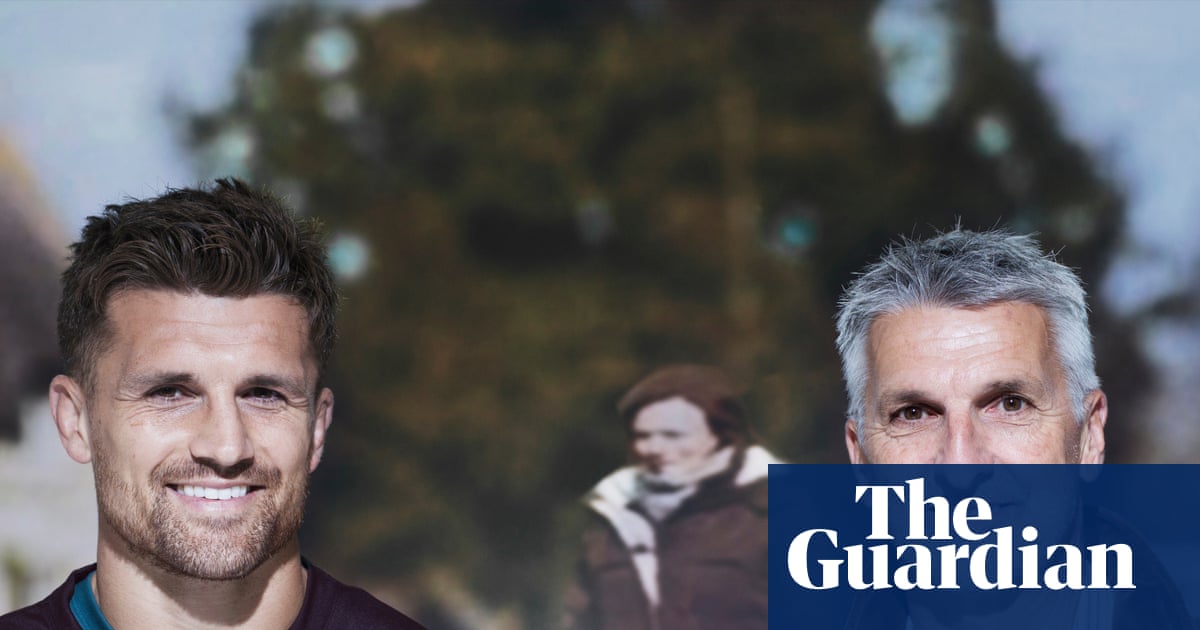
Composite of rugby player Henry Slade and his dad, John, standing side by side outdoors in 2026, recreating a photograph from 2011Henry and John Slade in 2011 and 2026. Later photograph: Pål Hansen/The Guardian. Styling: Andie Redman. Grooming: Neusa Neves at Arlington Artists using Ruby Hammer. Archive photograph: courtesy of Henry SladeBorn in Plymouth, Devon, in 1993, Henry Slade is a centre for Exeter Chiefs and England. He came up through the Exeter Chiefs academy, making his senior debut for the club in 2012, and has since earned more than 75 caps for England. He lifted the Champions Cup and won the Premiership title and the Six Nations in successive weekends in 2020. At 18, he was diagnosed with type 1 diabetes – a condition his father, John, also lives with – and he has since launched the Tackle Diabetes campaign, in partnership with the pharmaceutical company Sanofi, to raise awareness of the signs and symptoms of the disease and the value of early detection. He lives near Exeter with his wife and three daughters. For more information about early detection, visit testfortype1.comHenry (on left)This was taken after my first game for England’s under-18s. Wearing the shirt was a cool moment, but I was feeling knackered and giving a nervous smile. I was a bit of a shy kid back then.A few months later, I was diagnosed with diabetes. I was 18 and doing my A-levels. There was no real sign – I was healthy and didn’t have any of the typical symptoms, such as losing loads of weight, frequent urination or being thirsty. I just woke up and felt really bad one day. Actually, it was the only day I ever had off school – Mum and Dad never used to let me have a sick day as they needed to go to work. My mate was ill, too, but I didn’t realise he’d been admitted to hospital with diabetic ketoacidosis. He was back at school the next week and told us he’d been diagnosed with diabetes – he’d brought in a finger-prick test we could all try. I did mine and my blood glucose levels were high. I had another test at the GP that confirmed the diagnosis. It was a shock, but I was lucky we detected it early.I’d grown up seeing my dad live with diabetes, so my diagnosis wasn’t as upsetting as it might be for other people. Throughout my childhood, I’d always seen Dad do triathlons and windsurfing. There were definite challenges, though – I was a teenager and had started going out and drinking with mates, and I was also a sportsman. It took a lot of getting used to, constantly thinking about what food and drink I was putting in my body so I could get my blood glucose levels right. Has it inhibited me in a game? I’ve only needed to eat a load of Jelly Babies to avoid a hypo (low blood sugar) before playing a few times. If anything, I like to focus on the positive side to type 1 diabetes: it’s made me so resilient and very conscious of my body and what it needs.As a child, I did certain things to feel OK – small rituals to make sure my friends and family were safe. I now know that was obsessive-compulsive disorder (OCD). I’m a bit better now, but some rituals I can’t quite kick. Like, if I pick something up, I need to put my little finger down first, and there’s a certain way I like to turn off a light switch. In a strange way, OCD and type 1 diabetes aren’t a bad combination – both need controlling 24/7, and the hypervigilance that comes with OCD has actually made me very good at managing my levels. At the minute, I’m obsessed with my glucose data, which is obviously important because it’s my health – but it’s also occasionally annoying.Throughout it all, it’s been so reassuring to have Dad next to me, someone who understands completely. Dad’s very particular. He knows what he likes, and what he doesn’t. He is strong-willed, but I haven’t argued with him since I was a teenager. We’d have some small fallouts, and some louder ones. Mainly about going to parties. The day I passed my driving test, my mate was having a party in Cornwall and I wanted to drive my friends to it. Dad said no – he didn’t want me to be responsible for four other boys in the car the day I passed. He knew I would be too excited to drive properly. I was angry at the time, but now I’m a dad I’d do the exact same thing.I’ve probably played 280 times for Chiefs and I reckon Dad’s missed about five games in total. I’m very grateful for everything he has done for me. Along with Mum, he’s given up a lot. They sent us to private school when finances were tight. He gave me every opportunity, but never pushed me to do anything I didn’t want to. He told me anything was possible and has been there every step of the way.JohnI was extremely proud of Henry that day he played for England’s under-18s. I never expected my own child would play at that level. I’d always thought, “Wouldn’t it be great if I could be Jonny Wilkinson’s dad?” That’s why I am smiling from inside out.When Henry got diagnosed with diabetes, my first thought was, “This is my fault.” I worried he’d inherited it from my genes. It was a little bit traumatic for me to process what had happened, but since then I’ve learned there is a one in 300 chance of developing type 1 diabetes for anyone. If there’s a close family member, then it’s one in 20.Henry was nine months old when I was diagnosed. One of my biggest fears was that I wouldn’t be able to see him grow older. My eyesight had changed and I was worried I was going blind. That was a heavy time.skip past newsletter promotionafter newsletter promotionAs Henry got older, he became a determined kid – very focused. He didn’t like to lose. It’s a competitive spirit that my wife and I have. Henry and I are both quiet, compared with Henry’s mum, who can talk for England. He and I aren’t the loudest in the room, but we have to win.Even though I could see Henry had a tremendous talent, I was never a pushy parent. You do see mums or dads giving their kid £10 or a Mars bar for scoring a try, but I never did that. Instead, I encouraged him to acknowledge the commitment we were making. At the start of the season, I would hold the chequebook in front of me and say, “Right, I’m going to write this – if you want to drop out halfway through the season, forget it. It’s paid for.” That was the only push – that we were financially locked in for that year. I was also often loud on the touchline. Once, I got sent off by a school in Devon for cheering our side too enthusiastically. What did I shout? Nothing bad, I just loudly encouraged them, as the opposite side was cheating.Diabetes has definitely bonded us. Henry teaches me, really, because he’s so well controlled. I am 33 years into it now, so my symptoms are very faint, although I did fall asleep after bathing Henry’s daughter a few years ago. I took her into the bedroom to dry her and was just about to put her nappy on when I fell asleep on the floor. I’d been out for 10 minutes. She shouted, “Dada’s asleep!” Thankfully, someone else was at home to take over.Before every game, I text Henry, saying “best of luck”. I send him some heart emojis and tell him how proud I am. I don’t tend to say it to his face much, as the written word is easier. But I hope he knows that what he has achieved is beyond my wildest dreams.
Rugby centre Henry Slade and his father look back: ‘I’d seen my dad live with diabetes, so my diagnosis wasn’t as upsetting as it might have been’
Full Article
Original Source
Read the full article at Theguardian →KhanList aggregates and links to publicly available news content. We do not host full articles from third-party sources. Always verify important information with original sources.